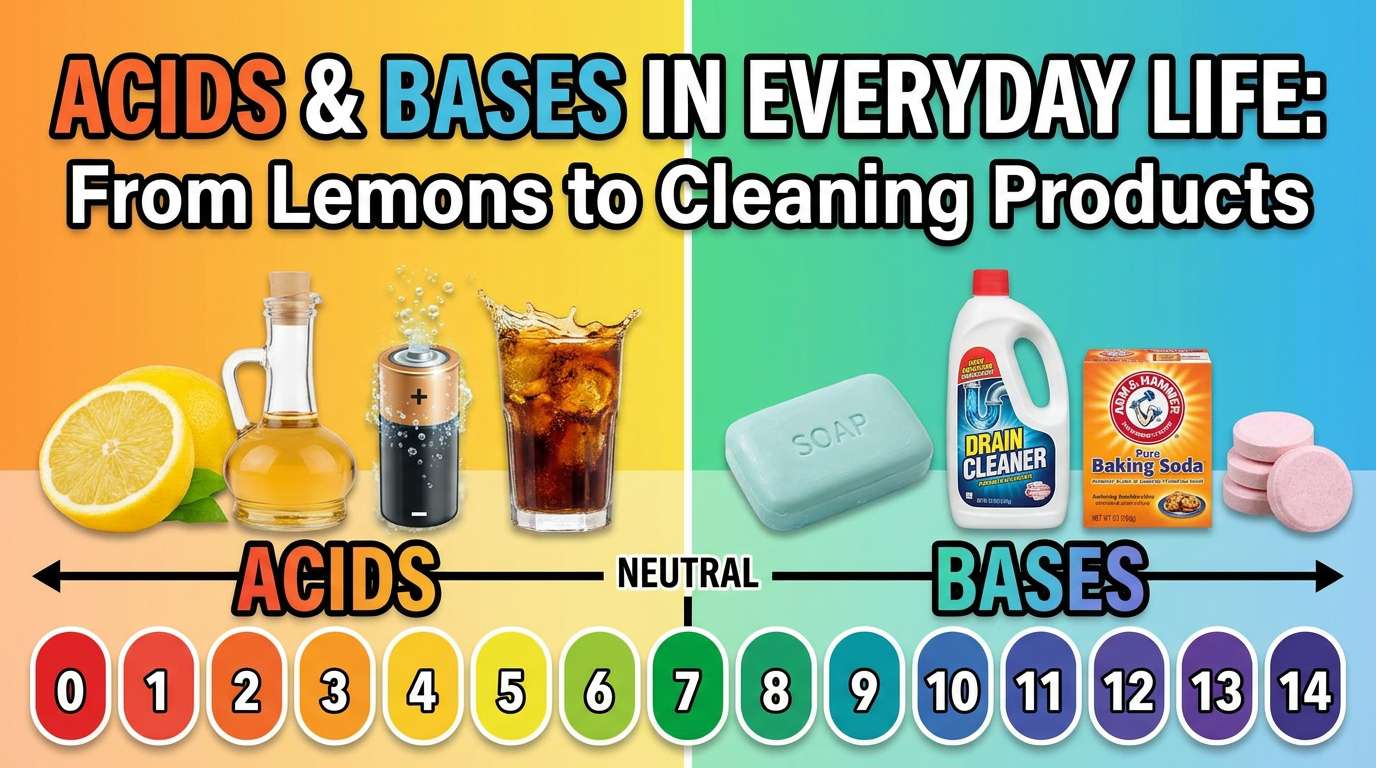
Acids and Bases in Everyday Life: From Lemons to Cleaning Products
Introduction
Bite into a lemon and your mouth puckers instantly — that sharp, sour taste is chemistry announcing itself directly to your tongue. Pick up a bar of soap and rub it between wet fingers, and it feels slippery — another chemical signature, entirely different from the lemon's, but just as real.
These everyday sensations are not random. They are the direct, physical result of two of the most important classes of chemical substances in existence: acids and bases. From the food on your plate to the products under your sink, acids and bases are everywhere — quietly shaping taste, cleaning, digestion, and even the safety of the water you drink.
What Are Acids and Bases?
Acids
An acid is a substance that releases hydrogen ions (H⁺) when dissolved in water, increasing the concentration of these ions in the solution.1 Acids typically share a set of recognisable properties:
- A sour taste (never test this directly on unknown chemicals)
- Turn blue litmus paper red
- React with certain metals to produce hydrogen gas2
- React with carbonates to release carbon dioxide gas
Bases
A base is a substance that releases hydroxide ions (OH⁻) when dissolved in water, or accepts hydrogen ions, reducing their concentration in the solution.1 Common properties of bases include:
- A bitter taste and a slippery, soapy feel2
- Turn red litmus paper blue
- Neutralise acids to form a salt and water
A base that dissolves in water is more specifically called an alkali — all alkalis are bases, though not all bases dissolve in water.
The pH Scale: Measuring Acidity and Alkalinity
Chemists measure exactly how acidic or basic a substance is using the pH scale, which runs from 0 to 14.3
- pH below 7 — acidic
- pH of 7 — neutral (pure water)
- pH above 7 — basic (alkaline)
The pH scale is logarithmic, meaning each single-unit change in pH represents a tenfold change in hydrogen ion concentration.3 A substance with a pH of 3 is not slightly more acidic than one with a pH of 4 — it is ten times more acidic. A substance with a pH of 2 is a hundred times more acidic than one with a pH of 4. This is why strong acids and strong bases must be handled with such care — small differences in pH number represent enormous differences in chemical strength.
Common Acids in Everyday Life
In the Kitchen
- Citric acid — found in lemons, oranges, and other citrus fruits, giving them their sharp, sour taste.4
- Acetic acid — the acid in vinegar, used in cooking, pickling, and salad dressings.4
- Carbonic acid — forms when carbon dioxide dissolves in water, giving fizzy soft drinks their characteristic tang.5
- Lactic acid — produced in soured or fermented dairy products such as yoghurt.
In the Body
Hydrochloric acid is produced in the stomach, where it helps break down food and kill harmful bacteria.5 The stomach lining is specially adapted to withstand this highly acidic environment, since stomach acid would cause serious damage to other tissues in the body.5
Common Bases in Everyday Life
Around the Home
- Sodium bicarbonate (baking soda) — a mild base, with a pH around 8.2, used in baking and as a household cleaner.6
- Ammonia — a stronger base with a pH around 8.3, commonly found in glass and surface cleaners.6
- Soap — bases in general tend to feel slippery, which is why soap has that distinctive slick texture on wet skin.2
- Laundry detergent — typically has a pH around 9.4, making it moderately alkaline.6
Strong Industrial and Cleaning Bases
Sodium hydroxide, also called caustic soda or lye, is a very strong base with a pH around 12 and is a key ingredient in many drain cleaners.6 Because it is so strongly alkaline, it must be handled with extreme care, as concentrated bases — just like concentrated acids — can severely burn skin and eyes.
Testing for Acids and Bases: Indicators
Since tasting or touching unknown chemicals is unsafe, chemists use indicators — substances that change colour depending on the pH of the solution they are placed in.
Litmus Paper
Litmus paper is coated with a natural dye extracted from lichen. It turns red in acidic conditions and blue in basic conditions, making it one of the simplest and most widely used pH indicators.7
Red Cabbage Juice: A Natural Indicator
Boiling red cabbage releases a natural pigment called anthocyanin, which changes colour across a wide range depending on pH. A very acidic solution turns red cabbage juice red, neutral solutions turn it purple, and basic solutions turn it a greenish colour.8 This makes red cabbage juice a popular, easily made indicator for classroom and home chemistry demonstrations.
pH Meters
For precise measurements, scientists use electronic pH meters, which use a glass electrode to detect the concentration of hydrogen ions in a solution directly, giving a numerical pH reading rather than just a colour change.1
Neutralisation: When Acids and Bases Meet
When an acid and a base react together in the right proportions, they undergo neutralisation, cancelling out each other's properties and producing a salt and water.10 If an equally strong acid and base are combined in the correct amounts, the resulting solution has a neutral pH.10
This is the same chemistry behind the classic baking soda and vinegar reaction — sodium bicarbonate (a base) reacting with acetic acid (an acid) to fizz and foam as carbon dioxide gas is released.8 Neutralisation reactions have many practical uses:
- Antacid tablets neutralise excess stomach acid to relieve indigestion.
- Farmers add lime (a base) to acidic soil to bring it closer to neutral pH.
- Treating acidic industrial waste with a base before it is released into rivers.
Why pH Matters Beyond the Kitchen and Bathroom
The Human Body
Human blood must be maintained within a narrow pH range of about 7.35–7.45 for the body's metabolic processes and oxygen delivery to function correctly.8 Conditions affecting the lungs, kidneys, or overall fluid balance can disrupt this balance, leading to serious health complications.8
Agriculture
Soil pH strongly influences plant growth, since different crops thrive within different pH ranges; environmental scientists and farmers regularly test and adjust soil pH to improve yields.3
The Environment
Environmental scientists monitor pH to track problems such as acid rain and water pollution, since aquatic ecosystems are highly sensitive to changes in the pH of the water they depend on.3
Acids and Bases in WAEC/JAMB Chemistry
- Definitions: Correctly defining acids and bases in terms of hydrogen and hydroxide ions is a core, frequently examined concept.
- Indicators: Knowing the colour changes of litmus and other indicators in acidic, neutral, and basic solutions.
- The pH scale: Understanding what pH values represent and being able to classify substances as acidic, neutral, or basic.
- Neutralisation reactions: Writing balanced equations for acid-base reactions that produce a salt and water.
- Everyday examples: Examination questions frequently draw on real-world acids and bases (vinegar, lemon juice, ammonia, baking soda) to test understanding in applied contexts.
Common Mistakes Students Make
- Confusing "strong" with "concentrated." Strength refers to how completely an acid or base ionises in water, while concentration refers to how much of it is dissolved. A dilute strong acid can still be a strong acid.
- Assuming all bases are alkalis. All alkalis are bases, but a base is only called an alkali if it actually dissolves in water.
- Misreading the pH scale as linear. Because the scale is logarithmic, a change of just one or two pH units represents a tenfold or hundredfold change in acidity, not a small difference.
- Forgetting the products of neutralisation. A correct neutralisation equation must show an acid reacting with a base to produce both a salt and water — omitting one of these products is a common examination error.
Conclusion
Acids and bases are not confined to laboratory beakers and warning-labelled bottles — they are dissolved in your lemonade, foaming in your kitchen sink, digesting your lunch, and quietly protecting rivers and farmland around the world. Understanding the simple chemistry of hydrogen and hydroxide ions unlocks an explanation for countless everyday experiences, from the sourness of fruit to the slipperiness of soap.
The next time you squeeze a lemon into your tea or wipe down a counter with a household cleaner, remember: you are handling real, working chemistry — acids and bases doing exactly what they have always done, quietly shaping the world around you.