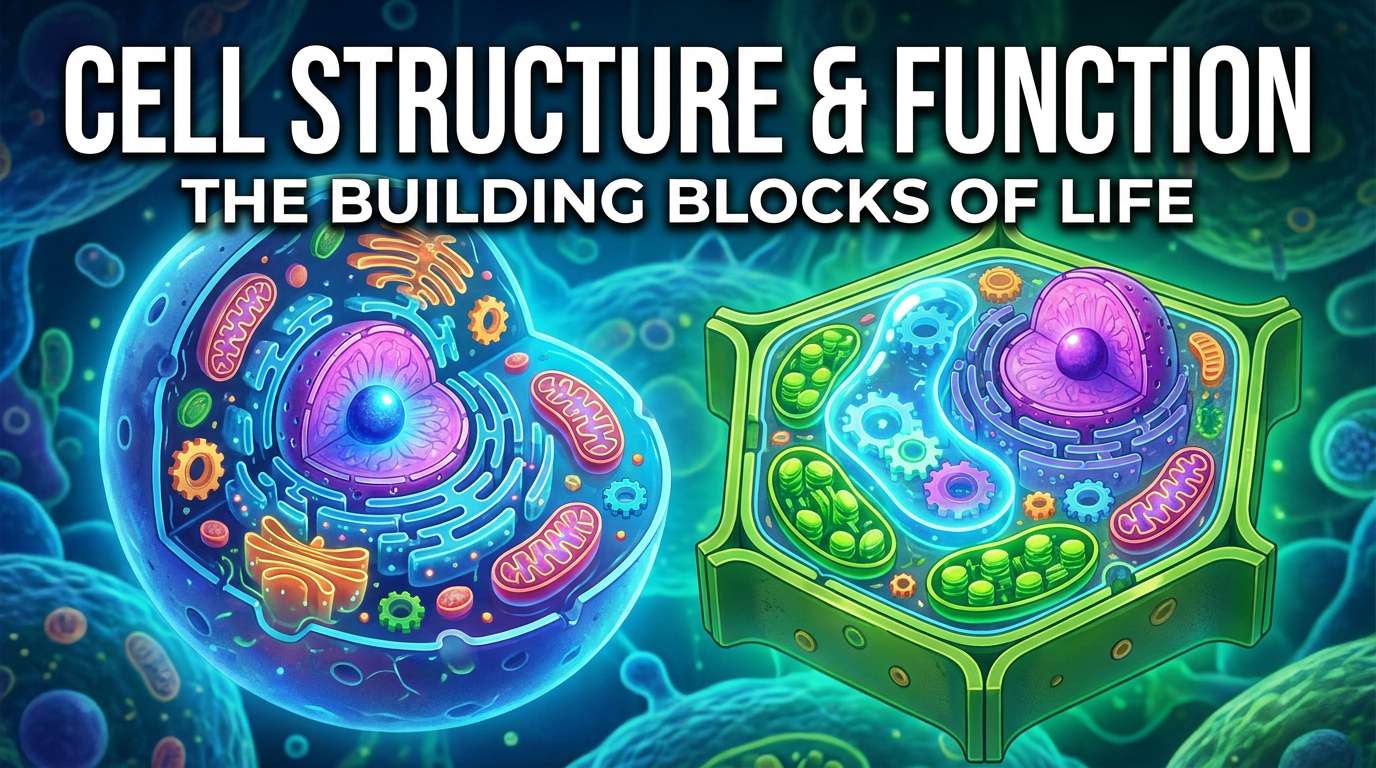
Cell Structure and Function: The Building Blocks of Life
Introduction
If you could shrink down small enough to walk through your own body, past your organs, through your tissues, and down to the smallest structures capable of independently carrying out the processes of life, you would eventually arrive at the cell — the basic structural and functional unit of every living organism on Earth.
Every living thing, from the smallest bacterium to the largest whale, from a single-celled amoeba to the trillions of cells that make up a human being, is built from cells. Some organisms consist of just one cell; others, like humans, are made up of an estimated 30 to 40 trillion cells, each one performing its own specialized role while cooperating as part of a much larger, coordinated whole.
This article explores the structure and function of cells in depth — the organelles they contain, the crucial differences between plant and animal cells, the distinction between prokaryotic and eukaryotic cells, and how this foundational topic connects to nearly every other area of the Biology syllabus.
The Cell Theory
The modern understanding of cells rests on a set of principles known as the cell theory, developed gradually during the seventeenth to nineteenth centuries as microscopes improved and scientists such as Robert Hooke, Anton van Leeuwenhoek, Matthias Schleiden, and Rudolf Virchow made increasingly detailed observations. The cell theory states that:
- All living organisms are made up of one or more cells.
- The cell is the basic structural and functional unit of life.
- All cells arise from pre-existing cells through cell division.
These principles remain foundational to biology today, and every topic involving growth, reproduction, healing, and inheritance ultimately traces back to processes happening at the level of individual cells.
Prokaryotic and Eukaryotic Cells
Not all cells are organized in the same way. Biologists divide cells into two broad categories based on their internal structure.
Prokaryotic Cells
Prokaryotic cells are simple, generally smaller cells that lack a true nucleus and most membrane-bound organelles. Their genetic material floats freely within the cell rather than being enclosed in a nuclear membrane. Bacteria are the most familiar example of prokaryotic organisms.
Eukaryotic Cells
Eukaryotic cells are generally larger and more complex, and they contain a true nucleus enclosed by a nuclear membrane, along with a variety of other specialized, membrane-bound organelles. Plants, animals, fungi, and protists are all made of eukaryotic cells. All the cells discussed in the human biology syllabus — and the plant and animal cells compared throughout this article — are eukaryotic.
Major Structures Found in Animal Cells
Cell Membrane
The cell membrane (also called the plasma membrane) forms the outer boundary of the cell, separating its internal contents from the external environment. It is described as selectively permeable, meaning it allows certain substances to pass through while restricting others, carefully controlling what enters and leaves the cell.
Nucleus
The nucleus is often described as the control centre of the cell. It contains the cell's genetic material in the form of chromatin (which condenses into visible chromosomes during cell division), and it directs the cell's activities by controlling which proteins are produced. The nucleus is enclosed by a double membrane called the nuclear envelope, which contains small pores allowing selected molecules to pass between the nucleus and the rest of the cell.
Cytoplasm
The cytoplasm is the jelly-like substance filling the interior of the cell, surrounding the nucleus and other organelles. Many important chemical reactions take place within the cytoplasm, and it also provides the medium through which organelles are suspended and materials move within the cell.
Mitochondria
Mitochondria (singular: mitochondrion) are often called the "powerhouse" of the cell, because they are the site of aerobic respiration, the process that releases energy from glucose in the presence of oxygen. Cells that require large amounts of energy — such as muscle cells — typically contain especially large numbers of mitochondria.
Ribosomes
Ribosomes are tiny structures responsible for protein synthesis — building proteins according to instructions carried from the nucleus. They may be found floating freely in the cytoplasm or attached to the rough endoplasmic reticulum.
Endoplasmic Reticulum
The endoplasmic reticulum is a network of membranes extending throughout the cytoplasm, involved in the transport of materials within the cell. It exists in two forms:
- Rough endoplasmic reticulum, studded with ribosomes, involved in the synthesis and transport of proteins.
- Smooth endoplasmic reticulum, without ribosomes, involved in the synthesis of lipids and the processing of certain substances.
Golgi Apparatus
The Golgi apparatus processes, packages, and sorts proteins and other substances produced within the cell, often preparing them for transport out of the cell or to their specific destination within it.
Lysosomes
Lysosomes contain digestive enzymes capable of breaking down waste materials, damaged cell parts, and, in certain white blood cells, engulfed bacteria and other pathogens. They act as the cell's internal waste disposal and recycling system.
Major Structures Found in Plant Cells
Plant cells share several structures in common with animal cells — including a cell membrane, nucleus, cytoplasm, mitochondria, ribosomes, endoplasmic reticulum, and Golgi apparatus — but they also contain several additional structures related to their specific needs as photosynthetic, stationary organisms.
Cell Wall
Unlike animal cells, plant cells are surrounded by a rigid cell wall, made primarily of a tough carbohydrate called cellulose, located just outside the cell membrane. The cell wall provides structural support and protection, helping the plant maintain its shape and resist bursting when water enters the cell.
Chloroplasts
Chloroplasts are the site of photosynthesis, the process by which plants convert light energy into chemical energy stored in glucose. They contain a green pigment called chlorophyll, which absorbs light energy and gives plants their characteristic green colour. Chloroplasts are found only in plant cells and certain other photosynthetic organisms — never in animal cells.
Large Central Vacuole
Plant cells typically contain one large, permanent vacuole, filled with a watery fluid called cell sap. This vacuole helps maintain the cell's rigidity through a pressure called turgor pressure, stores nutrients and waste products, and can occupy a very large proportion of the cell's total volume.
Comparing Plant and Animal Cells
| Feature | Animal Cell | Plant Cell |
|---|---|---|
| Cell wall | Absent | Present (made of cellulose) |
| Chloroplasts | Absent | Present |
| Vacuole | Small, if present, and temporary | Large, permanent, central vacuole |
| Shape | Usually irregular or rounded | Usually fixed, regular (often rectangular) |
| Nucleus position | Usually central | Often pushed to one side by the large vacuole |
Cell Specialization: Structure Matching Function
While all cells share certain basic structures, many cells within a multicellular organism become highly specialized — modified in structure to perform a particular function especially well. This principle, that structure is adapted to match function, appears throughout biology.
- Red blood cells are biconcave and lack a nucleus, maximizing space for haemoglobin and increasing surface area for oxygen absorption.
- Nerve cells (neurons) have long, thin extensions that allow them to carry electrical impulses over long distances within the body.
- Root hair cells in plants have long, thin projections that increase surface area for the efficient absorption of water and mineral salts from the soil.
- Muscle cells contain large numbers of mitochondria to supply the substantial amounts of energy required for repeated contraction.
- Sperm cells have a streamlined shape and a tail (flagellum) for swimming, along with numerous mitochondria to power that movement.
This process, in which cells develop specific structures suited to a particular role, is known as cell differentiation, and it is essential to how complex, multicellular organisms build the wide variety of tissues and organs needed to function.
From Cells to Organisms: Levels of Organization
In multicellular organisms, cells rarely function entirely alone. Instead, they are organized into increasingly complex levels of structure:
- Cells — the basic unit of life, each carrying out its own specialized function.
- Tissues — groups of similar cells working together to perform a shared function (for example, muscle tissue or nervous tissue).
- Organs — structures made up of different tissues working together (for example, the heart, made of cardiac muscle tissue, connective tissue, and nervous tissue).
- Organ systems — groups of organs working together toward a broader function (for example, the circulatory system).
- Organism — the complete, living individual, made up of multiple organ systems working in coordination.
Movement of Substances Across the Cell Membrane
The cell membrane's selective permeability allows several important processes to occur, each moving substances into or out of the cell in a different way.
Diffusion
Diffusion is the movement of particles from an area of higher concentration to an area of lower concentration, requiring no additional energy from the cell. Oxygen entering cells from the blood, and carbon dioxide leaving cells into the blood, both occur by diffusion.
Osmosis
Osmosis is a special case of diffusion involving specifically the movement of water molecules, from a region of higher water concentration (a dilute solution) to a region of lower water concentration (a more concentrated solution), across a selectively permeable membrane.
Active Transport
Active transport is the movement of particles from an area of lower concentration to an area of higher concentration — the opposite direction to diffusion — and because this goes against the natural concentration gradient, it requires the cell to use energy, usually supplied by the mitochondria. Root hair cells absorbing mineral salts from soil, even when soil concentrations are lower than concentrations within the cell, is a classic example of active transport.
Cell Division
Cells reproduce through a process of division, allowing organisms to grow, replace damaged or worn-out cells, and, in the case of reproductive cells, produce offspring. Two main types of cell division occur in eukaryotic organisms:
- Mitosis, which produces two genetically identical daughter cells, used for growth and repair.
- Meiosis, which produces four genetically varied daughter cells with half the usual chromosome number, used specifically in the production of sex cells (gametes).
These processes are explored in far greater depth in dedicated articles on genetics and cell division, but understanding basic cell structure is the essential foundation for understanding how and why cells divide in these different ways.
Cell Structure and WAEC/NECO/JAMB Biology
This topic is one of the most fundamental and consistently examined areas of the Biology syllabus:
- Labelled diagrams of typical plant and animal cells, correctly identifying and naming each organelle.
- Functions of specific organelles, particularly the nucleus, mitochondria, chloroplasts, and cell membrane.
- Comparing plant and animal cells, identifying structural differences and explaining their significance.
- Cell specialization, matching specific cell structures to the functions they perform.
- Diffusion, osmosis, and active transport, including practical examples and experiments demonstrating each process.
- The relationship between cells, tissues, organs, and organ systems.
Common Mistakes Students Make
- Stating that animal cells have a cell wall. Only plant cells (and some other organisms, such as fungi and bacteria) have cell walls; animal cells do not.
- Confusing the cell membrane with the cell wall. The cell membrane is present in all cells and controls what enters and leaves; the cell wall is a separate, rigid structure found only in certain cell types, providing structural support.
- Assuming all plant cells contain chloroplasts. Only cells involved in photosynthesis, such as those in leaves, typically contain chloroplasts — root cells, for example, generally do not.
- Confusing diffusion and osmosis. Osmosis refers specifically to the movement of water; diffusion is the broader, more general term covering the movement of any particle down a concentration gradient.
- Describing active transport as requiring no energy. Unlike diffusion and osmosis, active transport specifically requires energy because it moves substances against their concentration gradient.
Conclusion
Every structure, every organ, and every process discussed throughout the entire Biology syllabus ultimately depends on what happens at the level of the cell. Understanding cell structure and function is not simply memorizing a diagram — it is building the foundation on which nearly every other biological concept, from digestion to genetics to disease, is built.
A thorough grasp of how cells are structured, how their organelles work together, and how specialized cells differ from one another to serve specific functions will make every subsequent topic in Biology significantly easier to understand — because at their core, they are all, in one way or another, stories about cells doing what cells do.