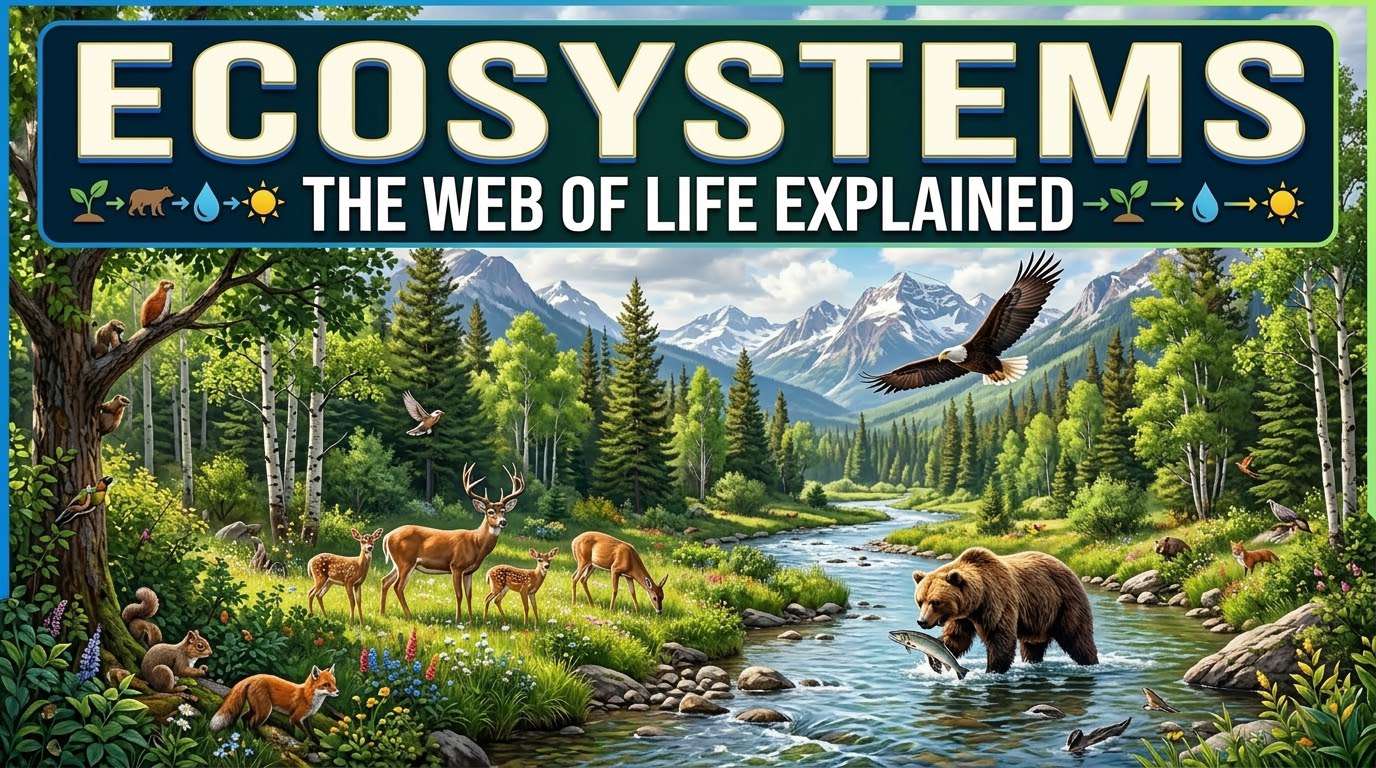
Ecosystem: Meaning, Components and Food Chains
Introduction
Think about a school garden. The soil, sunlight and rain support the growth of vegetables and flowers. Insects visit the flowers, lizards hunt the insects, and when a plant or animal dies, tiny organisms in the soil break it down. Nothing in that garden lives on its own — every living thing depends on other living things and on the environment around it. Scientists call this whole arrangement an ecosystem.
This article explains what an ecosystem is, the parts that make it up, how living things depend on one another, and how energy moves through a food chain — a core Basic Science topic for JSS3.
Meaning of Ecosystem
An ecosystem is a community of living things (plants, animals and micro-organisms) interacting with one another and with their non-living environment (air, water, soil, sunlight) in a particular place.
Examples of ecosystems include:
- A school garden
- A fish pond
- A forest
- A river or stream
Components of an Ecosystem
Every ecosystem is made up of two main components.
1. Biotic Components (Living Parts)
These are all the living organisms in the ecosystem. They are grouped into three types:
- Producers: Green plants that make their own food using sunlight (e.g. grass, maize, trees).
- Consumers: Animals that eat plants or other animals (e.g. goat, lizard, hawk).
- Decomposers: Organisms that break down dead plants and animals (e.g. bacteria, fungi, earthworms).
2. Abiotic Components (Non-Living Parts)
These include sunlight, air, water, soil, temperature and rocks. They support the living things in the ecosystem.
Interdependence and Balance of Nature
Living things depend on one another and on non-living things to survive. This is called interdependence. For example:
- Plants need carbon dioxide from animals and give out oxygen that animals breathe.
- Bees get nectar from flowers and help the flowers to produce seeds.
- Earthworms loosen the soil so that plant roots can grow easily.
When all these relationships work well, the ecosystem stays in balance. Too many or too few of any organism can disturb the balance.
Food Chains, Food Webs and Energy Flow
Food Chain
A food chain shows how energy moves from one living thing to another in a straight line. It always starts with a producer. A simple example:
Grass → Grasshopper → Lizard → Hawk
- Grass (producer) makes food.
- Grasshopper (primary consumer) eats the grass.
- Lizard (secondary consumer) eats the grasshopper.
- Hawk (tertiary consumer) eats the lizard.
Food Web
A food web is made up of many food chains that are linked together. In real life, most animals eat more than one type of food, so the relationships form a web rather than a single chain.
Energy Flow
Energy from the sun is captured by green plants. When an animal eats a plant or another animal, some of that energy is passed on. A large part of the energy is lost as heat at each step. That is why there are usually more plants than animals in an ecosystem.
Disruption of Ecosystems
An ecosystem can be disturbed when the balance is broken. Some common causes are:
- Cutting down too many trees (deforestation)
- Bush burning
- Polluting rivers with plastics and chemicals
- Over-hunting or over-fishing
- Building houses on wetlands without care
When an ecosystem is disrupted, some plants and animals may die or move away, and the whole community suffers.
Quick Revision Questions
- What is an ecosystem?
- Name the two main components of an ecosystem.
- Give one example of a producer and one example of a consumer.
- Write a simple food chain that starts with maize.
- State two human activities that can disrupt an ecosystem.
Conclusion
An ecosystem is made up of living things and non-living things working together. Plants produce food, animals consume it, and decomposers return nutrients to the soil. Energy flows from the sun through food chains and food webs. When we cut trees carelessly, pollute water or over-hunt animals, we disturb this balance. We must therefore protect our environment so that plants and animals can continue to live well.