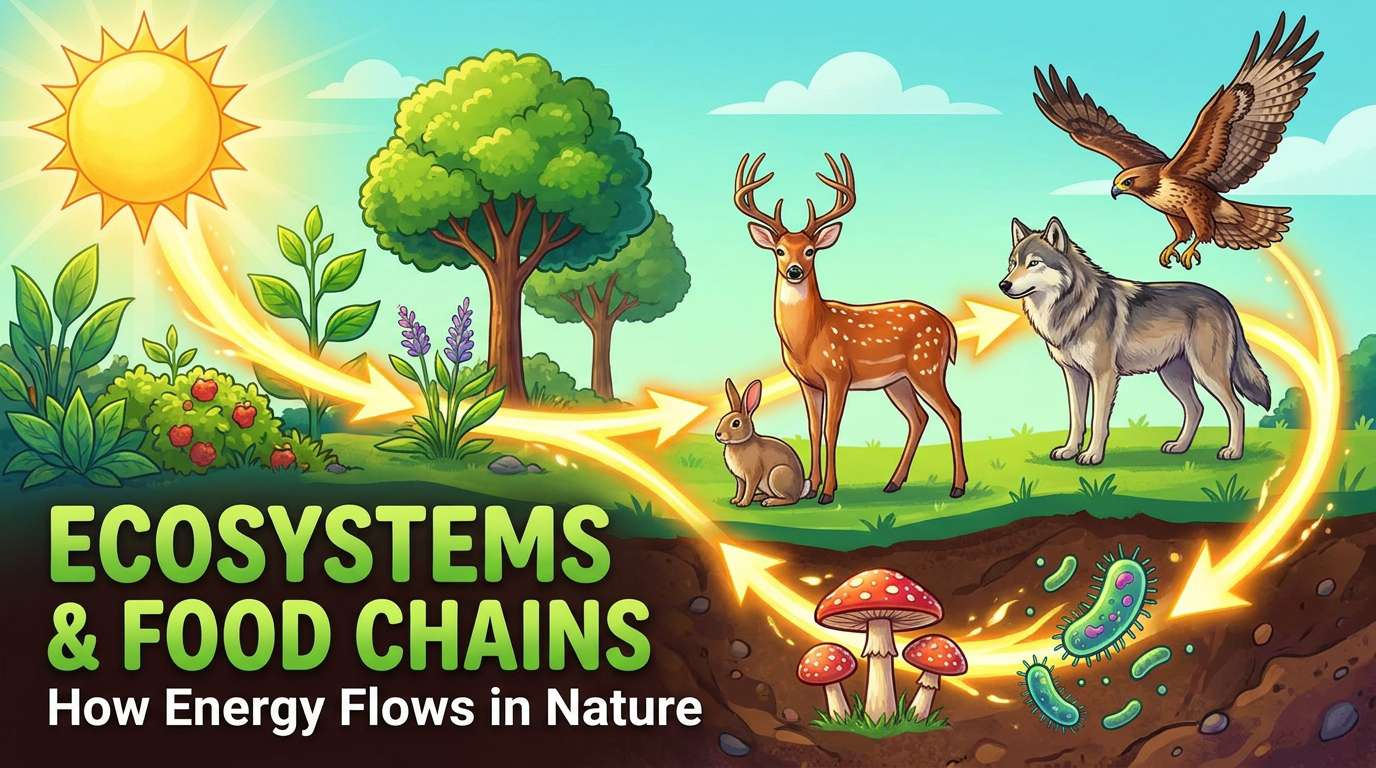
Ecosystems and Food Chains: How Energy Flows in Nature
Introduction
Picture a savanna in northern Nigeria. Grass grows, fed by sunlight and rain. A grasshopper feeds on the grass. A lizard catches and eats the grasshopper. A bird swoops down and catches the lizard. Eventually, that bird dies, and decomposers in the soil break down its remains, releasing nutrients back into the earth, where they help new grass grow again.
This simple sequence illustrates one of the most fundamental patterns in the natural world: energy and nutrients constantly moving from one living organism to another, following predictable pathways that ecologists study in detail. This article explores ecosystems, food chains, and the flow of energy through the natural world — concepts that connect biology to real, observable patterns in the environment around every student.
What Is an Ecosystem?
An ecosystem is a community of living organisms interacting with one another and with their non-living physical environment, functioning together as a system. Ecosystems can be as vast as an entire rainforest or as small as a single pond, and they include both:
- Biotic components: All the living organisms within the ecosystem — plants, animals, fungi, and microorganisms.
- Abiotic components: The non-living physical and chemical factors present, such as sunlight, temperature, water, soil composition, and air.
Key Terms in Ecology
- Habitat: The specific physical place where an organism lives.
- Population: All the individuals of the same species living in a particular area at a particular time.
- Community: All the different populations of different species living and interacting together in a particular area.
- Niche: The specific role an organism plays within its ecosystem, including what it eats, where it lives, and how it interacts with other organisms.
Producers, Consumers, and Decomposers
Every ecosystem depends on organisms fulfilling three broad roles, each essential to keeping energy and nutrients moving through the system.
Producers
Producers are organisms — primarily green plants and certain algae — that can make their own food through photosynthesis, converting light energy into chemical energy stored in glucose. Producers form the foundation of almost every food chain, since they are the entry point through which energy from the sun first becomes available to living organisms.
Consumers
Consumers are organisms that cannot make their own food and must obtain energy by feeding on other organisms. Consumers are further divided based on what they eat:
- Herbivores feed only on plants (primary consumers).
- Carnivores feed only on other animals.
- Omnivores feed on both plants and animals.
Decomposers
Decomposers — mainly bacteria and fungi — break down dead organisms and waste material, releasing the nutrients they contain back into the soil or water, where producers can absorb and reuse them. Without decomposers, nutrients would remain permanently locked inside dead organic matter, and ecosystems would eventually run out of the raw materials needed to sustain new life.
Food Chains
A food chain is a simple, linear sequence showing how energy passes from one organism to another through feeding relationships, always starting with a producer.
A typical food chain might be written as:
Grass → Grasshopper → Lizard → Bird
Each organism in this sequence occupies a specific position, or trophic level:
- Grass is the producer, forming the base of the food chain.
- Grasshopper is the primary consumer, feeding directly on the producer.
- Lizard is the secondary consumer, feeding on the primary consumer.
- Bird is the tertiary consumer, feeding on the secondary consumer.
The arrows in a food chain always point in the direction that energy flows — from the organism being eaten to the organism doing the eating.
Food Webs
In reality, very few organisms feed on just one type of prey, and very few are eaten by only one type of predator. A food web represents these more realistic, interconnected feeding relationships within an ecosystem, showing multiple food chains overlapping and connecting to one another.
Food webs illustrate an important ecological point: because most organisms have multiple food sources and multiple predators, the loss of a single species from an ecosystem rarely causes total collapse, though it can still significantly disrupt the balance of populations throughout the web.
Energy Flow Through an Ecosystem
Energy does not flow through an ecosystem with perfect efficiency. At each stage in a food chain, a significant portion of the energy available is lost, mainly as heat released during respiration, and only a fraction is actually passed on to the next trophic level.
On average, only about 10% of the energy available at one trophic level is transferred to the next level; the remaining roughly 90% is lost, primarily as heat, but also used for the organism's own movement, growth, and other life processes not passed on when it is eaten.
The Energy Pyramid
This pattern of decreasing available energy at each successive trophic level is often represented visually as an energy pyramid, with producers forming the wide base, and each successive consumer level forming a progressively smaller layer above it.
This explains several important ecological patterns:
- Ecosystems typically support far more producers than herbivores, and far more herbivores than top predators.
- Food chains rarely extend beyond four or five trophic levels, since so little usable energy remains by that point.
- Top predators, positioned at the very top of the pyramid, generally exist in much smaller numbers than the organisms below them in the food chain.
Nutrient Cycling: The Carbon and Nitrogen Cycles
Unlike energy, which flows through an ecosystem in essentially one direction (with most eventually lost as heat), key chemical nutrients are continuously recycled within ecosystems.
The Carbon Cycle
Carbon moves between the atmosphere, living organisms, and the physical environment through several key processes:
- Producers absorb carbon dioxide from the atmosphere during photosynthesis, incorporating carbon into glucose and other organic molecules.
- Consumers obtain this carbon by feeding on producers or other consumers.
- Both producers and consumers release carbon dioxide back into the atmosphere through respiration.
- Decomposers break down dead organisms, releasing carbon back into the environment as they respire.
- Over geological timescales, some carbon becomes locked away in fossil fuels, and human combustion of these fuels releases this stored carbon back into the atmosphere.
The Nitrogen Cycle
Nitrogen, essential for building proteins and DNA, cycles through the environment in a more complex way, since most organisms cannot use nitrogen gas from the atmosphere directly:
- Nitrogen-fixing bacteria, some living in the root nodules of leguminous plants, convert atmospheric nitrogen gas into forms plants can absorb and use.
- Plants incorporate this nitrogen into proteins and other molecules; consumers obtain nitrogen by eating plants or other animals.
- Decomposers break down waste and dead organisms, releasing nitrogen-containing compounds back into the soil.
- Denitrifying bacteria convert some soil nitrogen compounds back into nitrogen gas, returning it to the atmosphere and completing the cycle.
Ecological Pyramids: Numbers and Biomass
Beyond the energy pyramid, ecologists sometimes represent ecosystems using pyramids of numbers (showing how many individual organisms exist at each trophic level) or pyramids of biomass (showing the total mass of living material at each level). These generally follow the same overall pattern as the energy pyramid — decreasing at each successive trophic level — though exceptions can occur, particularly in pyramids of numbers, where a small number of very large producers (such as trees) might support a larger number of smaller consumers above them.
Human Impact on Ecosystems
Human activity can significantly disrupt the natural balance of ecosystems in several important ways, many of which are directly relevant to the Nigerian environment:
- Deforestation, which removes producers, destroys habitats, and disrupts the carbon cycle by reducing the amount of carbon dioxide absorbed from the atmosphere.
- Overfishing and overhunting, which can remove key species from a food web faster than their populations can naturally recover.
- Pollution, including water pollution from industrial or agricultural runoff, which can poison organisms at multiple trophic levels.
- Introduction of invasive species, which can outcompete native organisms and disrupt existing food webs.
- Bioaccumulation of toxins, where harmful substances such as certain pesticides become increasingly concentrated at each successive trophic level, often causing the greatest harm to top predators.
Ecosystems and WAEC/NECO/JAMB Biology
Key examinable areas of this topic include:
- Constructing and interpreting food chains and food webs, correctly identifying producers, consumers, and trophic levels.
- Explaining energy flow and energy loss between trophic levels, including the approximate 10% transfer figure.
- Drawing and interpreting energy pyramids, and explaining why they narrow at higher trophic levels.
- Describing the carbon and nitrogen cycles, including the specific roles of producers, consumers, and decomposers within each.
- Discussing human impacts on ecosystems and their ecological consequences.
Common Mistakes Students Make
- Drawing food chain arrows in the wrong direction. Arrows point from the organism being eaten toward the organism eating it, showing the direction of energy flow, not simply "who eats whom" written the other way.
- Confusing food chains and food webs. A food chain is a single, linear sequence; a food web shows multiple interconnected chains within a community.
- Assuming decomposers are consumers. Although decomposers do obtain energy from other organisms, they are generally treated as a distinct category due to their specific role in breaking down dead matter and recycling nutrients.
- Stating that all the energy from one trophic level passes to the next. In reality, only a small fraction (around 10%) is transferred, with the majority lost primarily as heat.
- Describing nutrient cycles as one-directional, like energy flow. Unlike energy, nutrients such as carbon and nitrogen are continuously recycled within ecosystems, not simply lost after one use.
Conclusion
Ecosystems reveal one of the most elegant patterns in all of biology: energy flowing steadily in one direction, from sunlight into producers and onward through each level of consumer, while essential nutrients cycle continuously and indefinitely through living organisms and the physical environment. Every food chain, no matter how simple it looks written on a page, represents a small piece of this much larger, interconnected system sustaining every environment on Earth.
Understanding how energy and nutrients move through ecosystems — and how human activity can disrupt these carefully balanced flows — gives students not just examination knowledge, but a genuine, practical framework for understanding environmental issues that are increasingly relevant to Nigeria and the wider world.