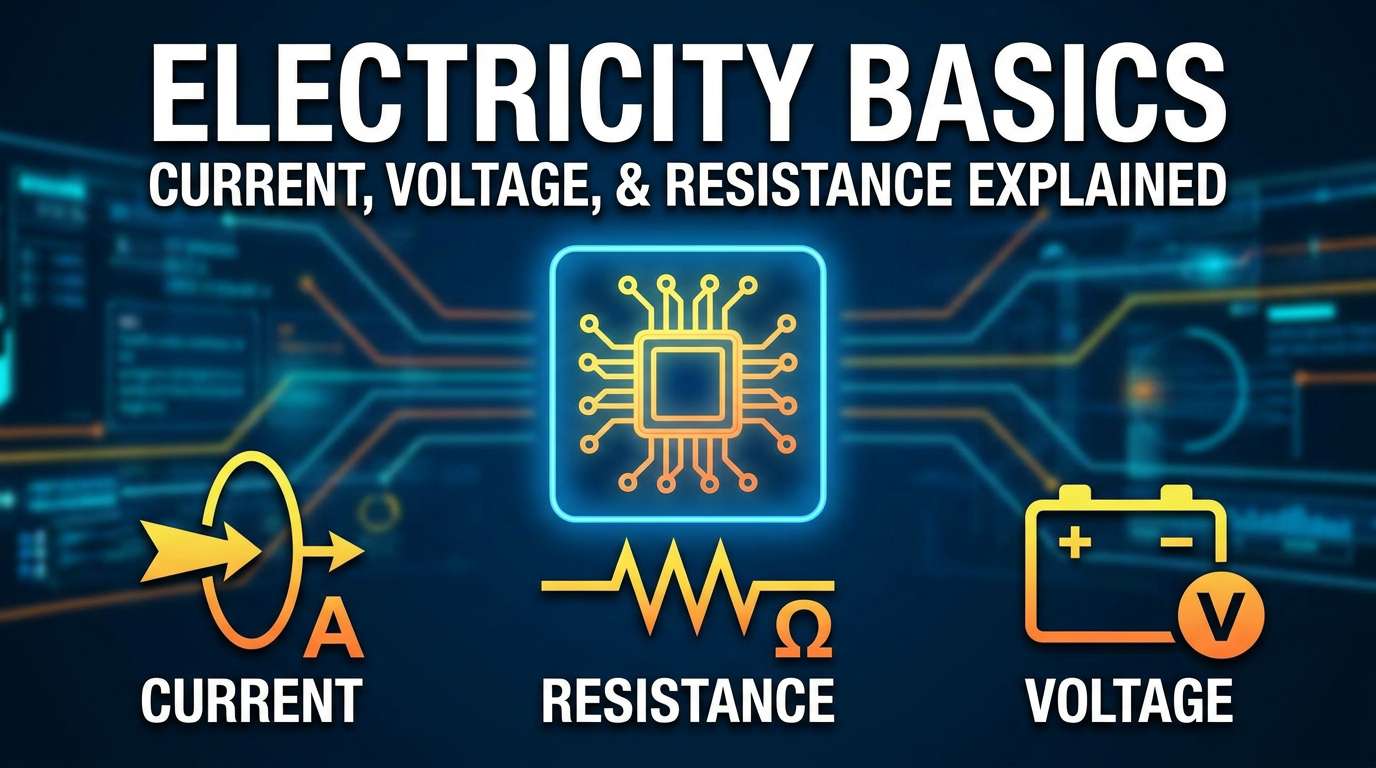
Electricity Basics: Current, Voltage, and Resistance Explained
Introduction
Electricity powers almost every aspect of modern life. It lights our homes, charges our phones, runs our computers, and keeps hospitals operating around the clock. Yet despite how central it is to daily life, electricity remains, for many people, a somewhat mysterious force — something that flows through wires and switches on with the flick of a finger, but whose underlying physics is rarely understood.
At its heart, electricity is governed by three closely related concepts: current, voltage, and resistance. Understanding how these three quantities interact is the key to understanding everything from why a torch lights up when you press its switch to how an entire national power grid is designed and operated.
What Is Electric Current?
All matter is made up of atoms, and atoms contain tiny negatively charged particles called electrons. In certain materials — particularly metals such as copper and silver — some of these electrons are loosely bound to their atoms and are free to move from one atom to another. These materials are called conductors.
Electric current is simply the flow of these charged particles through a conductor. When a complete, unbroken path — called a circuit — is provided, and a force is applied to push the electrons along, they begin to drift through the material, creating an electric current.
Current is measured in amperes, commonly shortened to "amps" (A), named after the French physicist André-Marie Ampère. One amp represents a substantial flow of roughly six quintillion electrons passing a given point every second. The greater the current, the more electrons are flowing, and generally the more power is available to do work, such as lighting a bulb or running a motor.
What Is Voltage?
Electrons do not move through a conductor on their own; they need to be pushed. This "push" is provided by voltage, also known as potential difference, which is measured in volts (V), named after the Italian physicist Alessandro Volta, inventor of the first chemical battery.
Voltage can be thought of as the amount of energy given to each unit of charge as it moves through a circuit. A useful analogy is water flowing through a pipe: voltage is like the water pressure that pushes the water along, while current is like the actual rate of water flow. A higher voltage provides a greater "push," driving more current through a circuit, much as higher water pressure drives more water through a pipe.
Batteries and power supplies provide the voltage needed to drive current through a circuit. A typical AA battery provides about one and a half volts, while a car battery typically provides around twelve volts, and a domestic electrical socket in many countries supplies around two hundred and twenty to two hundred and forty volts — a far higher voltage requiring much greater care and safety precautions.
What Is Resistance?
As electrons move through a conductor, they do not travel completely freely. They constantly collide with atoms within the material, which impedes their flow. This opposition to the flow of current is called resistance, measured in ohms (Ω), named after the German physicist Georg Ohm.
Different materials offer different amounts of resistance. Good conductors, such as copper and silver, have very low resistance, allowing current to flow easily — this is why they are used extensively in electrical wiring. Materials with very high resistance, called insulators, such as rubber, glass, and plastic, allow almost no current to flow, which is why they are used to coat wires and protect against electric shock.
Several factors affect the resistance of a conductor:
- Material — different substances inherently resist current flow to different degrees.
- Length — longer wires offer more resistance, since electrons must travel further and experience more collisions.
- Thickness — thicker wires offer less resistance, since there is more space for electrons to flow.
- Temperature — in most conductors, resistance increases as temperature rises, since hotter atoms vibrate more and obstruct electron flow more frequently.
Resistance is deliberately used in many electrical components, such as resistors, to control the amount of current flowing through a circuit, and in devices such as electric heaters and incandescent light bulbs, where resistance to current flow generates useful heat and light.
Ohm's Law: Connecting the Three
The relationship between current, voltage, and resistance is captured in one of the most fundamental equations in electronics: Ohm's Law. It states that the current flowing through a conductor is directly proportional to the voltage applied across it, and inversely proportional to its resistance. This is expressed as:
V = IR
where V is voltage (in volts), I is current (in amps), and R is resistance (in ohms). This simple equation can be rearranged to calculate any one of the three quantities if the other two are known, and it forms the basis for designing and analysing almost every electrical circuit, from the simplest torch to the most sophisticated computer.
Ohm's Law tells us two important things. First, increasing the voltage applied to a circuit, while keeping resistance constant, increases the current flowing through it. Second, increasing the resistance in a circuit, while keeping voltage constant, decreases the current. This is why adding more resistors to a circuit reduces the flow of current, and why a higher-voltage battery drives more current through the same circuit than a lower-voltage one.
Series and Parallel Circuits
Electrical components can be connected in two basic ways. In a series circuit, components are connected one after another along a single path, so the same current flows through each one in turn. If one component fails or the circuit is broken at any point, the entire circuit stops working — which is why old-style Christmas lights, wired in series, would all go dark if a single bulb blew.
In a parallel circuit, components are connected along multiple separate paths, or branches, allowing current to take more than one route. If one branch is broken, current can still flow through the others, meaning the rest of the circuit continues to operate. This is why household electrical wiring is arranged in parallel — so that switching off one light or appliance does not cut power to the rest of the house.
Why This Matters
Understanding current, voltage, and resistance is not just an academic exercise — it underpins the design of every electrical and electronic device in the modern world. Electrical engineers use these principles to design safe and efficient power grids, electronics designers use them to build everything from smartphones to satellites, and a basic grasp of these concepts helps everyone understand why electrical safety matters, from not overloading a socket to never touching a damaged wire.
Conclusion
Electricity may seem invisible and mysterious, but it follows clear, predictable, and well-understood physical laws. Current describes the flow of charged particles, voltage describes the force driving that flow, and resistance describes the opposition that flow encounters. Together, bound by the elegant simplicity of Ohm's Law, these three concepts explain how every electrical device — from the simplest torch to the most advanced computer — actually works.
The next time you switch on a light or plug in a charger, you will be drawing on more than a century of scientific understanding, harnessing the silent, invisible flow of electrons to power the modern world.