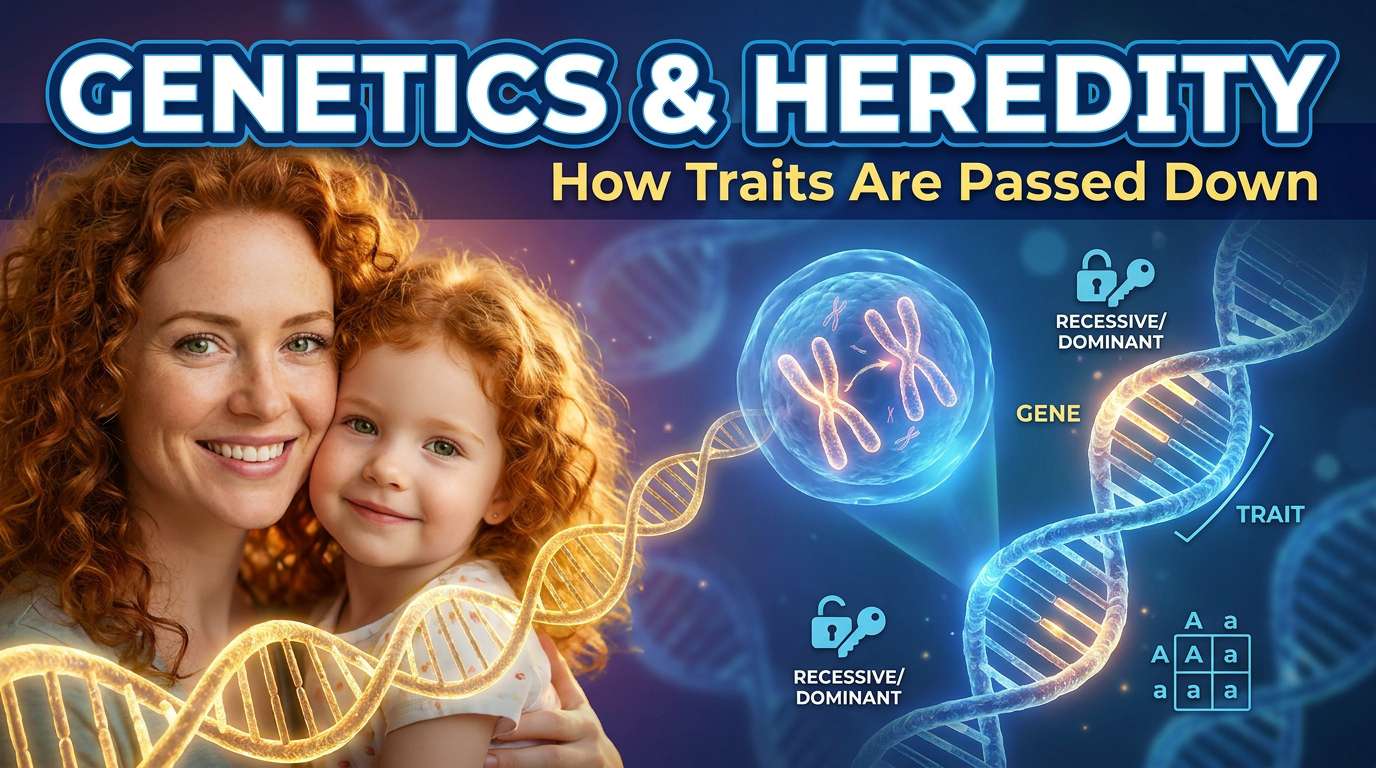
Genetics and Heredity: How Traits Are Passed Down
Introduction
Look around at your own family. Perhaps you share your mother's eyes, your father's height, or a grandparent's dimple that seems to reappear every other generation. These resemblances are not coincidences — they are the visible result of heredity, the passing of characteristics from parents to offspring through generations.
Genetics is the branch of biology that studies how these characteristics, or traits, are inherited, and it explains everything from why children resemble their parents, to why certain diseases run in families, to why two children from the same parents can still look noticeably different from one another. This article explores the structures and mechanisms behind inheritance, the rules first discovered by Gregor Mendel, and how genetics connects to health conditions significant in Nigeria, such as sickle cell anaemia.
Chromosomes, DNA, and Genes: The Basic Vocabulary of Genetics
DNA
DNA (deoxyribonucleic acid) is the molecule that carries genetic information in nearly all living organisms. It has a distinctive double helix structure, resembling a twisted ladder, and is made up of repeating units called nucleotides. The specific sequence in which these nucleotides are arranged encodes the instructions for building and operating an organism.
Genes
A gene is a specific section of DNA that contains the instructions for a particular characteristic or trait — for example, eye colour, blood type, or the ability to produce a particular protein. Genes are, in a sense, the individual "instructions" written along the DNA molecule.
Chromosomes
Inside the nucleus of a cell, DNA is tightly coiled and packaged together with proteins to form structures called chromosomes. Humans typically have 46 chromosomes, arranged in 23 pairs, in almost every cell of the body. One chromosome from each pair is inherited from the mother, and the other from the father.
Alleles
Because chromosomes come in pairs, an organism generally has two copies of each gene — one on each chromosome of a pair. These two copies are called alleles, and they may be identical or slightly different versions of the same gene, potentially leading to different versions of the same trait.
Dominant and Recessive Alleles
When two different alleles for the same gene are present, one is often dominant and the other recessive.
- A dominant allele will produce its associated trait even if only one copy is present.
- A recessive allele will only produce its associated trait if two copies of that recessive allele are present — one dominant allele will "mask" it.
By convention, dominant alleles are usually represented with a capital letter (e.g. "T" for tall), and recessive alleles with the corresponding lowercase letter (e.g. "t" for short).
Genotype and Phenotype
Two important terms describe the relationship between an organism's genes and its actual physical characteristics:
- Genotype refers to the actual genetic makeup of an organism — the specific combination of alleles it carries (for example, Tt).
- Phenotype refers to the observable physical characteristic that results from that genotype (for example, tall).
An organism's genotype may include one dominant and one recessive allele (heterozygous), two dominant alleles (homozygous dominant), or two recessive alleles (homozygous recessive). Importantly, a heterozygous genotype (Tt) and a homozygous dominant genotype (TT) will usually produce the exact same visible phenotype (tall), even though their underlying genetic makeup is different.
Gregor Mendel and the Foundations of Genetics
Long before DNA was discovered, an Austrian monk named Gregor Mendel conducted a series of careful breeding experiments on pea plants during the 1860s. By tracking traits such as flower colour, seed shape, and plant height across many generations, Mendel discovered consistent, predictable patterns in how traits were inherited — patterns that laid the foundation for the entire modern science of genetics, decades before anyone understood what a gene or a chromosome actually was.
Mendel's key conclusions, later formalized into what are now called Mendel's Laws, included:
- Traits are passed from parents to offspring through discrete, particulate units (what we now call genes), not through some kind of blending of parental characteristics.
- Each parent contributes one unit for each trait, and offspring receive one unit from each parent.
- Some units (dominant) can mask the expression of other units (recessive) when both are present together.
Monohybrid Crosses and the Punnett Square
A monohybrid cross studies the inheritance of a single trait controlled by one gene. Biologists use a tool called a Punnett square to predict the possible genotypes and phenotypes of offspring resulting from a particular cross.
Worked Example: Tall vs. Short Plants
Suppose tallness (T) is dominant over shortness (t). Consider a cross between two heterozygous plants (Tt × Tt):
| T | t | |
|---|---|---|
| T | TT | Tt |
| t | Tt | tt |
This cross produces offspring in a genotype ratio of 1 TT : 2 Tt : 1 tt. Since both TT and Tt produce a tall phenotype, while only tt produces a short phenotype, the resulting phenotype ratio is 3 tall : 1 short — the classic 3:1 ratio Mendel observed repeatedly in his pea plant experiments.
Worked Example: A Cross Involving a Homozygous Recessive Parent
Consider a cross between a heterozygous plant (Tt) and a homozygous recessive plant (tt):
| T | t | |
|---|---|---|
| t | Tt | tt |
| t | Tt | tt |
This cross produces a genotype ratio of 2 Tt : 2 tt, simplified to 1:1, and correspondingly a phenotype ratio of 1 tall : 1 short.
Genetic Terms Worth Knowing
- Homozygous: Having two identical alleles for a given gene (e.g. TT or tt).
- Heterozygous: Having two different alleles for a given gene (e.g. Tt).
- F1 generation: The first generation of offspring produced from a particular cross.
- F2 generation: The offspring produced from crossing members of the F1 generation with one another.
Sex Determination in Humans
Among the 23 pairs of chromosomes in humans, one pair — the sex chromosomes — determines biological sex. Females typically have two X chromosomes (XX), while males typically have one X and one Y chromosome (XY).
Since a mother can only contribute an X chromosome (as she has only X chromosomes), while a father can contribute either an X or a Y chromosome, it is the father's contribution that determines the sex of the offspring in each individual pregnancy. This is a frequently misunderstood point worth remembering clearly, since it is commonly and incorrectly assumed the mother's contribution determines this outcome.
Sickle Cell Anaemia: A Genetics Case Study Especially Relevant in Nigeria
Sickle cell anaemia, briefly introduced in the article on the circulatory system, provides one of the clearest and most locally relevant examples of recessive inheritance in the entire Biology syllabus.
Sickle cell anaemia is caused by a recessive allele affecting the haemoglobin produced in red blood cells. Using HbA to represent the normal haemoglobin allele and HbS to represent the sickle cell allele:
- HbAHbA: Normal, unaffected individual.
- HbAHbS: Carrier (sometimes referred to as having "sickle cell trait" or "AS genotype"); generally healthy, but able to pass the sickle allele to offspring.
- HbSHbS: Individual with sickle cell anaemia (the "SS genotype"), experiencing the full effects of the disorder.
This example explains a commonly observed and important scenario: two carrier (AS) parents, who are each generally healthy themselves, can produce a child with full sickle cell anaemia (SS), since each parent can independently pass on their recessive HbS allele. A Punnett square cross between two AS parents predicts a 1 in 4 chance of any child being SS, a 1 in 2 chance of being a carrier (AS), and a 1 in 4 chance of being entirely unaffected (AA) — knowledge that carries genuine importance for genetic counselling and family planning decisions in regions where sickle cell anaemia is relatively common.
Variation Within a Species
Genetics also explains why members of the same species are rarely identical to one another (with the exception of identical twins). Several sources contribute to this variation:
- Genetic variation, arising from the many possible combinations of alleles inherited from two parents.
- Mutation, a random change in the DNA sequence, which can introduce entirely new alleles into a population.
- Environmental influence, since factors such as nutrition, climate, and lifestyle can affect how a genotype is ultimately expressed as a phenotype.
Continuous and Discontinuous Variation
Traits can generally be grouped into two broad categories based on how they vary across a population:
- Discontinuous variation describes traits that fall into distinct, separate categories with no intermediate forms — for example, blood group (A, B, AB, or O) or the presence or absence of a specific genetic disorder.
- Continuous variation describes traits that vary gradually across a full range of values, with many intermediate forms — for example, height or skin colour, which are typically influenced by multiple genes acting together, as well as environmental factors.
Genetics and WAEC/NECO/JAMB Biology
Key examinable areas of this topic include:
- Definitions of key genetic terms — gene, allele, genotype, phenotype, dominant, recessive, homozygous, heterozygous.
- Constructing and interpreting Punnett squares for monohybrid crosses, including calculating expected genotype and phenotype ratios.
- Sex determination and the role of X and Y chromosomes.
- Sickle cell anaemia inheritance patterns, including crosses involving carrier (AS) parents.
- Continuous versus discontinuous variation, with appropriate examples of each.
- Sources of variation within a species, including genetic recombination, mutation, and environmental influence.
Common Mistakes Students Make
- Confusing genotype and phenotype. Genotype is the genetic makeup (e.g. Tt); phenotype is the resulting physical trait (e.g. tall).
- Assuming a heterozygous genotype produces a "blended" or intermediate phenotype. In simple dominant-recessive inheritance, the dominant allele's trait is fully expressed, with no blending, unless the specific trait follows a different inheritance pattern.
- Believing the mother determines the sex of a child. Since the mother contributes only X chromosomes, it is the father's contribution of either an X or Y chromosome that actually determines this.
- Incorrectly setting up Punnett squares, particularly forgetting to consider all possible allele combinations from both parents.
- Assuming both parents in a sickle cell carrier cross (AS × AS) must be visibly ill. Carriers are typically healthy, which is precisely why the condition can go unnoticed until it appears, sometimes unexpectedly, in their children.
Conclusion
Genetics reveals the hidden set of rules governing something every student has wondered about at some point: why we resemble our parents, why siblings can look so different from one another despite sharing the same parents, and why certain health conditions run predictably through particular families. What Mendel first observed in the shape and colour of pea seeds, without ever seeing a chromosome or a DNA molecule, has since been confirmed and explained in extraordinary molecular detail — yet the fundamental patterns he described still form the core of how genetics is taught and understood today.
For Nigerian students in particular, this topic carries real, practical significance well beyond the examination hall — understanding how conditions like sickle cell anaemia are inherited is genuinely valuable knowledge, relevant to real decisions people make about their own health and families.