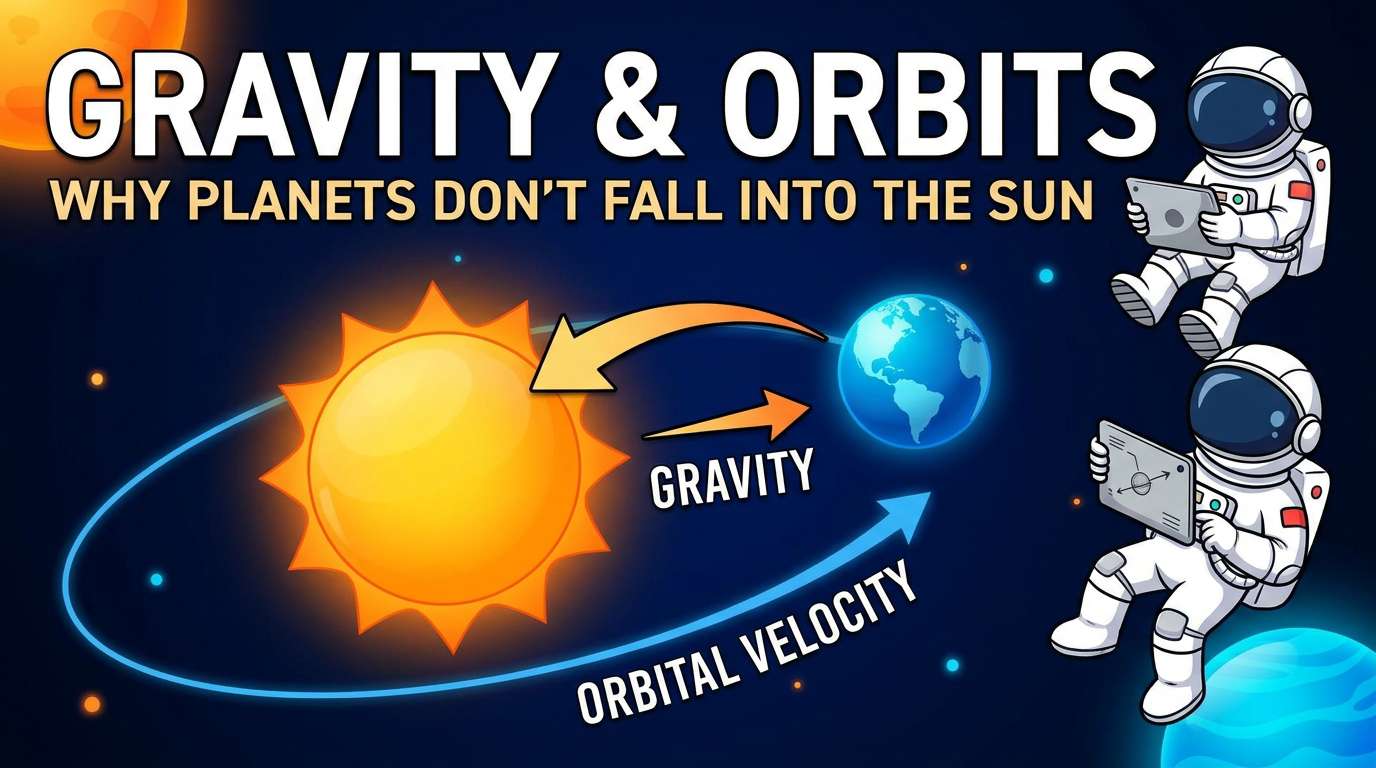
Gravity and Orbits: Why Planets Don't Fall Into the Sun
Introduction
Every moment of every day, the Earth is falling toward the Sun. This might sound alarming, but it is, in fact, exactly what is supposed to happen — and it is the very reason we are still here to read about it. The Earth has been "falling" toward the Sun for around four and a half billion years, and yet it never gets any closer. Understanding why requires unpacking one of the most elegant ideas in all of physics: the relationship between gravity and motion that produces a stable orbit.
Gravity is often described simply as "the force that pulls things down," but its true nature is far more interesting — and far more universal — than that everyday description suggests. The same force that causes an apple to fall from a tree also holds the Moon in orbit around the Earth, keeps the planets circling the Sun, and binds entire galaxies together across unimaginable distances.
What Is Gravity?
Gravity is a fundamental force of attraction that exists between any two objects that have mass. The English physicist Sir Isaac Newton was the first to describe this mathematically, proposing that every object in the universe attracts every other object with a force that depends on two factors: the masses of the objects involved, and the distance between them.
This relationship is expressed in Newton's law of universal gravitation:
F = G(m₁m₂)/r²
where F is the gravitational force, m₁ and m₂ are the masses of the two objects, r is the distance between their centres, and G is the gravitational constant, a fixed number that determines the overall strength of gravity throughout the universe.
This equation reveals two important truths about gravity. First, more massive objects exert a stronger gravitational pull — which is why the Sun, with its enormous mass, dominates the gravitational behaviour of the entire solar system. Second, gravity weakens rapidly with distance, following what is known as an inverse square relationship — doubling the distance between two objects reduces the gravitational force between them to just one quarter of its original strength.
Falling Forever: How Orbits Work
To understand why planets orbit the Sun rather than crashing into it, it helps to imagine a thought experiment that Newton himself famously proposed: a cannon fired horizontally from the top of an extremely tall mountain.
If the cannonball is fired slowly, gravity quickly pulls it down to the ground a short distance away, following a curved path. Fire it faster, and it travels further before landing, but it still falls to the ground eventually. However, if the cannonball is fired fast enough, something remarkable happens: as it falls due to gravity, the curve of the Earth falls away beneath it at the same rate. The cannonball continues falling toward the Earth forever, without ever actually hitting the ground, because the surface curves away beneath it just as quickly as the cannonball drops toward it.
This is precisely what an orbit is: an object that is continuously falling under the influence of gravity, but moving forward fast enough that it continually "misses" the object it is falling toward. The Moon orbits the Earth in exactly this way, as does the International Space Station, and as does every planet orbiting the Sun.
This explains why astronauts aboard the International Space Station appear weightless. They are not actually beyond the reach of Earth's gravity — at that altitude, gravity is still almost as strong as it is on the surface. Instead, the station and everything inside it, including the astronauts, are continuously falling toward the Earth together, while simultaneously moving forward fast enough to remain in orbit. This continuous state of "free fall" is what produces the sensation of weightlessness.
Why Orbits Are Stable
A stable orbit results from a delicate and continuous balance between two competing tendencies: the object's inertia, which causes it to want to travel in a straight line, and the gravitational pull of the object it is orbiting, which continuously bends that straight-line path into a curve.
If a planet were moving too slowly for a given distance from the Sun, gravity would overcome its forward motion, and it would spiral inward, eventually crashing into the Sun. If it were moving too quickly, its forward momentum would overcome the Sun's gravitational pull, and it would fly off into space, escaping the solar system entirely. The Earth, and every other planet in the solar system, travels at precisely the speed required to balance these two effects at its particular distance from the Sun, producing a stable — though not perfectly circular — orbital path.
This is also why planets closer to the Sun, such as Mercury, must travel at much higher speeds to maintain a stable orbit than planets further away, such as Neptune. Mercury experiences a much stronger gravitational pull due to its proximity to the Sun, and must move correspondingly faster to avoid spiralling inward.
Elliptical, Not Circular, Orbits
While orbits are often drawn as simple circles, the German astronomer Johannes Kepler discovered in the early seventeenth century that planetary orbits are actually slightly elongated ellipses, with the Sun positioned not at the centre, but at one of the two focal points of the ellipse. This means that a planet's distance from the Sun — and therefore its orbital speed — varies slightly throughout its orbit, moving fastest when closest to the Sun and slowest when furthest away, a relationship now known as Kepler's second law of planetary motion.
Beyond the Solar System
The same principles that govern the orbit of the Earth around the Sun also explain the structure of the wider universe. Moons orbit planets for the same reasons that planets orbit stars. Stars themselves orbit the centre of their galaxy, often taking hundreds of millions of years to complete a single revolution. Even entire galaxies can orbit one another, bound together across vast distances by the same gravitational force that keeps an apple from floating away after it falls from a tree.
Engineers and scientists use these same gravitational principles to plan the paths of artificial satellites and spacecraft, carefully calculating the exact speed and altitude needed to achieve a stable orbit, or to use a planet's gravity to slingshot a spacecraft toward its destination — a technique known as a gravitational assist, used extensively in missions exploring the outer solar system.
Conclusion
The fact that the Earth has orbited the Sun safely for billions of years, neither spiralling into it nor drifting away into the cold of deep space, is not a matter of luck — it is the inevitable result of a precise and continuous balance between gravity and motion. Every planet, moon, and satellite in the universe is, in a very real sense, perpetually falling, kept from ever truly landing by the sheer speed of its forward motion.
Understanding gravity and orbital motion not only explains the structure of our solar system, but also reveals one of the most beautiful and far-reaching ideas in all of science: that the same simple force responsible for a falling apple is also responsible for holding the entire universe together.