Mitosis and Meiosis: How Cells Divide and Reproduce
Introduction
A single fertilized egg, invisible to the naked eye, eventually becomes a human being made of trillions of cells. A cut on your finger, made of damaged and destroyed cells, eventually heals as new cells replace what was lost. A parent passes on a unique combination of traits to their child, different from any combination that parent has passed on before. All three of these processes — growth, repair, and reproduction with genetic variation — depend on cells dividing, but not always in the same way.
Cell division occurs primarily through two distinct processes: mitosis and meiosis. Though both begin with a single parent cell and involve the careful division of genetic material, they serve fundamentally different purposes, follow different sequences of steps, and produce very different results. This article examines both processes in detail, building on the foundation of cell structure and genetics covered elsewhere in this syllabus.
Why Cells Need to Divide
Cell division serves several essential biological purposes:
- Growth: Multicellular organisms grow larger primarily by producing more cells, not by making existing cells larger.
- Repair and replacement: Damaged, worn-out, or dead cells must be replaced to maintain healthy tissue.
- Reproduction: Sexual reproduction requires the production of specialized reproductive cells (gametes) with half the usual number of chromosomes.
Chromosomes: A Quick Refresher
As covered in the article on genetics, human cells normally contain 46 chromosomes, arranged in 23 pairs. Cells containing the full set of paired chromosomes are described as diploid. Before a cell can divide, its DNA must first be copied, so that each resulting daughter cell receives a complete set of genetic instructions.
Mitosis: Division for Growth and Repair
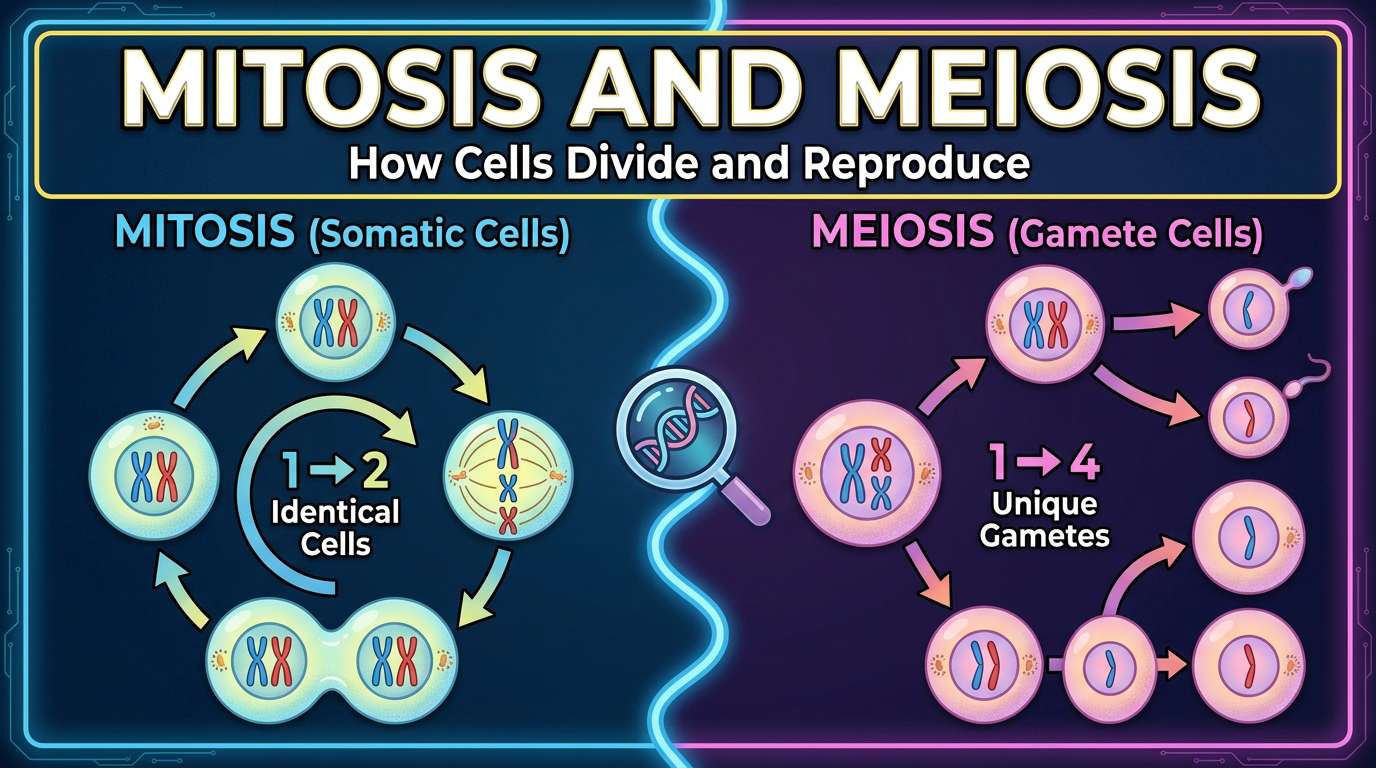
Mitosis is the type of cell division responsible for growth, tissue repair, and the replacement of damaged or dying cells throughout an organism's life. It produces two daughter cells that are genetically identical to one another and to the original parent cell, each containing the full diploid number of chromosomes.
The Stages of Mitosis
Mitosis is generally described as occurring in four main stages, following an earlier stage in which DNA is copied.
Interphase (Preparation, Not Technically Part of Mitosis Itself)
Before mitosis begins, the cell spends most of its life in a stage called interphase, during which it grows, carries out its normal functions, and — critically — replicates its DNA, producing an identical copy of each chromosome. At this stage, each chromosome now exists as two identical strands called chromatids, joined together at a point called the centromere.
Prophase
The replicated chromosomes, each consisting of two chromatids, condense and become visible under a microscope. The nuclear envelope begins to break down, and structures called spindle fibres begin to form, which will later help separate the chromatids.
Metaphase
The chromosomes, each still consisting of two joined chromatids, line up along the middle (equator) of the cell, attached to spindle fibres extending from opposite ends of the cell.
Anaphase
The spindle fibres contract, pulling the two chromatids of each chromosome apart from one another, and drawing one complete set of chromosomes toward each end of the cell. Each separated chromatid is now considered an individual chromosome in its own right.
Telophase
A new nuclear envelope forms around each of the two separated sets of chromosomes at opposite ends of the cell, and the chromosomes begin to uncoil back into their less condensed form. The cell then physically divides into two separate daughter cells, in a process called cytokinesis, completing mitosis.
The Result of Mitosis
Mitosis produces two daughter cells, each genetically identical to the original parent cell and to each other, and each containing the full diploid number of chromosomes (46 in humans). This genetic identity is essential for growth and repair, since a newly formed skin cell, for example, needs to function exactly like the surrounding skin cells it is replacing.
Meiosis: Division for Sexual Reproduction
Meiosis is the type of cell division specifically responsible for producing gametes — sperm cells in males and egg cells in females — the specialized reproductive cells involved in sexual reproduction. Unlike mitosis, meiosis involves two successive rounds of division, and it produces four daughter cells, each genetically different from one another and from the original parent cell, and each containing only half the usual number of chromosomes.
Why Gametes Need Half the Usual Chromosome Number
During sexual reproduction, a sperm cell fuses with an egg cell in a process called fertilization, combining their genetic material to form a new individual. If both gametes contained the full diploid number of chromosomes (46 each), the resulting fertilized cell would contain 92 chromosomes — double the normal number. Meiosis solves this by producing gametes with exactly half the usual chromosome number (23 in humans), described as haploid, so that fertilization restores the normal diploid number (46) in the resulting offspring.
An Overview of the Stages of Meiosis
Meiosis involves two rounds of division, generally referred to as meiosis I and meiosis II, and follows a broadly similar stage structure to mitosis (prophase, metaphase, anaphase, telophase) repeated twice, but with two crucial differences that distinguish it from mitosis.
Meiosis I: Separating Homologous Chromosome Pairs
During the first division, the two chromosomes making up each homologous pair (one originally inherited from the mother, one from the father) are separated from one another and distributed into two separate cells. Before this separation occurs, a process called crossing over can take place, in which homologous chromosomes exchange small segments of genetic material with one another — a key source of genetic variation, since it creates new combinations of alleles not present in either original parental chromosome.
Meiosis II: Separating Chromatids
The second division resembles mitosis more closely, separating the sister chromatids of each chromosome from one another, ultimately producing four haploid daughter cells in total, each genetically distinct from the others due to the earlier crossing over and the random way homologous chromosomes were distributed during meiosis I.
The Result of Meiosis
Meiosis produces four daughter cells, each haploid (containing 23 chromosomes in humans) and each genetically different from one another, from the original parent cell, and from any other gamete the same organism might produce. This genetic variation is precisely why full siblings, despite sharing the same two parents, are never genetically identical to one another (except in the special case of identical twins).
Comparing Mitosis and Meiosis
| Feature | Mitosis | Meiosis |
|---|---|---|
| Number of divisions | One | Two |
| Number of daughter cells | Two | Four |
| Chromosome number in daughter cells | Diploid (same as parent cell) | Haploid (half of parent cell) |
| Genetic identity of daughter cells | Identical to each other and the parent cell | Genetically different from each other and the parent cell |
| Purpose | Growth, repair, and replacement of cells | Production of gametes for sexual reproduction |
| Occurs in | Almost all body cells (somatic cells) | Specialized reproductive organs (testes and ovaries) |
Why Genetic Variation From Meiosis Matters
The genetic variation introduced by meiosis, through both crossing over and the random distribution of homologous chromosomes, plays a crucial evolutionary role. A population with greater genetic variation among its individuals is generally better equipped to survive environmental changes and challenges — such as new diseases or shifting climate conditions — since a wider range of traits increases the likelihood that at least some individuals will possess characteristics suited to surviving and reproducing under the new conditions.
Errors in Cell Division
Occasionally, errors occur during mitosis or meiosis, resulting in daughter cells with an incorrect number of chromosomes. One well-known example involves an error during meiosis leading to an extra copy of chromosome 21 in a resulting gamete; if this gamete is involved in fertilization, the resulting individual will have three copies of chromosome 21 instead of the usual two — a condition known as Down syndrome. This illustrates how precisely chromosome separation during cell division must occur, and how a single error at this microscopic level can have significant effects on an entire developing organism.
Mitosis, Meiosis, and WAEC/NECO/JAMB Biology
Key examinable areas of this topic include:
- The stages of mitosis, in correct sequence, and the genetic outcome (two identical diploid cells).
- The stages and outcome of meiosis, including why it produces four genetically varied haploid cells.
- Comparing mitosis and meiosis directly, particularly in terms of chromosome number and genetic identity of the resulting cells.
- The biological significance of each process — mitosis for growth and repair, meiosis for sexual reproduction and genetic variation.
- The role of crossing over in introducing genetic variation during meiosis.
Common Mistakes Students Make
- Confusing the purposes of mitosis and meiosis. Mitosis is for growth and repair; meiosis is specifically for producing gametes.
- Stating that mitosis produces genetically varied cells. Mitosis produces genetically identical daughter cells; genetic variation is a specific feature of meiosis.
- Forgetting that meiosis involves two rounds of division, not one. This is a key structural difference from mitosis, and it is why meiosis produces four daughter cells rather than two.
- Describing gametes as diploid. Gametes are haploid, containing half the usual chromosome number, which is restored to the full diploid number only after fertilization.
- Placing the stages of mitosis in the wrong order, particularly confusing metaphase (chromosomes aligned at the centre) with anaphase (chromatids being pulled apart).
Conclusion
Mitosis and meiosis represent two elegant, precisely regulated solutions to two very different biological problems. Mitosis faithfully copies a cell's entire genetic makeup, over and over, to build and maintain a body made of trillions of genetically identical cells working together. Meiosis deliberately introduces variation, halving the chromosome number and reshuffling genetic material, to ensure that sexual reproduction produces offspring that are related to, but never identical to, either parent.
Together, these two processes explain some of biology's most fundamental patterns — how a single cell becomes a fully developed organism, and how that same organism can go on to produce offspring that are recognizably related, yet genuinely unique.