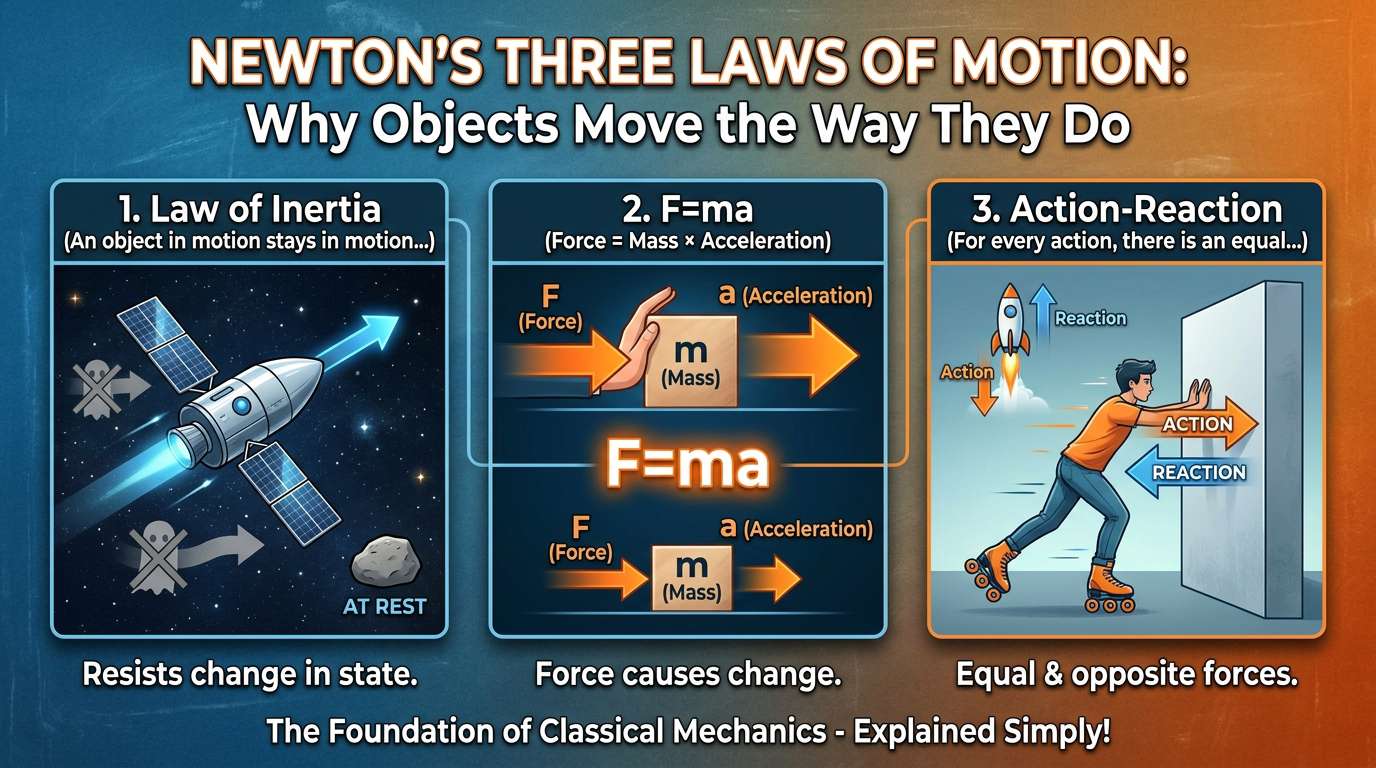
Newton's Three Laws of Motion: Why Objects Move the Way They Do
Introduction
Why does a football keep rolling after you kick it, only to eventually stop? Why do you lurch forward when a bus suddenly brakes? Why does a rocket need to expel burning gas downward in order to fly upward? The answers to all of these questions come from three remarkably simple ideas published over three hundred years ago by the English scientist Sir Isaac Newton.
In 1687, Newton published a book called Philosophiæ Naturalis Principia Mathematica — usually just called the Principia — in which he set out three laws of motion. These laws describe the relationship between a physical object and the forces acting upon it, and how the object moves in response to those forces. More than three centuries later, they remain one of the most important foundations of physics, used by engineers, athletes, pilots, and scientists every single day.
Newton's First Law: The Law of Inertia
Newton's first law states that an object at rest will stay at rest, and an object in motion will stay in motion at a constant speed and in a straight line, unless acted upon by an unbalanced force.
This property of matter — its tendency to resist changes in its state of motion — is called inertia. The word comes from the Latin for "idleness" or "laziness," and it is a useful way to think about the concept: objects are, in a sense, lazy. A stationary object does not want to start moving, and a moving object does not want to stop, speed up, slow down, or change direction.
This explains many everyday experiences:
- A book resting on a table stays exactly where it is until something pushes or pulls it.
- When a car suddenly stops, passengers continue moving forward — which is why seatbelts exist, to provide the unbalanced force needed to stop the passenger's body.
- A spinning ice skater glides smoothly across the ice because very little friction acts to slow them down.
- In the vacuum of space, a spacecraft that fires its engines briefly will continue travelling at that speed indefinitely, since there is no air resistance to slow it down.
The greater an object's mass, the greater its inertia, and the harder it is to change its motion. This is why it takes far more force to push a stalled truck than to push a shopping trolley.
Newton's Second Law: Force, Mass, and Acceleration
Newton's second law builds on the first by explaining exactly what happens when an unbalanced force does act on an object. It states that the acceleration of an object depends on two things: the net force acting on it, and its mass. This relationship is usually written as the equation:
F = ma
where F is the net force applied (measured in newtons), m is the mass of the object (measured in kilograms), and a is the resulting acceleration (measured in metres per second squared).
This equation tells us two important things. First, the more force applied to an object, the greater its acceleration — push a swing harder, and it speeds up faster. Second, for a given amount of force, a more massive object will accelerate less than a lighter one. This is why a tennis ball flies much further than a bowling ball when struck with the same force.
Examples of the second law in action include:
- A loaded shopping trolley requires more effort to push and accelerate than an empty one.
- Sports cars are built with powerful engines to maximise force while keeping mass low, allowing for rapid acceleration.
- Cyclists shift to lower gears on steep hills, effectively increasing the force their legs can apply against the resistance of gravity.
- Rockets must burn enormous amounts of fuel to generate the huge forces needed to accelerate their substantial mass into orbit.
Newton's Third Law: Action and Reaction
Newton's third law is perhaps the most famous, and is often summarised as: for every action, there is an equal and opposite reaction. More precisely, it states that when one object exerts a force on a second object, the second object simultaneously exerts a force of equal size and opposite direction back on the first.
This law explains a huge range of phenomena that might otherwise seem puzzling:
- When you walk, your feet push backward against the ground, and the ground pushes forward against your feet with equal force, propelling you ahead.
- A swimmer pushes water backward with their hands and feet, and the water pushes the swimmer forward in response.
- A rocket engine pushes hot gas downward and out of its exhaust, and that gas pushes the rocket upward with equal force — this is how rockets can accelerate even in the vacuum of space, where there is no air to "push against."
- When you sit in a chair, your body pushes down on the seat due to gravity, and the chair pushes back up on you with equal force, which is why you do not fall through it.
An important point of confusion students often encounter is why, if the forces are equal and opposite, objects move at all. The answer lies in the fact that the two forces act on different objects. When a rocket pushes gas downward and the gas pushes the rocket upward, those two forces do not cancel out — they act on two separate objects (the gas and the rocket) and each causes its own acceleration according to the second law.
Why These Laws Still Matter
Although Newton formulated his laws over three centuries ago, and although modern physics has since revealed that they break down under extreme conditions — such as speeds approaching the speed of light, where Einstein's theory of relativity takes over — Newton's laws remain remarkably accurate and useful for almost every situation encountered in daily life and engineering.
Engineers use Newton's laws to design everything from bridges and buildings to cars and aircraft. Sports scientists use them to analyse and improve athletic performance. Space agencies such as NASA rely on them to calculate the trajectories of rockets and satellites. Even something as simple as designing a safer car seatbelt or a more effective running shoe depends on a solid understanding of how forces affect motion.
Conclusion
Newton's three laws of motion transformed our understanding of the physical world, replacing centuries of guesswork and assumption with a clear, mathematical framework that could predict exactly how objects would behave under the influence of force. From the inertia that keeps a parked car still, to the careful balance of force, mass, and acceleration that determines how quickly a cyclist can climb a hill, to the elegant push-and-pull of action and reaction that powers a swimmer through water or a rocket into orbit — these three simple statements explain an extraordinary amount about the universe in which we live.
The next time you fasten a seatbelt, kick a ball, or watch a rocket launch into the sky, you will be witnessing Newton's laws of motion at work — proof that some of the most powerful scientific ideas are also among the simplest.