Peer Group Pressure and Decision-Making for Teenagers
Introduction
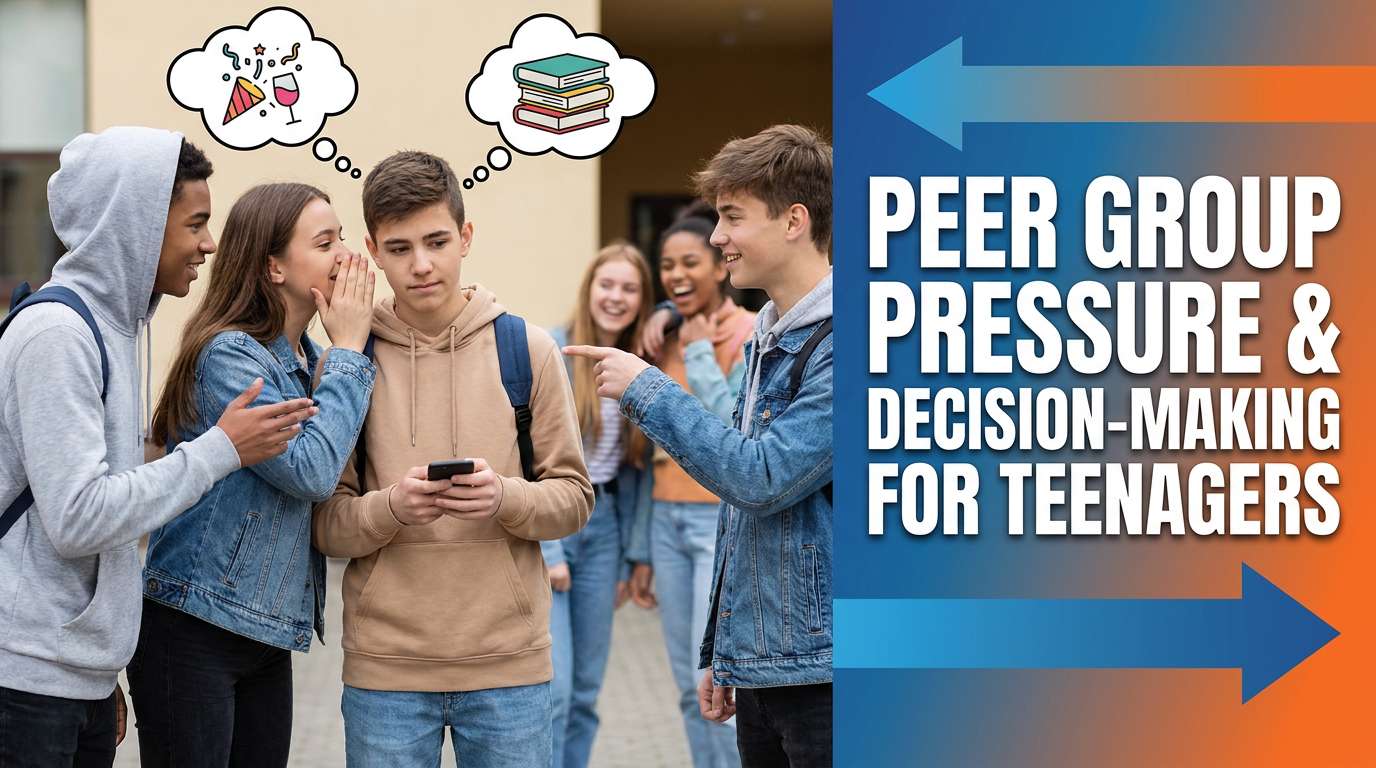
A group of friends decides to skip an important class together. Another group encourages a hesitant member to keep studying for an upcoming exam instead of going out. A teenager is offered a cigarette at a party and has to decide, in that exact moment, whether to accept or decline in front of people whose opinion matters deeply to them. Every one of these situations involves the same powerful social force: peer group pressure.
Peer pressure is one of the most significant influences shaping teenage behaviour and decision-making, and it is neither purely good nor purely bad — it can push a young person toward genuinely harmful choices, or it can support and strengthen positive ones. This article explores peer group pressure in depth: what it is, why it holds such strong influence during adolescence, its positive and negative forms, and practical strategies for navigating it wisely.
What Is Peer Group Pressure?
Peer group pressure refers to the influence exerted by individuals of a similar age or social group, encouraging a person to change their attitudes, values, or behaviour in order to conform to the perceived norms, expectations, or preferences of that group. This influence can be explicit, such as direct encouragement or teasing, or implicit, arising simply from a desire to fit in and be accepted, without anyone directly saying anything at all.
Why Peer Pressure Is Especially Powerful During Adolescence
Several factors specific to adolescence make peer influence particularly powerful during the teenage years, compared to earlier childhood or later adulthood.
The Growing Importance of Social Identity
Adolescence is a critical period during which young people are actively forming their own sense of identity, often significantly through their relationships and standing within their peer group, making peer acceptance feel especially important during this stage of life.
Psychological and Neurological Development
Research in adolescent psychology suggests that regions of the brain associated with reward and social sensitivity develop more rapidly during adolescence than regions associated with long-term planning and impulse control, which can make teenagers particularly sensitive to social approval and peer reactions in the moment, sometimes at the expense of carefully weighing longer-term consequences.
Reduced Reliance on Parental Guidance
As teenagers naturally seek greater independence from parents and family, peers often become an increasingly significant source of guidance, validation, and social reference, filling a role that parents and other adults held more exclusively during earlier childhood.
Negative Peer Pressure
Negative peer pressure occurs when peer influence encourages a young person toward behaviour that is harmful, unwise, or inconsistent with their own genuine values, often driven by a fear of rejection or a desire to appear a certain way to others.
Common Examples of Negative Peer Pressure
- Encouragement to skip school or neglect academic responsibilities.
- Pressure to experiment with alcohol, tobacco, or other substances, as discussed in the article on drug abuse.
- Pressure to engage in risky or reckless behaviour to appear brave or impressive to peers.
- Pressure to participate in bullying, exclusion, or unkind treatment of others.
- Pressure to engage in dishonest behaviour, such as cheating during examinations.
- Pressure regarding appearance, spending, or lifestyle choices that may not align with a young person's own values, priorities, or financial circumstances.
Positive Peer Pressure
It is important to recognize that peer influence is not inherently negative. Positive peer pressure occurs when a peer group encourages behaviour that is genuinely beneficial, supportive, or constructive.
Common Examples of Positive Peer Pressure
- Friends encouraging one another to study consistently and take academic work seriously.
- A peer group discouraging harmful behaviour, such as substance use or reckless risk-taking.
- Friends supporting healthy habits, such as regular exercise or constructive hobbies.
- A peer group encouraging participation in positive community or civic activities.
- Friends holding one another accountable for honest, respectful behaviour toward others.
Recognizing the existence of positive peer pressure is genuinely important — the goal is not to avoid peer influence altogether, which is largely unavoidable and, in many respects, a normal part of healthy social development, but rather to cultivate relationships and social environments in which peer influence tends to reinforce good choices rather than undermine them.
Why Some Teenagers Are More Vulnerable to Negative Peer Pressure
- Low self-esteem or a strong need for approval, which can make a teenager more willing to compromise their own values or judgment in order to gain acceptance.
- Lack of a strong, clear sense of personal values, making it harder to recognize when a particular expectation conflicts with one's own genuine priorities.
- Limited practice in assertively declining unwanted requests, making it more difficult to say no confidently in the moment.
- Social isolation or a strong desire to belong to a particular group, which can increase willingness to comply with group expectations, even harmful ones, in order to gain acceptance.
Practical Strategies for Resisting Negative Peer Pressure
Clarify Your Own Values in Advance
Taking time, before being placed in a pressured situation, to think clearly about one's own personal values and boundaries makes it significantly easier to recognize and resist pressure that conflicts with those values when it actually arises.
Prepare Responses in Advance
Having a few simple, comfortable responses ready in advance — such as a straightforward "No thanks, that's not really my thing" — can make it much easier to decline confidently in the moment, rather than being caught off guard and unsure how to respond.
Choose Friendships Thoughtfully
Actively seeking out friendships with peers who share similar values and who generally support rather than undermine healthy decision-making significantly reduces the frequency and intensity of negative pressure encountered day to day.
Practice Confident Body Language and Tone
A calm, confident, and direct manner of declining — rather than an apologetic or uncertain one — often results in less persistent pressure from others, since confident refusals are typically respected more readily than hesitant ones.
Have an "Exit Strategy" for Difficult Situations
Planning in advance how to leave an uncomfortable situation — such as having a trusted adult available to call, or a pre-arranged reason to depart early — can provide a practical, face-saving way to remove oneself from pressure without unnecessary confrontation.
Seek Support From Trusted Adults
Parents, teachers, or other trusted adults can offer valuable guidance, perspective, and support in navigating difficult peer pressure situations, and should generally be seen as a resource rather than someone to be entirely kept out of such matters.
Building Healthy, Supportive Friendships
Beyond simply resisting negative pressure, cultivating friendships characterized by mutual respect, honesty, and genuine support for one another's wellbeing tends to naturally produce far more positive peer influence. Healthy friendships generally involve accepting a friend's right to decline something without excessive pressure or ridicule, celebrating one another's genuine achievements and positive choices, and offering support during difficulty rather than judgment or exclusion.
Peer Group Pressure and WAEC/NECO Civic Education
Key examinable areas of this topic include:
- The definition of peer group pressure and why it holds particular influence during adolescence.
- The distinction between positive and negative peer pressure, with clear practical examples of each.
- Factors that increase vulnerability to negative peer pressure.
- Practical strategies for resisting negative peer pressure.
- The characteristics of healthy, supportive friendships.
Common Mistakes Students Make
- Describing peer pressure as always negative. Positive peer pressure genuinely exists and can meaningfully support good decision-making.
- Assuming resisting peer pressure simply requires willpower alone, without recognizing the value of practical strategies, such as preparing responses in advance or choosing supportive friendships.
- Overlooking the psychological and developmental factors that make adolescence a period of particular sensitivity to peer influence.
- Assuming only "weak" or troubled teenagers experience difficulty resisting peer pressure. Peer pressure is a normal, near-universal social experience during adolescence, not a sign of individual weakness.
- Framing the goal as avoiding peer influence altogether, rather than recognizing that some degree of peer influence is a normal, and even healthy, part of adolescent social development.
Conclusion
Peer group pressure is one of the most powerful social forces shaping teenage decision-making — capable of pushing young people toward serious harm, or genuinely supporting them toward positive, constructive choices, depending significantly on the values and character of the peer group involved and the individual teenager's own preparedness to navigate that influence wisely.
Understanding why this influence feels so powerful during adolescence, learning to distinguish between positive and negative forms of peer pressure, and building practical, confident strategies for responding to pressure that conflicts with one's own values are genuinely valuable life skills — equipping students not just for examination success, but for navigating one of the most significant social challenges of their teenage years with greater confidence and clarity.