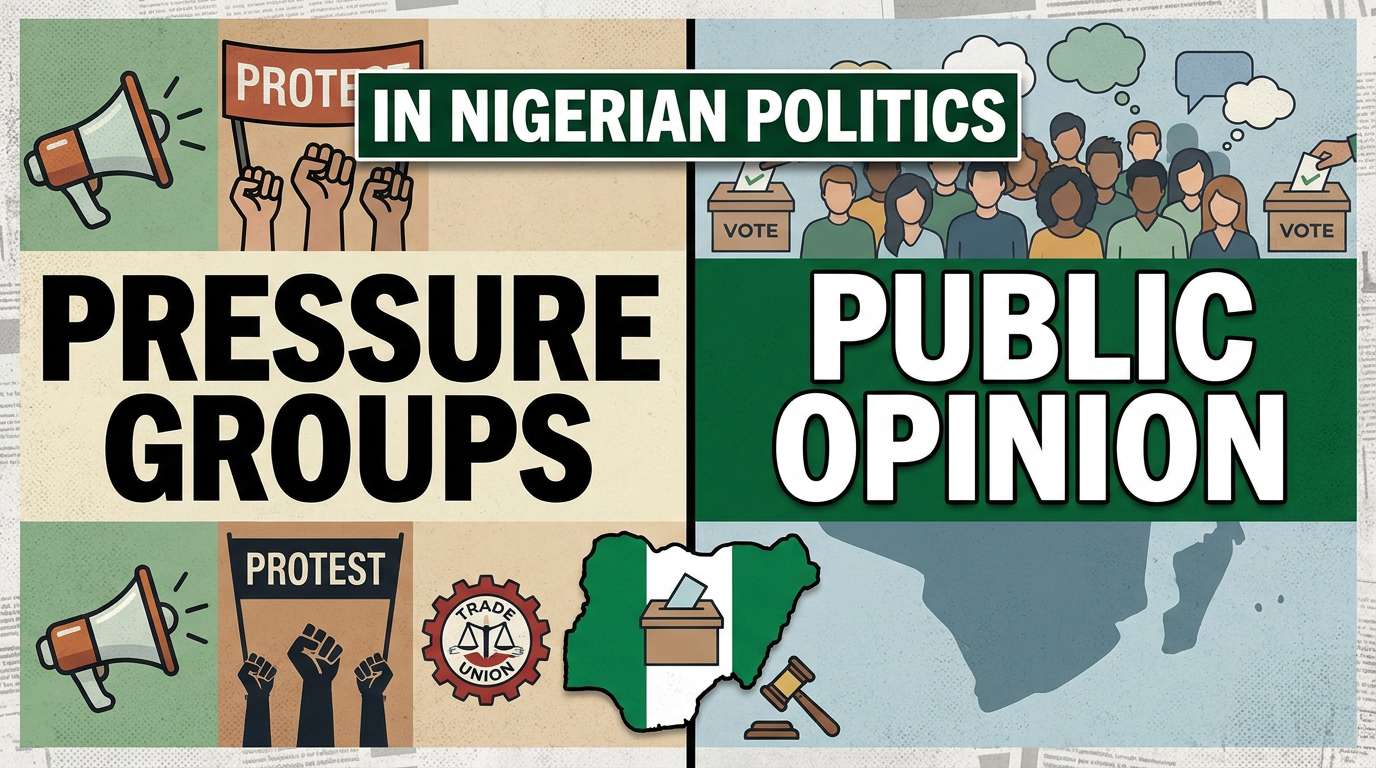
Pressure Groups and Public Opinion in Nigerian Politics
Introduction
Not every group seeking to influence government policy wants to actually run for office or form a government. A trade union negotiating for better working conditions, a professional association advocating for changes to industry regulation, a civil society organization campaigning for stronger anti-corruption laws, or a market women's association pressing local authorities over a proposed policy — none of these groups seek to become the government themselves, yet all of them play an important role in shaping government decisions.
These organizations are known as pressure groups, and alongside the broader concept of public opinion, they form an essential, if sometimes less visible, part of how democratic political systems function. This article explores pressure groups and public opinion in depth, their methods of influence, and their particular significance within Nigerian politics.
What Is a Pressure Group?
A pressure group (also called an interest group or advocacy group) is an organized group of individuals who share a common interest or goal and who seek to influence government policy or public opinion in favour of that interest, without themselves seeking to contest elections or directly control government. This is the essential feature distinguishing pressure groups from political parties.
Pressure Groups vs. Political Parties: A Key Distinction
| Feature | Pressure Groups | Political Parties |
|---|---|---|
| Goal | Influence government policy on specific issues | Win elections and directly control government |
| Scope of interest | Usually narrow, focused on specific issues | Broad, covering a wide range of policy areas |
| Contest elections | No | Yes |
| Example | Nigeria Labour Congress (NLC) | All Progressives Congress (APC) |
Types of Pressure Groups
Sectional (Interest) Groups
Sectional groups represent the specific shared interests of a particular section of society, typically limiting membership to individuals who belong to that section, such as workers in a particular industry or members of a particular profession. Examples in Nigeria include trade unions such as the Nigeria Labour Congress (NLC) and professional associations such as the Nigerian Bar Association (NBA) or the Nigerian Medical Association (NMA).
Promotional (Cause) Groups
Promotional groups campaign in support of a particular cause or principle, generally open to any member of the public who supports that cause, regardless of their profession or background. Examples include human rights organizations, environmental advocacy groups, and civil society organizations campaigning for issues such as electoral reform or anti-corruption measures.
Methods Pressure Groups Use to Exert Influence
Lobbying
Pressure groups often engage directly with government officials, legislators, or civil servants, presenting their case and attempting to persuade decision-makers to adopt policies favourable to their interests.
Public Campaigns and Media Engagement
Groups often use public campaigns, press releases, and media appearances to raise awareness of their cause and build broader public support and pressure on the government.
Strikes and Industrial Action
Particularly for labour-based pressure groups such as trade unions, organizing strikes or other forms of industrial action can be a powerful means of pressing demands, since disruption to essential services or economic activity can create significant pressure on government or employers to respond.
Protests and Demonstrations
Public protests, marches, and demonstrations are frequently used to visibly display the scale of public support for a particular cause, drawing media attention and placing direct pressure on government to respond.
Litigation
Some pressure groups, particularly those focused on human rights or civil liberties, pursue legal action through the courts, seeking judicial rulings that advance their cause or overturn government policies they consider unlawful.
Petitions and Formal Submissions
Groups may organize petitions or submit formal position papers to relevant government bodies or legislative committees, presenting evidence and arguments in support of a particular policy position.
Prominent Pressure Groups in Nigeria
- Nigeria Labour Congress (NLC): A major umbrella trade union organization representing workers across numerous industries, frequently involved in negotiations over wages, fuel prices, and broader economic policy.
- Trade Union Congress (TUC): Another significant labour union federation, often working alongside or in coordination with the NLC on major national labour issues.
- Nigerian Bar Association (NBA): A professional association representing lawyers, which frequently advocates on matters relating to the rule of law, judicial independence, and legal reform.
- Manufacturers Association of Nigeria (MAN): Represents the interests of manufacturers, frequently engaging government on matters of industrial policy, trade, and economic regulation.
- Civil society and human rights organizations, which campaign on issues including anti-corruption, electoral reform, and the protection of fundamental rights.
What Is Public Opinion?
Public opinion refers to the collective views, attitudes, and preferences held by the general public, or a significant portion of it, regarding a particular issue, policy, or political figure. Unlike a pressure group, public opinion is not a formally organized body — it represents a broader, more diffuse expression of collective sentiment, often measured through opinion polls, media commentary, and general public discourse.
How Public Opinion Is Formed
Public opinion is shaped by a wide range of influences, including:
- The media, including television, radio, newspapers, and increasingly, social media platforms, which play a significant role in shaping how issues are presented and understood by the public.
- Education, which shapes individuals' capacity to critically evaluate political information and form independent views.
- Religious and traditional institutions, which hold considerable influence over social attitudes and values in many Nigerian communities.
- Personal experience, including individuals' direct experiences with government services, the economy, or security conditions.
- Political parties and pressure groups themselves, which actively work to shape public opinion in support of their own positions.
How Public Opinion Influences Government
Government officials, particularly elected ones facing future re-election, are often highly sensitive to public opinion, since a government perceived to be acting against strong public sentiment risks significant political consequences, including electoral defeat. Public opinion can pressure government to introduce new policies, reverse unpopular decisions, or respond more urgently to particular public concerns.
The Relationship Between Pressure Groups and Public Opinion
Pressure groups and public opinion frequently interact with and reinforce one another. A well-organized pressure group can shape and mobilize public opinion in support of its cause through effective campaigning, while strong existing public opinion on an issue can, in turn, provide a pressure group with greater credibility and leverage in its efforts to influence government policy.
The Significance of Pressure Groups in a Democracy
- Representing specific interests that might otherwise be overlooked within the broader platforms of major political parties.
- Providing specialized expertise and detailed information on particular issues, which can genuinely inform better government policy.
- Enhancing government accountability, by scrutinizing and publicly challenging specific government policies or actions.
- Broadening political participation, offering citizens additional avenues for political engagement beyond simply voting in periodic elections.
Criticisms and Challenges Associated With Pressure Groups
- Unequal influence, since wealthier or better-organized groups may have significantly greater capacity to influence government than less-resourced groups representing equally legitimate interests.
- Potential for disruption, particularly where strikes or protests significantly affect essential services or public order.
- Risk of narrow self-interest, where a pressure group's demands, if adopted, might primarily benefit its own members at the broader expense of the general public.
- Questions of accountability, since pressure groups, unlike elected political parties, are not directly accountable to the general electorate for the positions they advocate.
Pressure Groups and WAEC/NECO Government
Key examinable areas of this topic include:
- The definition of a pressure group and how it differs from a political party.
- Types of pressure groups — sectional and promotional — with relevant Nigerian examples.
- Methods used by pressure groups to influence government, including lobbying, strikes, and protests.
- The definition and formation of public opinion, and the factors that shape it.
- The relationship between pressure groups and public opinion in shaping government policy.
- The significance and limitations of pressure groups within a democratic system.
Common Mistakes Students Make
- Confusing pressure groups with political parties. The essential distinction is that pressure groups seek to influence government policy without contesting elections themselves, while political parties seek to win elections and directly control government.
- Confusing sectional and promotional groups. Sectional groups represent a specific section of society with restricted membership (e.g. a particular profession); promotional groups campaign for a cause and are generally open to any supporter.
- Assuming public opinion is always accurately or fairly measured. Public opinion, particularly as reported through media or informal channels, can be influenced by factors that do not necessarily reflect the true, considered views of the broader population.
- Overlooking the role of the media in shaping public opinion, focusing solely on pressure groups as the source of political influence.
- Assuming pressure group influence is always positive for democracy, without considering legitimate criticisms regarding unequal influence and narrow self-interest.
Conclusion
Pressure groups and public opinion together form an essential, ongoing channel through which citizens and organized interests influence government policy between elections, complementing the more formal, periodic influence exercised through voting for political parties. From the organized advocacy of trade unions and professional associations, to the broader, more diffuse influence of public sentiment shaped by media and lived experience, these forces continuously shape the practical direction of government policy in Nigeria.
Understanding how pressure groups operate, the methods they use, and how they interact with broader public opinion provides students with genuine insight into how political influence in a democracy extends well beyond the ballot box, shaping government decisions through a much wider and more continuous process of persuasion, negotiation, and public pressure.