Separation of Powers: Executive, Legislature, and Judiciary Explained
Introduction
Imagine a country where a single person or group could write the laws, decide who broke them, and then personally punish the offenders — all without anyone else having the authority to question or reverse a single decision. History has shown, repeatedly, how dangerous this concentration of power can be, often leading to abuse, corruption, and the erosion of citizens' basic rights and freedoms.
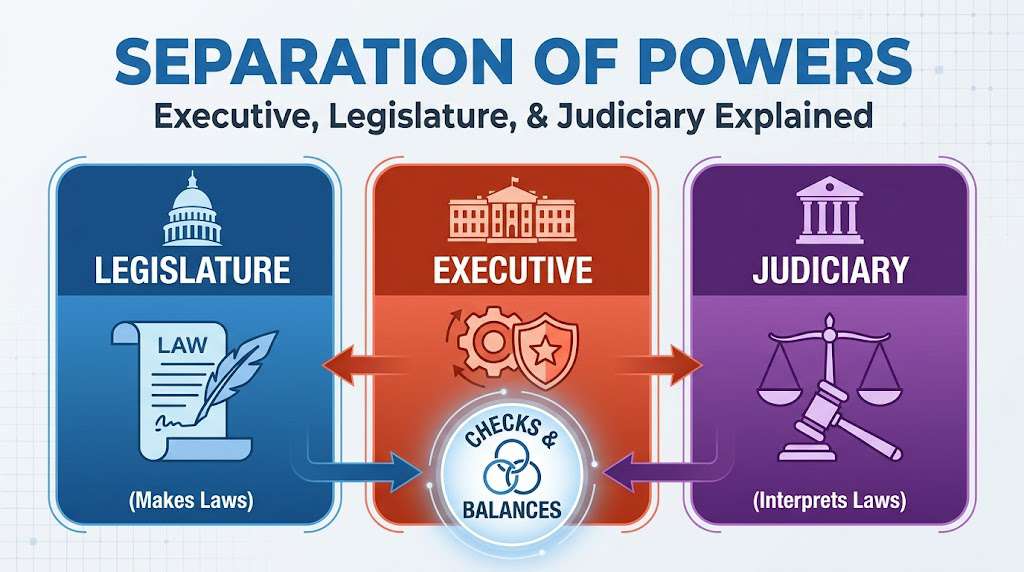
The doctrine of separation of powers exists specifically to prevent this outcome. It divides the essential functions of government among three distinct, independent arms — the executive, the legislature, and the judiciary — ensuring that no single arm can dominate the others or exercise total control over the state. This article explores the doctrine in depth: its origins, the specific roles of each arm of government, how they check and balance one another, and how this principle is applied within Nigeria's system of government.
The Origins of Separation of Powers
While elements of this idea can be traced back to ancient political thought, the doctrine in its modern form is most closely associated with the French philosopher Baron de Montesquieu, who, in his 1748 work The Spirit of the Laws, argued that political liberty could only be secured where governmental power was divided among separate bodies, each capable of restraining the others. Montesquieu's ideas drew heavily on his study of the British system of government, and they went on to profoundly influence the framers of the United States Constitution, and later, the constitutions of many other nations, including Nigeria.
The Three Arms of Government
Under the doctrine of separation of powers, governmental authority is divided among three distinct arms, each responsible for a different core function of the state.
The Executive
The executive arm of government is responsible for implementing and enforcing laws — putting into practice the policies and legislation passed by the legislature. In Nigeria's presidential system, the executive is headed by the President at the federal level, and by Governors at the state level, supported by ministers, commissioners, and various government agencies and departments (referred to collectively as the civil service or public service) that carry out the day-to-day work of government.
Key functions of the executive include:
- Implementing and enforcing laws passed by the legislature.
- Formulating and executing government policy.
- Managing the day-to-day administration of the country or state.
- Representing the country in international affairs and negotiations.
- Commanding the armed forces and overseeing national security (at the federal level).
The Legislature
The legislature is the arm of government responsible for making laws. In Nigeria, the federal legislature is called the National Assembly, and it is bicameral, meaning it consists of two chambers: the Senate (the upper chamber) and the House of Representatives (the lower chamber). Each state also has its own legislature, called the State House of Assembly, which is unicameral (a single chamber).
Key functions of the legislature include:
- Debating and passing bills into law.
- Approving the government's budget and controlling public spending.
- Representing the interests and concerns of the citizens who elected them.
- Overseeing and scrutinizing the actions of the executive, including through committee hearings and investigations.
- Confirming certain executive appointments, such as ministers or heads of key agencies.
The Judiciary
The judiciary is the arm of government responsible for interpreting laws and administering justice. In Nigeria, the judiciary is headed by the Supreme Court, the highest court in the land, with other courts — including the Court of Appeal, the Federal High Court, State High Courts, and various specialized and lower courts — operating beneath it in a structured hierarchy.
Key functions of the judiciary include:
- Interpreting the constitution and other laws passed by the legislature.
- Resolving disputes between individuals, organizations, and the government.
- Determining guilt or innocence in criminal cases and imposing appropriate penalties.
- Reviewing the actions of the executive and legislature to ensure they comply with the constitution — a power known as judicial review.
Why Separation of Powers Matters
The central purpose of separating these three functions among independent arms is to prevent the concentration and abuse of power. If the same body that makes laws also enforced them and judged violations of them, there would be little to stop that body from creating self-serving laws, ignoring rules it did not wish to follow, or punishing political opponents unfairly, with no independent check on any of these actions.
By dividing these functions, separation of powers achieves several important goals:
- Prevents tyranny, by ensuring that no single arm of government can act without restraint.
- Protects individual rights and freedoms, since an independent judiciary can strike down laws or executive actions that violate constitutional rights.
- Promotes accountability, since each arm is subject to oversight from the others.
- Encourages careful, deliberate decision-making, since major decisions typically require the cooperation or approval of more than one arm of government.
Checks and Balances
Separation of powers alone is not enough to prevent the abuse of power — it must be paired with a system of checks and balances, in which each arm of government is given specific powers to monitor, restrain, and, where necessary, override the actions of the other arms. This ensures that the three arms remain interdependent, cooperating and restraining one another, rather than operating in complete isolation.
How the Executive Checks the Legislature
- The President may exercise a veto, declining to sign a bill passed by the National Assembly into law, though the legislature may be able to override this veto with a sufficient majority vote.
- The executive proposes the national budget, shaping much of what the legislature ultimately debates and approves.
How the Legislature Checks the Executive
- The National Assembly must approve the national budget before government spending can proceed.
- The Senate must confirm certain key executive appointments, such as ministers and heads of particular agencies.
- The legislature can investigate the conduct of the executive through committee hearings and public inquiries.
- In serious cases of misconduct, the legislature holds the power of impeachment, allowing it to remove a sitting President, Vice President, Governor, or Deputy Governor from office through a defined constitutional process.
How the Judiciary Checks the Executive and Legislature
- Courts can declare a law passed by the legislature unconstitutional if it conflicts with the constitution, rendering that law invalid.
- Courts can rule that a specific action taken by the executive is unlawful or unconstitutional, requiring it to be reversed or corrected.
- Courts resolve disputes, including election disputes, between different arms or levels of government.
How the Executive and Legislature Check the Judiciary
- Judicial appointments, particularly to senior courts, typically require approval or confirmation from the legislature (such as Senate confirmation of nominees to certain courts).
- The legislature can, through a defined constitutional process, remove judges found guilty of serious misconduct.
- The legislature can amend laws in response to court interpretations it disagrees with, provided any such amendment remains within constitutional limits.
Separation of Powers Within Nigeria's Presidential System
Nigeria operates a presidential system of government, adopted formally with the 1979 Constitution and continued under the current 1999 Constitution (as amended), modeled significantly on the United States system. Under this system, the President serves as both head of state and head of government, elected separately and directly by the people, rather than being selected from within the legislature, as occurs in parliamentary systems such as that of the United Kingdom.
This structural choice reinforces the separation of powers, since the President's position does not depend on maintaining the ongoing confidence or support of the legislature (unlike a Prime Minister in a parliamentary system), which further strengthens the independence of the executive from the legislature, while the legislature in turn retains its own independent electoral mandate and constitutional powers.
Is Separation of Powers Ever Complete?
In practice, no system of government achieves a perfectly rigid separation of powers. Some overlap and interaction between the arms is both unavoidable and, in many respects, necessary for government to function effectively. For example, the executive proposes legislation for the National Assembly to consider, and judicial appointments involve cooperation between the executive and the legislature. What matters most is not perfect separation, but rather that no single arm can dominate or override the others without meaningful, constitutional restraint.
Challenges to Separation of Powers in Practice
While the doctrine is enshrined in Nigeria's constitution, its effective operation in practice can face genuine challenges, including:
- Executive overreach, where the executive attempts to act without proper legislative approval or ignores judicial rulings.
- Political party influence, where members of the legislature, often belonging to the same political party as the executive, may be reluctant to provide genuine, independent oversight.
- Delays or interference in judicial appointments, which can affect the independence and efficiency of the judiciary.
- Budgetary control, where disputes over funding for the judiciary or legislature can, in some cases, be used to indirectly pressure these arms.
A functioning democracy depends not just on having these three arms formally established in a constitution, but on each arm genuinely exercising its powers independently and holding the others accountable in practice.
Separation of Powers and WAEC/NECO Government
Key examinable areas of this topic include:
- Definitions and functions of the executive, legislature, and judiciary.
- The meaning and purpose of separation of powers as a doctrine.
- Specific examples of checks and balances between the three arms of government.
- The structure of Nigeria's National Assembly, including the distinction between the Senate and House of Representatives.
- Differences between presidential and parliamentary systems of government, particularly regarding the relationship between the executive and legislature.
- The concept of judicial review and its significance for constitutional government.
Common Mistakes Students Make
- Confusing separation of powers with checks and balances. Separation of powers refers to dividing functions among three arms; checks and balances refers to the specific powers each arm holds to restrain the others. The two concepts work together but are not identical.
- Assuming the three arms of government never interact. In reality, cooperation and interaction between the arms is both normal and often constitutionally required, provided no single arm dominates the others.
- Describing Nigeria's legislature as unicameral at the federal level. The National Assembly is bicameral, consisting of the Senate and House of Representatives; it is the State Houses of Assembly that are unicameral.
- Confusing the roles of the executive and legislature. The legislature makes laws; the executive implements and enforces them — a distinction students sometimes reverse.
- Overlooking the judiciary's role in checking the other two arms, focusing only on the more commonly discussed executive-legislature relationship.
Conclusion
Separation of powers stands as one of the most important safeguards built into modern constitutional government — a deliberate structural choice to prevent any single individual or institution from accumulating unchecked authority over an entire nation. By dividing the essential functions of lawmaking, law enforcement, and legal interpretation among three genuinely independent arms, and equipping each with specific powers to check the others, this doctrine creates a system in which power is continuously balanced, questioned, and restrained.
For Nigerian students, understanding this principle is not merely an academic exercise — it provides the essential framework for understanding how the country's own government is structured, how power is meant to be exercised responsibly within it, and why the independence of each arm of government remains such a consistently important issue in Nigeria's ongoing political development.