Simple Machines: How Levers, Pulleys, and Inclined Planes Make Work Easier
Introduction
Long before the invention of engines, electricity, or even basic metalworking, early humans were already finding clever ways to lift enormous stones, move heavy loads, and accomplish tasks that would otherwise have been impossible using muscle power alone. The ancient pyramids of Egypt, the construction of Stonehenge, and countless other feats of early engineering were achieved not through brute force, but through the clever application of a small handful of basic mechanical principles known as simple machines.
A simple machine is a basic mechanical device that changes the direction or magnitude of a force, making a task easier to perform. There are six classic simple machines: the lever, the pulley, the wheel and axle, the inclined plane, the wedge, and the screw. Remarkably, every complex machine ever built — from a bicycle to a car engine to an aeroplane — is ultimately constructed from combinations of these six basic building blocks.
The Key Idea: Trading Force for Distance
Before exploring each simple machine individually, it is worth understanding the single principle that unites them all. Simple machines do not create energy or reduce the total amount of work required to complete a task — that would violate the law of conservation of energy. Instead, they allow the same amount of work to be accomplished using a smaller force, applied over a greater distance.
In physics, work is calculated as force multiplied by distance:
W = Fd
This means that if a machine reduces the force required to perform a task, it must correspondingly increase the distance over which that force is applied, so that the total work remains the same. This trade-off is the secret behind every simple machine, and the ratio between the input force and the output force a machine provides is known as its mechanical advantage.
The Lever
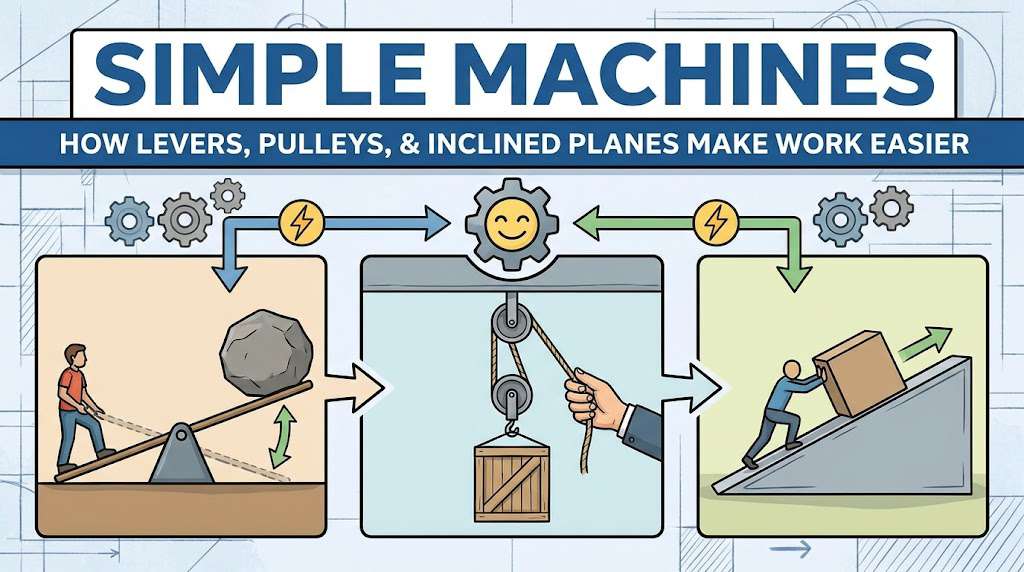
A lever consists of a rigid bar that pivots around a fixed point called a fulcrum. By applying force to one end of the lever, a much larger force can be exerted at the other end, allowing heavy objects to be lifted or moved with relatively little effort. This is the principle behind a simple seesaw, a pair of scissors, a wheelbarrow, and a crowbar used to prise open a stuck lid.
The position of the fulcrum relative to the input and output forces determines how much mechanical advantage a lever provides. Moving the fulcrum closer to the load being lifted increases the mechanical advantage, allowing a smaller input force to lift a much heavier load — though at the cost of having to move the input end of the lever a greater distance.
The Pulley
A pulley consists of a wheel with a groove around its edge, over which a rope or cable runs. A single fixed pulley, such as one mounted at the top of a flagpole, does not reduce the amount of force needed to lift an object, but it does change the direction of the force, allowing someone to pull downward in order to lift something upward — often a far more convenient and comfortable motion.
When multiple pulleys are combined into a system, known as a block and tackle, the arrangement can significantly reduce the force required to lift a heavy object, by spreading the load across multiple supporting rope sections. This principle is widely used in construction cranes, lifts, and sailing ship rigging, allowing enormous loads to be raised using comparatively modest effort.
The Wheel and Axle
A wheel and axle consists of a large wheel attached to a smaller cylindrical axle, both rotating together around the same central point. Applying force to turn the large wheel results in a much greater force being generated at the smaller axle, since the wheel travels a much greater distance with each rotation than the axle does.
This principle is at work in a doorknob, where turning the relatively large knob generates enough force to rotate the much smaller, stiffer spindle inside the door's lock mechanism, and in a car's steering wheel, which allows a driver to turn the front wheels using relatively little effort, despite the greater force required at the axle itself.
The Inclined Plane
An inclined plane is simply a flat surface set at an angle, such as a ramp. While it requires less force to push or roll an object up a ramp than to lift it straight up, the object must travel a much greater distance along the slope to reach the same height — a clear illustration of the trade-off between force and distance.
Ramps have been used since ancient times to move heavy loads, and remain essential today in contexts ranging from wheelchair access ramps, which allow people to move between different heights without lifting any weight at all, to loading ramps used to move heavy cargo onto trucks and ships.
The Wedge
A wedge is essentially a pair of inclined planes joined back to back, forming a thin edge that tapers to a point. Wedges convert a force applied to the broad end into a much larger force concentrated and directed outward through the thin edges, making them ideal for splitting, cutting, or piercing materials.
An axe head, a knife blade, a chisel, and even the front of a ship's hull, which is shaped to split water efficiently as it moves forward, are all practical applications of the wedge.
The Screw
A screw is, in essence, an inclined plane wrapped around a central cylinder, forming a continuous spiral ridge known as a thread. As a screw is turned, this spiral motion converts rotational force into a powerful linear force, allowing it to be driven steadily into materials such as wood, generating far more force along its length than could be achieved by pushing the same screw directly with the same effort.
This same spiral principle is used in jar lids, in the giant screw mechanisms of some bridges and lifting jacks, and even in the Archimedes screw, an ancient device still used today to lift water from a lower level to a higher one.
Compound Machines
While the six simple machines are each useful on their own, most real-world tools and devices combine several simple machines together to form a compound machine. A pair of scissors, for example, combines two levers with two wedges (the cutting blades). A bicycle combines wheels and axles, levers (the pedals), and gears. Even something as complex as a car engine is, at its core, an elaborate combination of these same fundamental simple machines, working together to convert one form of motion or energy into another.
Why Simple Machines Still Matter
Although modern engineering has produced extraordinarily complex technology, simple machines remain just as relevant today as they were thousands of years ago. Understanding them provides essential insight into how mechanical advantage works, why certain tools are designed the way they are, and how engineers continue to apply these same basic principles when designing everything from surgical instruments to space launch systems.
Conclusion
From the ramps used to build ancient pyramids to the pulleys used on modern construction sites, simple machines represent some of humanity's earliest and most enduring engineering achievements. Though they may seem basic compared to today's advanced technology, the lever, pulley, wheel and axle, inclined plane, wedge, and screw remain the fundamental building blocks of mechanical engineering — a powerful reminder that some of the most important scientific principles are also the simplest.