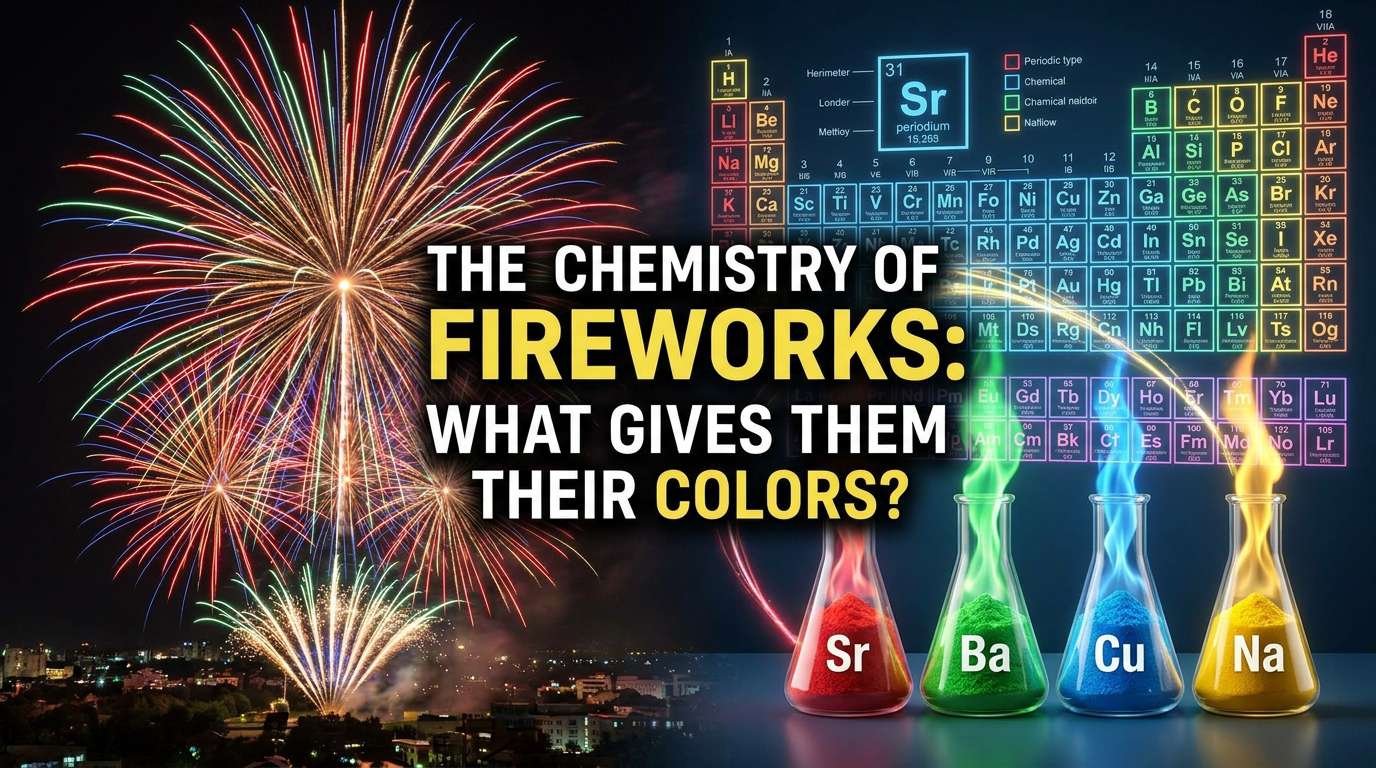
The Chemistry of Fireworks: What Gives Them Their Colors?
Introduction
A firework display looks like pure spectacle — bursts of red, gold, green, and blue blooming across the night sky. But every one of those colours is the direct, visible result of chemistry happening in real time, thousands of feet above the ground. There is no coloured smoke, no dye, no paint involved at all. The colour you see is light being released directly from excited atoms as they return to their normal state.
Long before anyone understood electron energy levels, pyrotechnicians in ancient China had already discovered, through centuries of trial and error, that certain minerals reliably turned flames different colours.1 Modern chemistry now explains exactly why.
Inside a Firework: The Basic Components
Every firework "star" — the small, pea-sized pellet responsible for a single burst of colour — is built from four key ingredients:2
- An oxidizer — commonly potassium nitrate (KNO₃) or potassium perchlorate (KClO₄) — which supplies the oxygen needed for rapid combustion.2
- A fuel — typically charcoal (carbon) and sulfur — which burns rapidly, releasing the heat energy that powers the whole reaction.2
- A binder — usually a substance called dextrin — which holds the mixture together in a solid pellet.1
- A colour-producing metal salt — the ingredient directly responsible for the colour you actually see in the sky.2
Hundreds of these small stars are packed around a central burst charge inside a firework shell. When the burst charge detonates in the air, it scatters the burning stars outward, creating the familiar expanding sphere of light.1
The Real Source of Colour: Excited Electrons
When a firework ignites, the rapid combustion of its fuel and oxidizer generates extremely high temperatures — typically between 1,700°C and 2,000°C.3 This intense heat energy is absorbed by the electrons within the metal atoms contained in the colour-producing salts, causing them to jump from their normal, lowest-energy "ground state" up to a higher-energy "excited state."4
This excited state is inherently unstable, and the electrons almost immediately fall back down to their original, lower energy level.4 As they fall, they release the exact amount of energy they had absorbed — but now as a photon of light.4 The wavelength, and therefore the colour, of that photon depends entirely on the specific energy gap between the electron's excited state and its ground state — a gap that is different for every element.4
This means the vivid colour you see in a firework display is not the colour of anything burning — it is light emitted directly by excited metal atoms as their electrons return home.5
Which Metals Produce Which Colours
Because each metal's electrons have a unique set of energy levels, each metal produces its own distinctive, characteristic colour when excited:
- Red: Strontium salts, such as strontium carbonate or strontium nitrate, are the classic source of red fireworks; lithium salts can also produce red.6
- Orange: Calcium salts, such as calcium chloride, produce warm orange tones.6
- Yellow: Sodium salts produce an intense, easily recognisable yellow, with a strong emission near 589 nanometres.7
- Green: Barium salts, such as barium chloride or barium nitrate, produce bright green light.6
- Blue: Copper compounds, such as copper chloride, produce blue light.6
- Purple: Achieved by combining copper and strontium compounds, producing a blend that appears purple or lavender.8
- White/Silver sparks: Metallic elements like magnesium, titanium, and aluminium burn with brilliant white or silver light, often used for sparkle and brightness rather than colour.8
Why Blue Fireworks Are So Difficult to Create
Among all firework colours, blue is widely considered the most difficult and expensive to produce reliably.9 The copper compounds responsible for blue light are chemically delicate, and can break down or decompose if the flame burns too hot, disrupting the precise conditions needed to produce a clean blue emission.7 Achieving a genuinely vivid, stable blue requires carefully controlling both the exact copper compound used and the burning temperature of the star — a balance that pyrotechnic chemists still consider one of the field's greatest challenges.9
Why Metal Chlorides Specifically Are Used
Many modern fireworks rely specifically on metal chlorides — barium chloride for green, strontium chloride for red, and copper chloride for blue — because these compounds fluoresce especially strongly in visible wavelengths.10 However, many of these metal chloride compounds are highly attracted to water (hygroscopic), which would make a pre-mixed firework composition damp, unstable, and difficult to ignite reliably.10 To solve this, manufacturers often keep the metal compound and the chlorine-donating compound separate until the moment of ignition; the two combine as a vapour during combustion, at which point their electrons are excited and the colourful light emission occurs.10
Flame Colour as a Chemical Fingerprint
This same principle — that excited electrons in different metals release light of different, characteristic colours — is the basis of the flame test, a standard laboratory technique used to identify unknown metal ions by observing the colour a sample produces when held in a flame.11 Because each element's emission pattern acts as a kind of chemical fingerprint, scientists use the very same principle far beyond fireworks — including analysing the composition of rocks on Mars using their characteristic spectral emissions.11
Fireworks Chemistry and WAEC/JAMB Chemistry
- Electron energy levels: Explaining how electrons absorb energy to move to a higher (excited) state, and release energy as light when returning to the ground state.
- Flame tests: Identifying metal ions based on the characteristic colour they produce in a flame — a direct practical application of the same chemistry behind fireworks.
- Oxidation and combustion: Understanding the role of an oxidizer in supplying oxygen for rapid combustion reactions.
- Metal salts and ionic compounds: Recognising common metal salts (such as strontium carbonate, sodium nitrate, and copper chloride) and their properties.
- Energy and light: Connecting the relationship between energy released and the wavelength (colour) of light emitted, an important link between chemistry and physics.
Common Mistakes Students Make
- Thinking firework colours come from coloured powder or dye. The visible colour comes from light emitted by excited metal ions, not from any pigment or dye in the mixture.7
- Assuming a hotter flame always produces a brighter blue. Copper compounds responsible for blue can actually decompose and lose their colour if the flame is too hot.7
- Confusing sodium and strontium. Sodium salts give a strong yellow emission, while strontium salts are responsible for red — these are frequently mixed up.7
- Forgetting the role of the oxidizer. Without an oxidizer supplying oxygen, the fuel inside a firework star could not burn fast enough to sustain the reaction.7
Conclusion
Every burst of colour in a firework display is a live demonstration of atomic physics and chemistry, playing out on a spectacular scale. Metal salts, carefully chosen for their unique electron structures, are heated until their electrons leap to an excited state — and as those electrons fall back down, they release exactly the wavelength of light that paints the sky red, green, gold, or blue.
The same principle chemists use to identify unknown elements in a laboratory flame test, or even to analyse the surface of Mars, is the very same principle lighting up the sky on New Year's Eve. Fireworks are, quite literally, chemistry you can watch from a mile away.