The Electromagnetic Spectrum: From Radio Waves to Gamma Rays
Introduction
Right now, invisible waves are passing through the room around you. Radio broadcasts, mobile phone signals, Wi-Fi data, and even faint traces of radiation left over from the birth of the universe itself are streaming through the air, through walls, and through your own body — completely undetected by your senses. These are all examples of electromagnetic radiation, and together they make up what scientists call the electromagnetic spectrum.
The visible light that allows us to see the world around us is, remarkably, only a tiny sliver of this much larger spectrum. Beyond what our eyes can detect lies an enormous range of radiation — from the long, gentle waves used in radio broadcasting, to the extraordinarily high-energy gamma rays produced by the most violent events in the universe. Despite their vastly different properties and uses, all of these forms of radiation share the same fundamental nature.
What Is Electromagnetic Radiation?
Electromagnetic radiation consists of waves made up of oscillating electric and magnetic fields, travelling together through space at a constant speed: the speed of light, approximately three hundred million metres per second in a vacuum. Unlike sound waves, electromagnetic waves do not require a medium to travel through — they can move through the vacuum of space, which is how sunlight is able to reach the Earth across ninety-three million miles of empty space.
Every type of electromagnetic radiation is fundamentally the same phenomenon, differing only in wavelength (the distance between successive wave peaks) and frequency (the number of wave cycles passing a point each second). These two properties are inversely related: as wavelength increases, frequency decreases, and vice versa. Frequency is also directly related to energy — higher-frequency waves carry more energy than lower-frequency ones.
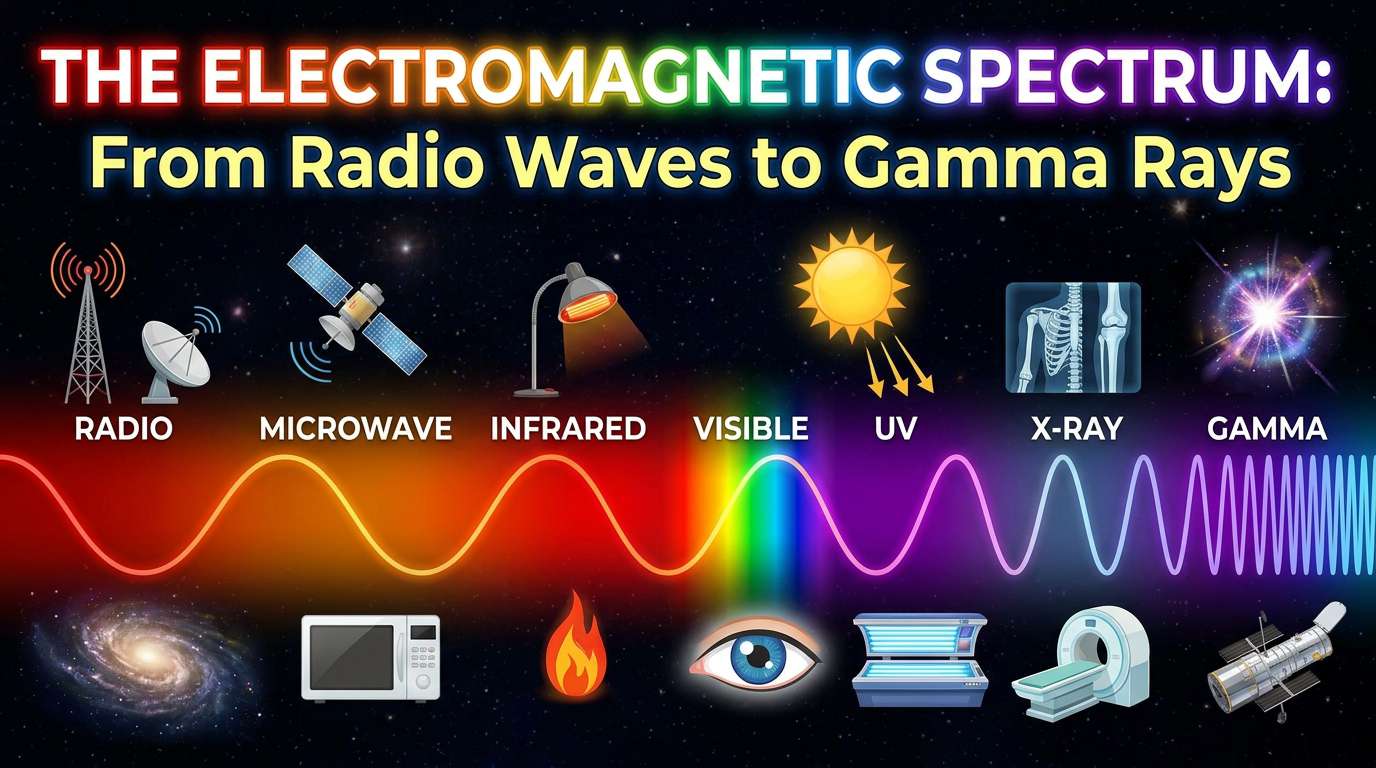
Arranged in order from longest wavelength and lowest frequency to shortest wavelength and highest frequency, the electromagnetic spectrum consists of seven main regions: radio waves, microwaves, infrared radiation, visible light, ultraviolet radiation, X-rays, and gamma rays.
Radio Waves
Radio waves have the longest wavelengths in the electromagnetic spectrum, ranging from about one millimetre to many kilometres in length, and correspondingly the lowest energy. Despite carrying relatively little energy, radio waves are extraordinarily useful for communication, since their long wavelengths allow them to travel great distances and pass around obstacles such as buildings and hills.
Radio waves are used to broadcast television and radio signals, to enable mobile phone networks and Wi-Fi connections, and even by astronomers, who use giant radio telescopes to detect faint radio emissions from distant galaxies, pulsars, and other cosmic objects.
Microwaves
Microwaves have shorter wavelengths than radio waves, typically ranging from about one millimetre to thirty centimetres. They are widely used in telecommunications, including satellite communication and radar systems, which use reflected microwave pulses to detect the position and speed of distant objects, such as aircraft or weather systems.
Microwaves are also famously used in microwave ovens, which exploit the fact that water molecules absorb microwave radiation particularly effectively, causing them to vibrate rapidly and generate heat — efficiently cooking food from within.
Infrared Radiation
Infrared radiation lies just beyond the red end of the visible spectrum, with wavelengths slightly longer than those of visible light. All objects with a temperature above absolute zero emit some infrared radiation, with warmer objects emitting more intensely — which is why infrared cameras can be used to create thermal images, detecting the heat given off by people, animals, and machinery even in complete darkness.
Infrared radiation is also responsible for much of the warmth we feel from sunlight and from sources such as electric heaters, and is used in remote controls, fibre-optic communication, and night-vision equipment.
Visible Light
Visible light occupies an extremely narrow band within the electromagnetic spectrum — roughly between four hundred and seven hundred nanometres in wavelength — yet it is the only part of the spectrum that human eyes can directly detect. Within this narrow range, different wavelengths correspond to the different colours we perceive: longer wavelengths appear red, while shorter wavelengths appear violet, with orange, yellow, green, and blue falling in between.
White light, such as sunlight, is in fact a combination of all these wavelengths travelling together, which is why a glass prism — or natural raindrops, forming a rainbow — can split white light into its full spectrum of colours by bending each wavelength by a slightly different amount.
Ultraviolet Radiation
Just beyond violet light lies ultraviolet (UV) radiation, with shorter wavelengths and higher energy than visible light. The Sun is a major source of ultraviolet radiation, and while moderate exposure helps the human body produce vitamin D, excessive exposure can damage skin cells and DNA, leading to sunburn, premature ageing, and an increased risk of skin cancer — which is why sunscreen and protective clothing are recommended during prolonged sun exposure.
Ultraviolet radiation is also used in technologies such as sterilisation equipment, where its energy is sufficient to kill bacteria and viruses, and in certain types of security markings, such as those used in banknotes, which glow visibly under UV light.
X-rays
X-rays carry significantly more energy than ultraviolet radiation, with wavelengths short enough to pass through soft tissue while being absorbed by denser materials such as bone. This property makes X-rays extremely valuable in medicine, allowing doctors to capture images of bones and detect fractures, dental problems, and other internal conditions without the need for invasive surgery.
Because of their high energy, X-rays can damage living cells with prolonged or excessive exposure, which is why medical X-ray procedures are carefully limited and why radiographers stand behind protective shielding when operating X-ray equipment.
Gamma Rays
At the extreme high-energy end of the electromagnetic spectrum lie gamma rays, with the shortest wavelengths and the highest frequencies and energy of any form of electromagnetic radiation. Gamma rays are produced by some of the most energetic processes in the universe, including nuclear reactions, radioactive decay, and cataclysmic cosmic events such as supernova explosions.
Due to their extremely high energy, gamma rays can penetrate deeply into materials and cause significant damage to living cells, making exposure potentially very dangerous. However, this same destructive power is harnessed carefully in medicine, where controlled doses of gamma radiation are used in radiotherapy to target and destroy cancerous cells.
Why the Spectrum Matters
The electromagnetic spectrum is not simply a scientific curiosity — it underpins an enormous range of technologies that shape modern life. Communication systems, medical imaging and treatment, cooking appliances, astronomy, security systems, and countless other technologies all rely on harnessing different parts of this single, unified spectrum.
Astronomers, in particular, rely heavily on observing the universe across the full electromagnetic spectrum, since visible light alone reveals only a small part of the picture. Telescopes designed to detect radio waves, infrared radiation, X-rays, and gamma rays have revealed phenomena entirely invisible to the human eye, from the afterglow of the Big Bang to the violent regions surrounding black holes.
Conclusion
From the radio waves carrying your favourite song to the gamma rays bursting forth from distant exploding stars, the electromagnetic spectrum reveals a vast and largely invisible universe of energy surrounding us at all times. Though visible light is the only part of this spectrum our eyes can perceive, every other region plays an essential role in science, medicine, and technology — proof that some of the most important forces shaping our world remain completely hidden from view.