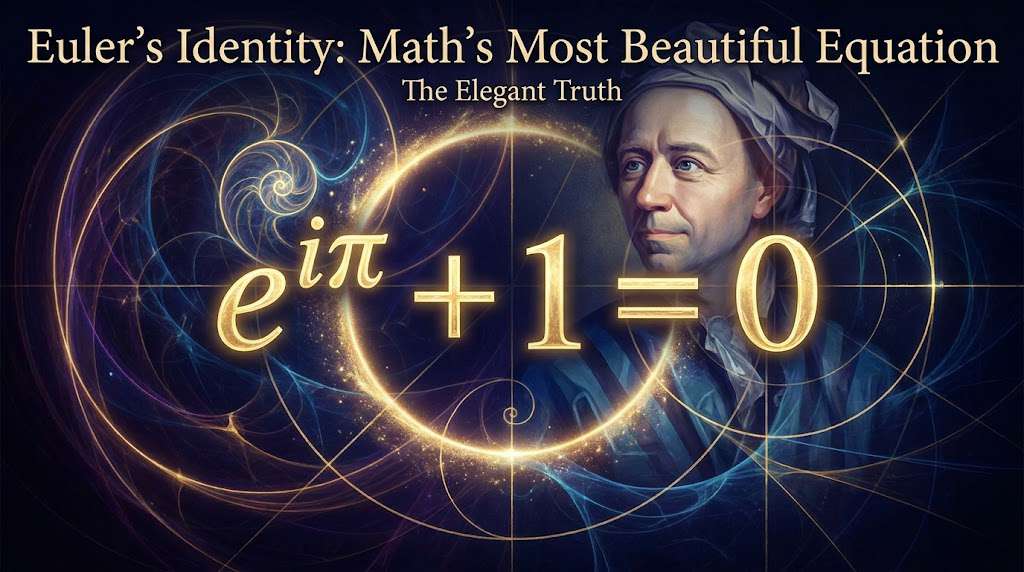
The Elegant Truth Behind Euler's Identity: Mathematics' Most Beautiful Equation
Introduction
In 1988, a mathematical journal asked its readers to vote for the most beautiful theorem in mathematics. The winner, by a considerable margin, was a single equation so compact it fits on a t-shirt, yet so profound that Richard Feynman — one of the greatest physicists of the twentieth century — called it "the most remarkable formula in mathematics."
The equation is this:
eiπ + 1 = 0
It is known as Euler's Identity, named after the Swiss mathematician Leonhard Euler, and it has been inspiring awe, wonder, and deep reflection for nearly three centuries. Mathematicians who encounter it for the first time often describe something close to an emotional response — a sense that they have glimpsed something true and beautiful at the very heart of mathematics.
But why? What makes this particular arrangement of five symbols so extraordinary? And what does it actually mean? This article will take you on a journey through the five remarkable numbers that make up Euler's Identity, explain how they connect, and reveal why this single equation tells us something profound about the hidden unity of mathematics.
The Five Numbers in Euler's Identity
What makes Euler's Identity so celebrated is that it unites five of the most fundamental and important constants in all of mathematics — numbers that arise independently in completely different areas of the subject, yet turn out to be bound together by a single elegant relationship.
1. The Number 0 — The Additive Identity
Zero is the additive identity: add it to any number and that number is unchanged. As we explored in our article on mathematical history, zero was one of humanity's most revolutionary mathematical inventions, taking thousands of years to be accepted as a number in its own right. It is the foundation of our positional number system and the origin point of the number line. Without zero, arithmetic, algebra, and calculus as we know them would be impossible.
2. The Number 1 — The Multiplicative Identity
One is the multiplicative identity: multiply any number by it and that number is unchanged. It is the most fundamental of the counting numbers, the unit from which all other whole numbers are built by repeated addition. In a deep mathematical sense, 1 is where counting begins and where number theory is rooted.
3. Pi (π) — The Circle Constant
Pi is perhaps the most famous mathematical constant of all. It is the ratio of a circle's circumference to its diameter — approximately 3.14159 — and its decimal expansion continues forever without repeating, making it an irrational number. Pi appears wherever circles, curves, and cycles appear in mathematics and physics:
- The area of a circle: A = πr²
- The circumference of a circle: C = 2πr
- The volume of a sphere: V = (4/3)πr³
- Wave equations describing light, sound, and quantum mechanics.
- The normal distribution in statistics — the famous bell curve.
- The solution to the Basel Problem: 1 + 1/4 + 1/9 + 1/16 + ... = π²/6
Pi turns up in contexts that have nothing obviously to do with circles, which hints at something deep about the structure of mathematics. Whenever there is periodicity, symmetry, or rotation in a mathematical problem, pi tends to appear.
4. The Number e — The Base of Natural Growth
The number e is approximately 2.71828, and like pi, its decimal expansion continues forever without repeating — it too is irrational, and in fact belongs to an even rarer class called transcendental numbers, meaning it cannot be the solution to any polynomial equation with rational coefficients.
The number e arises naturally whenever something grows or decays continuously:
- Compound interest calculated continuously: A = Pert
- Radioactive decay: N(t) = N₀e−λt
- Population growth models.
- The cooling of objects over time.
- The spread of diseases through populations.
- The charging and discharging of electrical capacitors.
The number e also has a remarkable property that makes it uniquely important in calculus: the function ex is its own derivative. This means the rate of change of ex at any point is equal to its value at that point — a property no other base shares. This makes e the natural base for exponential functions in calculus and physics.
One beautiful way to define e is as the limit:
e = lim(n→∞) (1 + 1/n)n
This formula describes what happens to compound interest as the compounding period becomes infinitely short — continuous compounding. The result is always the same magical number: e.
5. The Imaginary Unit i — The Square Root of −1
Of the five numbers in Euler's Identity, i is perhaps the most mysterious. It is defined as the square root of negative one:
i = √(−1)
For centuries, mathematicians encountered expressions involving the square root of negative numbers and dismissed them as meaningless — after all, no real number multiplied by itself gives a negative result. The term "imaginary number" was originally coined as an insult by the philosopher René Descartes, who considered such numbers to be fictitious and useless.
He was profoundly wrong. Imaginary numbers, and the broader system of complex numbers that includes both real and imaginary parts, turned out to be essential tools in mathematics, physics, and engineering:
- Electrical engineering: Alternating current circuits are analysed using complex numbers. The impedance of a circuit — how it resists alternating current — is a complex number.
- Quantum mechanics: The fundamental equation of quantum mechanics — the Schrödinger equation — is written in terms of complex numbers. The wave functions that describe particles are complex-valued.
- Signal processing: The Fourier Transform, which breaks any signal into its component frequencies, uses complex numbers. It underpins digital audio, image compression, and telecommunications.
- Fluid dynamics: Complex number methods simplify the mathematics of fluid flow around objects — essential for aeronautical engineering.
- Control theory: Engineers designing control systems for aircraft, robots, and chemical plants use complex number analysis to ensure stability.
The "imaginary" numbers that once seemed like mathematical fiction turned out to be indispensable tools for describing physical reality.
Understanding Euler's Formula
Euler's Identity is a special case of a more general result known as Euler's Formula:
eiθ = cos(θ) + i·sin(θ)
This formula tells us something extraordinary: raising e to an imaginary power produces a combination of cosine and sine — the two fundamental trigonometric functions. To understand why this is remarkable, we need to understand what it means geometrically.
The Complex Plane
Complex numbers are represented on a two-dimensional plane called the complex plane or Argand diagram. The horizontal axis represents the real part of a complex number; the vertical axis represents the imaginary part. Every complex number corresponds to a unique point on this plane.
On the complex plane, the number eiθ traces out a circle of radius 1 centred at the origin as θ varies. When θ = 0, we are at the point (1, 0) — the number 1 on the real axis. As θ increases, the point moves counterclockwise around the unit circle.
The cosine of θ gives the horizontal (real) position on the unit circle. The sine of θ gives the vertical (imaginary) position. So eiθ = cos(θ) + i·sin(θ) is simply saying: the point at angle θ on the unit circle has real part cos(θ) and imaginary part sin(θ).
How Euler's Identity Emerges
Now substitute θ = π into Euler's Formula:
eiπ = cos(π) + i·sin(π)
We know that cos(π) = −1 and sin(π) = 0. Therefore:
eiπ = −1 + i·(0) = −1
Adding 1 to both sides:
eiπ + 1 = 0
And there it is — Euler's Identity. What the formula is telling us, geometrically, is that starting at the number 1 on the complex plane and rotating by π radians (180 degrees) around the unit circle brings you to exactly −1. Adding 1 then brings you back to zero.
The most beautiful equation in mathematics is, at its geometric heart, a statement about rotation: rotate halfway around a circle, and you end up at the opposite point.
Why Mathematicians Call It Beautiful
Mathematical beauty is a real phenomenon, even if it is difficult to define precisely. Mathematicians speak of beautiful proofs, elegant solutions, and remarkable identities with genuine emotion — and there is growing evidence from neuroscience that the experience of mathematical beauty activates the same brain regions as the experience of beauty in art and music.
Euler's Identity is considered beautiful for several reasons:
Economy
The equation contains exactly five symbols — e, i, π, 1, and 0 — and three operations: exponentiation, addition, and equality. Nothing is redundant. Nothing could be removed without destroying the statement. This extreme economy of expression, conveying a profound truth in the minimum possible space, is a hallmark of mathematical elegance.
Unexpectedness
The five numbers in Euler's Identity come from completely different areas of mathematics. Zero and one are the foundations of arithmetic. Pi comes from geometry. e comes from calculus and the mathematics of growth. i comes from algebra and the extension of the number system. That five numbers from five different mathematical worlds should be connected by a single simple equation is profoundly surprising.
As the mathematician Benjamin Peirce said after deriving the identity for his students at Harvard: "Gentlemen, that is surely true, it is absolutely paradoxical; we cannot understand it, and we don't know what it means. But we have proved it, and therefore we know it must be the truth."
Depth
Euler's Identity is not a curiosity or a coincidence. It is a window into deep mathematical structure. It reveals that complex exponentials, trigonometric functions, and the geometry of the circle are not separate mathematical ideas — they are different views of the same underlying reality. Euler's Formula unifies them completely.
Consequence
Beautiful mathematics tends to be useful mathematics. Euler's Formula — of which the Identity is a special case — is one of the most applied results in all of mathematics. It is used daily by engineers, physicists, and computer scientists around the world.
Who Was Leonhard Euler?
Leonhard Euler (1707–1783) was a Swiss mathematician and physicist who is widely regarded as the most prolific mathematician in history. He published over 800 papers and books across almost every area of mathematics known in his time, and his collected works fill more than 90 volumes.
Euler worked in St Petersburg and Berlin and made foundational contributions to:
- Graph theory — solving the Seven Bridges of Königsberg problem (the subject of another article in this series).
- Number theory — including major work on prime numbers and what is now called the Euler totient function.
- Calculus and analysis — developing and systematising much of the notation we still use today, including the function notation f(x) and the use of Σ for summation.
- Mechanics and physics — equations describing fluid flow are still called the Euler equations.
- Topology — the Euler characteristic formula V − E + F = 2 for polyhedra.
Remarkably, Euler produced some of his most important work after going completely blind in 1771, dictating papers to assistants and performing complex calculations entirely in his head. His productivity actually increased after he lost his sight.
Euler was also responsible for standardising much of mathematical notation. The use of e for the base of natural logarithms, i for the imaginary unit, π for the circle constant, and f(x) for functions all come from Euler. In a very real sense, he shaped not just the content of modern mathematics but the language in which it is written.
Deriving Euler's Formula: The Power Series Approach
For students who want to see the mathematical reasoning behind Euler's Formula, the cleanest derivation uses power series — infinite polynomial expansions of functions that are studied in Further Mathematics.
The exponential function ex can be written as:
ex = 1 + x + x²/2! + x³/3! + x⁴/4! + x⁵/5! + ...
The cosine function can be written as:
cos(x) = 1 − x²/2! + x⁴/4! − x⁶/6! + ...
The sine function can be written as:
sin(x) = x − x³/3! + x⁵/5! − x⁷/7! + ...
Now substitute x = iθ into the exponential series, using the fact that i² = −1, i³ = −i, i⁴ = 1, and the pattern repeats:
eiθ = 1 + iθ + (iθ)²/2! + (iθ)³/3! + (iθ)⁴/4! + ...
= 1 + iθ − θ²/2! − iθ³/3! + θ⁴/4! + iθ⁵/5! − ...
Collecting real and imaginary terms separately:
= (1 − θ²/2! + θ⁴/4! − ...) + i(θ − θ³/3! + θ⁵/5! − ...)
= cos(θ) + i·sin(θ)
And there is Euler's Formula — emerging naturally from the algebra of power series, with no tricks and no hand-waving. The connection between exponentials and trigonometry is not imposed from outside; it flows inevitably from the mathematics itself.
Applications of Euler's Formula in the Real World
Electrical Engineering
Engineers analysing alternating current circuits use Euler's Formula constantly. A sinusoidal voltage — one that oscillates like a sine wave — can be represented as the real part of a complex exponential: V = Re(Veiωt). This makes the mathematics of circuit analysis far simpler, turning differential equations into algebraic ones.
Signal Processing and Digital Audio
The Fourier Transform — which decomposes any signal into its component frequencies — is built on Euler's Formula. When you stream music, your device uses the Fast Fourier Transform (an algorithm based on Euler's Formula) to compress and decompress audio data. Every MP3 file, every phone call, every digital broadcast involves Euler's mathematics.
Quantum Mechanics
The wave functions of quantum mechanics are complex exponentials. The behaviour of electrons, photons, and all subatomic particles is described using Euler's Formula. Without it, modern physics — and therefore all the technology it has produced, from transistors to lasers to MRI machines — would be impossible.
Computer Graphics
Rotations in two-dimensional computer graphics are performed by multiplying complex numbers — an operation that uses Euler's Formula implicitly. In three dimensions, a generalisation called quaternions (related to complex numbers) is used to rotate objects in video games, animations, and simulations.
Euler's Identity and WAEC/JAMB Mathematics
While Euler's Identity itself is beyond the standard WAEC and JAMB syllabus, the concepts that surround and support it appear throughout your mathematics curriculum:
- Trigonometry: Sine, cosine, and their properties are core WAEC and JAMB topics. Understanding that these functions describe circular motion deepens your intuition for all trigonometric identities.
- Surds and irrational numbers: Both e and π are irrational — understanding what this means connects to standard syllabus content on surds and number classification.
- Indices and exponentials: The laws of indices that govern expressions like ex are examined directly in both WAEC and JAMB.
- Series and sequences: The power series derivation of Euler's Formula connects to geometric progressions and the concept of infinite series in Further Mathematics.
- Complex numbers: Introduced in Further Mathematics at WAEC level, complex numbers and the Argand diagram are directly connected to the geometric interpretation of Euler's Formula.
Common Misconceptions About Euler's Identity
- "It is just a coincidence." Euler's Identity is not a numerical accident — it follows necessarily and inevitably from the deep mathematical relationship between exponential functions and trigonometry. It could not be otherwise.
- "Only mathematicians care about it." Engineers, physicists, computer scientists, and signal processors use Euler's Formula as a daily working tool. Its applications are concrete and ubiquitous.
- "Beauty in mathematics is subjective." While aesthetic judgements always have a subjective element, the beauty of Euler's Identity — its economy, unexpectedness, depth, and consequence — is recognised so consistently across cultures and centuries that it points to something more than personal taste.
- "i is not a real number so Euler's Identity is not really true." Imaginary numbers are as mathematically rigorous as real numbers. The word "imaginary" is a historical accident, not a description of their mathematical status. Euler's Identity is proved with the same rigour as any other mathematical theorem.
Conclusion
Five numbers. Three operations. One equation. And hidden within it, the deepest connections in mathematics — between growth and rotation, between algebra and geometry, between the discrete world of counting numbers and the continuous world of curves and cycles.
Euler's Identity is beautiful not because it has been declared beautiful by authority, but because it reveals something true about the structure of mathematics that we did not expect to find. It tells us that e, i, π, 1, and 0 — numbers discovered in different centuries, by different mathematicians, for different reasons — are not strangers. They are part of the same family, connected at a level deeper than any of them individually suggests.
That is what mathematical beauty is: the shock of recognition when something that seemed complicated and separate turns out to be simple and unified. Euler's Identity delivers that shock more cleanly than almost anything else in mathematics.
The next time you see a circle, remember: hidden in its geometry are e and i and π, all whispering the same equation to each other. The universe is stranger and more elegant than it appears — and mathematics is the language in which it confesses.