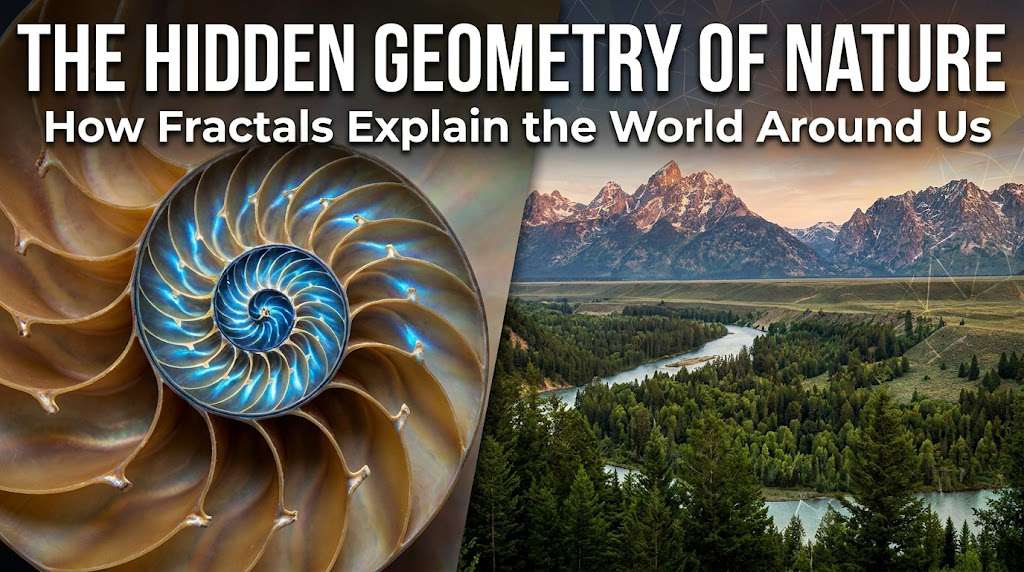
The Hidden Geometry of Nature: How Fractals Explain the World Around Us
Introduction
Look closely at a tree. Notice how the trunk splits into large branches, which split into smaller branches, which split into even smaller twigs, which split into tiny stems holding leaves. Now look at one of those leaves. Do you notice how its veins branch out in almost the same pattern as the tree itself?
This is not a coincidence. It is mathematics — a special kind called fractal geometry. For centuries, traditional geometry gave us tools to describe man-made objects: the straight lines of buildings, the perfect circles of wheels, the smooth curves of bridges. But nature does not build in straight lines. Nature is rough, jagged, branching, and endlessly complex. Fractals are the mathematical language that finally describes it.
Whether you are a secondary school student encountering the word for the first time or a curious reader who has always wondered why clouds look the way they do, this article will open your eyes to a hidden layer of mathematical beauty woven into the world around you.
What Is a Fractal?
A fractal is a pattern that repeats itself at different scales. No matter how closely you zoom in on a fractal, you keep seeing the same basic shape reappearing. Mathematicians call this property self-similarity.
The word "fractal" was coined in 1975 by the Polish-French mathematician Benoît Mandelbrot, from the Latin word fractus, meaning broken or fragmented. Mandelbrot spent years arguing that the rough, irregular shapes of nature were not mathematical chaos — they followed deep, precise rules that classical geometry had simply failed to notice.
Fractals have three key properties:
- Self-similarity: The same pattern appears at every level of magnification.
- Infinite complexity: You can zoom in forever and never reach a smooth, simple edge.
- Fractional dimensions: Fractals exist between the dimensions we are used to — they are more than a line but less than a flat surface, or more than a surface but less than a solid object.
A Brief History of Fractal Geometry
Although Mandelbrot gave fractals their name, the mathematical ideas behind them go back much further.
Early Mathematical Discoveries
In 1883, German mathematician Georg Cantor described what is now called the Cantor Set — a line divided into thirds, with the middle third removed, then each remaining segment divided again, the middle removed again, and so on infinitely. The result is a set of points that is neither a line nor a collection of isolated dots. It was one of the first hints that mathematics could describe something endlessly fragmented.
In 1904, Swedish mathematician Helge von Koch described the Koch Snowflake — a triangle whose sides are repeatedly broken into smaller triangles, producing a shape with an infinitely long perimeter enclosing a finite area. This was deeply puzzling to mathematicians of the era.
Mandelbrot Changes Everything
Benoît Mandelbrot's breakthrough came in 1967 when he published a paper asking a deceptively simple question: How long is the coastline of Britain? His answer shocked the scientific world — it depends entirely on the scale of your measuring tool. The smaller your ruler, the longer the coastline becomes, as it captures more and more tiny inlets and bumps. Coastlines, he argued, are fractals. They have no single measurable length.
In 1982, Mandelbrot published The Fractal Geometry of Nature, a book that permanently changed how scientists, mathematicians, and artists understood the physical world.
Famous Fractals Explained
The Mandelbrot Set
The most famous fractal of all is named after Mandelbrot himself. The Mandelbrot Set is generated by a simple mathematical formula applied repeatedly to complex numbers. When plotted on a graph, it produces a shape of breathtaking complexity — a bulging central body surrounded by smaller bulges, each surrounded by even smaller ones, with spiraling tendrils of infinite detail extending from every edge.
What makes it extraordinary is that this endless complexity emerges from a single simple rule repeated millions of times. Modern computers allow us to zoom into the Mandelbrot Set and explore it like a landscape, revealing new structures at every level of magnification — forever.
The Koch Snowflake
Start with an equilateral triangle. Replace the middle third of each side with two sides of a smaller equilateral triangle. Repeat this process on every new edge. After just a few iterations, you have a shape that looks remarkably like a snowflake. After infinite iterations, you have a shape with:
- An infinitely long perimeter.
- A finite, bounded area.
- Perfect self-similarity at every scale.
This seems paradoxical — how can something have an infinite boundary enclosing a finite space? Yet this is exactly the kind of complexity that fractals make mathematically rigorous.
The Sierpiński Triangle
Take a triangle. Remove the central triangle formed by connecting the midpoints of each side. Repeat this process on the three remaining triangles. Continue forever. What remains is the Sierpiński Triangle — a pattern of infinite holes within holes, endlessly self-similar.
Interestingly, the Sierpiński Triangle appears naturally in Pascal's Triangle when you shade all the odd numbers — a beautiful connection between two seemingly unrelated areas of mathematics.
Fractals in Nature
Once you know what to look for, fractals appear everywhere in the natural world.
Trees and Plants
As described at the start of this article, trees are natural fractals. The branching pattern of a tree — trunk to branch to twig to stem — repeats at every scale. The same is true of:
- The veins inside a single leaf.
- The structure of a head of broccoli (especially Romanesco broccoli, which displays near-perfect fractal spirals).
- The root systems of plants beneath the ground.
- Fern leaves, where every smaller leaflet is a miniature version of the whole frond.
Coastlines and Rivers
As Mandelbrot discovered, coastlines are fractal. Zoom into any section of a jagged coastline on a map and it looks remarkably similar to the coastline as a whole. The same applies to river networks — main rivers branch into tributaries, which branch into smaller streams, which branch into tiny channels, in a self-similar pattern governed by gravity and erosion.
Clouds and Mountains
Clouds have no smooth edges. Their billowing, cauliflower-like surfaces repeat the same irregular texture at every scale — a fractal structure. Computer graphics artists use fractal algorithms to generate realistic-looking clouds and mountain ranges in films and video games, because Euclidean geometry cannot replicate nature's roughness, but fractal mathematics can.
Snowflakes
Every snowflake is a natural fractal. As ice crystals form, they grow outward in branching structures, with smaller branches forming on each branch, and smaller ones on those. The exact pattern depends on the precise temperature and humidity the snowflake encounters during its fall — which is why no two snowflakes are ever identical, yet all share the same six-fold fractal symmetry.
Lightning and River Deltas
The forked path of a lightning bolt through the sky follows a fractal branching pattern, as electrical discharge seeks the path of least resistance through air. River deltas — where rivers meet the sea and fan out into many channels — display the same fractal branching from the sky.
The Human Body
Perhaps the most astonishing place fractals appear is inside us. The human body uses fractal geometry for maximum efficiency:
- Lungs: Airways branch from the trachea into bronchi, then bronchioles, then alveoli — a fractal structure that packs a surface area the size of a tennis court into a space the size of two fists.
- Blood vessels: Arteries branch into smaller arteries, then arterioles, then capillaries, in a fractal network that reaches every cell in the body.
- The brain: The folded, wrinkled surface of the cerebral cortex maximises the area of grey matter that can fit inside the skull — a fractal folding strategy.
- The heart: Research has shown that healthy heartbeat rhythms have fractal patterns. When this fractal irregularity breaks down, it can signal heart disease.
The Mathematics Behind Fractals
Fractal Dimension
In everyday life, we think of dimension as whole numbers: a line is one-dimensional, a flat shape is two-dimensional, a solid object is three-dimensional. Fractals break this rule.
The fractal dimension of an object measures how completely it fills space. A perfectly smooth curve has a dimension of 1. A rough, jagged curve that almost fills a plane has a fractal dimension between 1 and 2. The coastline of Britain has a fractal dimension of approximately 1.25. The surface of a crumpled piece of paper has a fractal dimension between 2 and 3.
This might seem abstract, but fractal dimension is a precise, measurable quantity that tells us something real and useful about the roughness and complexity of natural objects.
Iteration: The Engine of Fractals
Most fractals are generated through iteration — applying the same rule or formula over and over again. The formula for the Mandelbrot Set, for instance, is:
z → z² + c
Where z and c are complex numbers. This simple formula, iterated millions of times for millions of starting values of c, produces the entire infinite complexity of the Mandelbrot Set. It is a profound demonstration that extreme complexity can emerge from extreme simplicity.
Fractals in Technology and Science
Computer Graphics and Film
Before fractal mathematics, computer-generated landscapes looked artificial and geometric. Fractal algorithms changed everything. Today, the mountains, clouds, oceans, and alien worlds in blockbuster films are generated using fractal geometry. The first major Hollywood use of fractals was in the 1982 film Star Trek II: The Wrath of Khan, where a fractal algorithm generated a realistic alien planet.
Antenna Design
Fractal shapes are now used to design mobile phone antennas. A fractal antenna can receive signals across a much wider range of frequencies than a traditional straight antenna, while taking up far less space — which is why modern smartphones can handle calls, Wi-Fi, Bluetooth, and GPS with a tiny internal antenna.
Medicine
Doctors use fractal analysis to study medical images and detect disease. Cancerous tumours, for example, have different fractal dimensions from healthy tissue — their edges are more irregular. Fractal analysis of retinal blood vessels can detect early signs of diabetes and cardiovascular disease before other symptoms appear.
Earthquake Prediction
The distribution of earthquake sizes follows a fractal pattern known as the Gutenberg-Richter Law. Understanding the fractal nature of fault lines and seismic activity helps scientists model earthquake risk and design safer buildings.
Financial Markets
Mandelbrot himself applied fractal mathematics to financial markets, arguing that stock price fluctuations are self-similar across different time scales — the pattern of price changes over a day looks statistically similar to changes over a month or a year. This insight led to more accurate models of financial risk.
Fractals in Art and Architecture
Long before mathematicians formalised the concept, artists and architects were intuitively using fractal principles.
- African architecture: Researchers have documented fractal patterns in traditional African villages, where the overall layout of a settlement mirrors the layout of individual compounds, which mirrors the layout of rooms within them — self-similarity at multiple scales.
- Gothic cathedrals: The repeating arches, spires, and decorative elements of Gothic architecture display fractal-like self-similarity, contributing to their sense of overwhelming complexity and grandeur.
- Japanese art: The famous woodblock print The Great Wave by Hokusai depicts waves with a fractal structure — large waves contain smaller waves with the same curved, foaming form.
- Jackson Pollock: Studies have found that the drip paintings of abstract expressionist Jackson Pollock contain fractal patterns, and that viewers find these paintings more aesthetically pleasing when their fractal dimension falls within the same range as natural landscapes.
How to Explore Fractals Yourself
You do not need advanced mathematics to start exploring fractals. Here are some ways to begin:
- Draw the Koch Snowflake: Start with a triangle, divide each side into thirds, and build a smaller triangle on the middle third. Repeat as many times as you can by hand. You will quickly see the snowflake shape emerge.
- Draw the Sierpiński Triangle: Draw a triangle, find the midpoints of each side, connect them, and shade the central triangle. Repeat on the three outer triangles.
- Use Pascal's Triangle: Write out Pascal's Triangle and shade all odd numbers. The Sierpiński Triangle will appear.
- Explore online tools: Free tools like GeoGebra and Desmos allow you to plot fractal curves and explore the Mandelbrot Set interactively.
- Look for fractals in nature: On your next walk, notice the branching patterns of trees, the edges of clouds, the shapes of leaves, and the courses of streams. You are now seeing the mathematics hidden in the world.
Fractals and WAEC/JAMB Mathematics
While fractals are not yet a formal topic in the WAEC or JAMB syllabus, the concepts that underlie them are deeply connected to topics you will encounter:
- Sequences and series: Fractal iteration is a form of infinite sequence. Understanding how patterns repeat connects directly to geometric progressions.
- Mensuration: The paradox of the Koch Snowflake — infinite perimeter, finite area — deepens your understanding of perimeter and area beyond simple formulas.
- Coordinate geometry: The Mandelbrot Set is plotted on the complex plane, building on the coordinate geometry principles in your syllabus.
- Problem-solving and reasoning: The habit of looking for patterns, testing rules, and thinking about infinity sharpens the mathematical thinking skills examiners reward.
Common Misconceptions About Fractals
- "Fractals are just computer art." While fractals produce beautiful images, they are rigorous mathematical objects with precise definitions and measurable properties.
- "Fractals only exist in mathematics." As this article shows, fractals are everywhere in the natural world — they are how nature solves engineering problems.
- "You need advanced mathematics to understand fractals." The core idea — a pattern that repeats at different scales — is accessible to anyone. The deeper mathematics can wait.
- "All repeating patterns are fractals." Wallpaper patterns repeat, but they are not fractals. True self-similarity requires the pattern to repeat across different scales of magnification, not just across space.
Conclusion
Geometry did not end with Euclid. For most of human history, we described the world using straight lines, perfect circles, and smooth surfaces — shapes that exist in textbooks but rarely in nature. Fractal geometry gave us the mathematical tools to describe the world as it actually is: rough, branching, irregular, and endlessly complex.
From the branching of your own lungs to the jagged edge of a coastline, from the design of your smartphone antenna to the generation of cinematic alien worlds, fractals are at work everywhere. They reveal that beneath the apparent disorder of nature lies deep mathematical order — and that one of the most powerful ideas in modern mathematics began with the simple observation that a tree looks like its branches, and its branches look like the tree.
The next time you see a cloud, a fern, or a bolt of lightning, you are not just seeing nature. You are seeing geometry — the hidden geometry of the world around you.