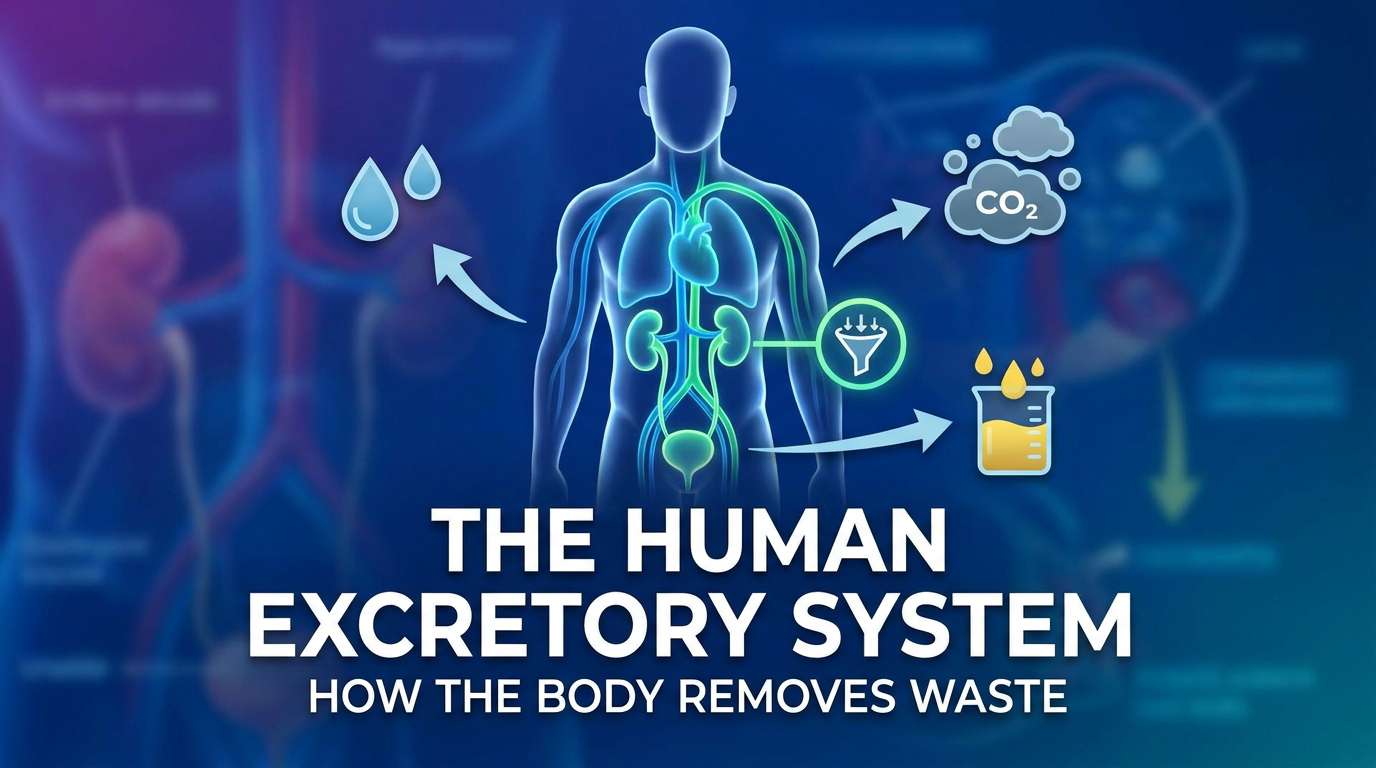
The Human Excretory System and How the Body Removes Waste
Introduction
Every process that keeps the body alive also produces waste. Cellular respiration produces carbon dioxide. The breakdown of excess proteins produces a toxic compound called urea. Metabolic reactions generate a variety of other by-products that, if allowed to accumulate, would poison the very cells that produced them.
The excretory system exists to solve this problem, continuously removing metabolic waste products from the body before they can build up to harmful levels. While several organs contribute to excretion, the kidneys perform the most extensive and precisely regulated work, filtering the entire volume of the body's blood many times over each day. This article explores excretion in detail — the organs involved, the structure and function of the kidney, and how this system maintains a stable internal environment.
What Is Excretion?
Excretion is the removal of metabolic waste products — substances produced by chemical reactions within the body's own cells — from the body. This is an important distinction from egestion, which refers to the removal of undigested food material (faeces) from the digestive system. Faeces are not a product of the body's internal metabolism; they are simply material that was never absorbed in the first place, which is why egestion is not considered a form of excretion.
The Main Excretory Organs
Several organs contribute to removing waste from the body, each specializing in different substances:
- Kidneys: Filter blood to remove urea, excess salts, and excess water, producing urine.
- Lungs: Remove carbon dioxide and some water vapour during exhalation, as covered in the article on the respiratory system.
- Skin: Removes water, salts, and small amounts of urea through sweat.
- Liver: Breaks down excess amino acids and toxic substances, converting ammonia into the less toxic urea, which the kidneys then remove from the blood.
While all of these organs play a role, the kidneys are generally considered the primary organs of excretion, given the sheer scale and precision of the filtering work they perform.
The Kidneys: Structure and Position
Humans have two kidneys, bean-shaped organs located toward the back of the abdominal cavity, roughly at waist level, one on either side of the spine. Each kidney receives blood through a renal artery and returns filtered blood to the body through a renal vein. Urine produced by the kidneys travels down a tube called the ureter to the bladder, where it is temporarily stored before being released from the body through the urethra.
Internal Structure of the Kidney
A cross-section of the kidney reveals three main regions:
- Cortex: The outer region, where much of the initial blood filtering takes place.
- Medulla: The inner region, involved in concentrating urine and reabsorbing water.
- Pelvis: The central, funnel-shaped cavity where urine collects before passing into the ureter.
The Nephron: The Functional Unit of the Kidney
Each kidney contains roughly a million tiny filtering units called nephrons. The nephron is to the kidney what the neuron is to the nervous system or the alveolus is to the lungs — the microscopic structural unit responsible for actually carrying out the organ's main function.
Structures Within a Nephron
- Glomerulus: A tightly coiled knot of capillaries where blood is initially filtered under pressure.
- Bowman's capsule: A cup-shaped structure surrounding the glomerulus, which collects the fluid filtered out of the blood.
- Proximal convoluted tubule: The section of the nephron where useful substances, including glucose, amino acids, and much of the water and salts, are reabsorbed back into the blood.
- Loop of Henle: A long, U-shaped section that plays a key role in further concentrating urine by reabsorbing additional water.
- Distal convoluted tubule: A further site of selective reabsorption and fine adjustment of the fluid's composition.
- Collecting duct: Carries the final urine from several nephrons toward the renal pelvis.
How Urine Is Formed: Three Key Stages
Stage 1: Filtration (Ultrafiltration)
Blood entering the glomerulus is under relatively high pressure, forcing water, glucose, amino acids, salts, and urea out of the blood and into the surrounding Bowman's capsule. This filtered fluid is often referred to as glomerular filtrate. Importantly, larger components of blood — red and white blood cells and large plasma proteins — are too big to pass through the filtering membrane and remain in the blood.
Stage 2: Reabsorption
As the filtrate travels through the proximal convoluted tubule, loop of Henle, and distal convoluted tubule, useful substances are selectively reabsorbed back into the surrounding blood capillaries. This includes essentially all of the filtered glucose (in a healthy individual), most amino acids, and a large proportion of the water and salts, since the body cannot afford to lose these valuable substances along with its waste.
Stage 3: Secretion and Final Adjustment
Additional waste substances and excess ions may be actively secreted from the surrounding blood into the tubule at various points, fine-tuning the final composition of the fluid. What remains after filtration, reabsorption, and secretion is urine — primarily water, urea, and various salts — which travels through the collecting duct to the renal pelvis and onward through the ureter to the bladder.
Why Glucose Should Not Normally Appear in Urine
In a healthy individual, virtually all glucose filtered into the nephron at the glomerulus is reabsorbed back into the blood at the proximal convoluted tubule, meaning healthy urine should contain no significant glucose. The presence of glucose in urine (glycosuria) is an important clinical sign, often associated with diabetes mellitus, in which unusually high blood glucose levels exceed the kidney's capacity to reabsorb it all, allowing some to remain in the urine.
The Role of the Kidneys in Osmoregulation
Beyond simply removing waste, the kidneys play a central role in osmoregulation — maintaining a stable balance of water and dissolved salts within the body's fluids. If a person drinks a large volume of water, the kidneys respond by reabsorbing less water in the nephron, producing a larger volume of more dilute urine. If a person becomes dehydrated, the kidneys respond by reabsorbing more water, producing a smaller volume of more concentrated urine.
This adjustment is controlled by a hormone called antidiuretic hormone (ADH), released by the pituitary gland. Higher ADH levels increase water reabsorption in the collecting duct, concentrating the urine; lower ADH levels decrease reabsorption, producing more dilute urine. This hormonal control links the excretory system closely to the endocrine system, illustrating how different body systems continuously coordinate to maintain a stable internal environment — a broader principle known as homeostasis.
The Liver's Role in Excretion
Although the liver is not, strictly speaking, an excretory organ itself, it performs essential preparatory work that makes excretion by the kidneys possible. When the body breaks down excess amino acids (from protein), it produces a highly toxic substance called ammonia. The liver converts this dangerous ammonia into urea, a far less toxic compound, through a process called deamination followed by the urea cycle. This urea then travels in the blood to the kidneys, where it is filtered out and excreted in urine.
The Skin as an Excretory Organ
The skin excretes waste primarily through sweat, produced by sweat glands located in the dermis. Sweat is composed mostly of water, along with small amounts of salts and urea. While sweating serves a primary role in cooling the body through the evaporation of water from the skin's surface, it does also contribute, to a smaller extent, to the removal of metabolic waste.
Common Disorders of the Excretory System
Kidney Stones
Kidney stones are hard deposits, often composed of crystallized salts and minerals, that form within the kidney. They can cause significant pain, especially if they block the flow of urine through the ureter, and in some cases require medical intervention to remove.
Kidney Failure
Kidney failure occurs when the kidneys lose the ability to filter blood effectively, allowing waste products and excess fluid to accumulate dangerously in the body. Depending on severity, treatment may involve dialysis — a medical procedure that artificially filters the blood outside the body — or, in severe cases, a kidney transplant.
Urinary Tract Infections (UTIs)
Urinary tract infections occur when bacteria enter and infect parts of the urinary system, such as the bladder or urethra, often causing pain, a frequent urge to urinate, and discomfort during urination.
How the Excretory System Connects to Other Body Systems
- Circulatory system: Delivers blood to the kidneys for filtering and carries reabsorbed substances back into general circulation.
- Endocrine system: Antidiuretic hormone (ADH) regulates the degree of water reabsorption in the kidneys.
- Digestive system: Excess amino acids from digested protein are ultimately broken down and excreted via the liver and kidneys.
The Excretory System and WAEC/NECO/JAMB Biology
Key examinable areas of this topic include:
- Labelled diagrams of the kidney and the nephron, correctly identifying all major structures.
- The three stages of urine formation: filtration, reabsorption, and secretion.
- Differences between excretion and egestion.
- The composition of urine and why substances like glucose should not normally be present.
- The role of the liver in converting ammonia to urea.
- Osmoregulation and the role of ADH in controlling water balance.
- The excretory functions of the skin and lungs, alongside the kidneys.
Common Mistakes Students Make
- Confusing excretion with egestion. Excretion removes metabolic waste produced within the body's own cells; egestion removes undigested food material that was never absorbed.
- Describing the glomerulus and Bowman's capsule as the same structure. The glomerulus is the capillary network; Bowman's capsule is the structure surrounding it that collects the filtrate.
- Stating that glucose is normally present in urine. In healthy individuals, glucose should be almost completely reabsorbed and therefore absent from urine.
- Assuming the liver excretes urea directly from the body. The liver only converts ammonia into urea; it is the kidneys that actually filter urea out of the blood and excrete it in urine.
- Forgetting the role of ADH when explaining how the body responds to dehydration or excess water intake.
Conclusion
The excretory system performs one of the body's quietest but most essential jobs, continuously filtering an enormous volume of blood, removing toxic waste products, and carefully balancing water and salt levels to keep the internal environment of the body stable. The nephron, though microscopic and easily overlooked, performs an extraordinarily precise three-stage process — filtering, reabsorbing, and secreting — millions of times over throughout a single day.
Understanding this system in depth reveals just how much careful, continuous regulation is required simply to keep the body's internal chemistry stable enough for every other system — nervous, circulatory, digestive — to keep functioning normally.