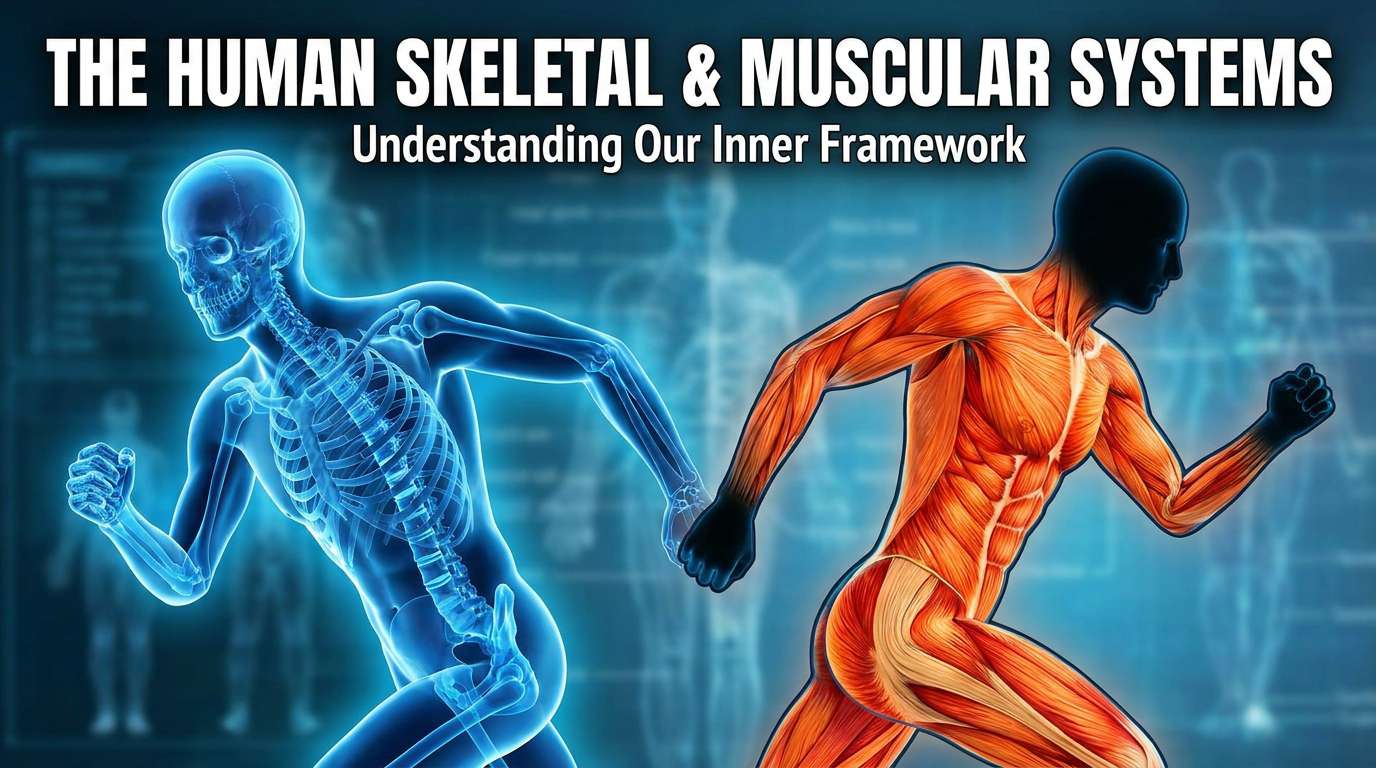
The Human Skeletal and Muscular Systems
Introduction
Stand up, walk across the room, and sit back down. This simple sequence of movements, performed without a second thought thousands of times each day, depends on an intricate partnership between two body systems working closely together: the skeletal system, which provides the rigid framework and points of attachment, and the muscular system, which provides the force needed to actually move that framework.
Neither system can produce movement alone. Bones, on their own, are simply rigid structures incapable of moving themselves. Muscles, on their own, have nothing firm to pull against. Only together, connected at specific points and working in carefully coordinated pairs, do bones and muscles produce the enormous range of movement the human body is capable of — from the powerful stride of a sprinter to the delicate precision of threading a needle.
The Skeletal System
Functions of the Skeleton
The human skeleton serves several essential functions beyond simply providing shape:
- Support: Provides a rigid internal framework that holds the body upright and gives it structure.
- Protection: Shields delicate internal organs — the skull protects the brain, the rib cage protects the heart and lungs.
- Movement: Provides fixed points of attachment for muscles, allowing coordinated movement when muscles contract.
- Blood cell production: Red bone marrow, found within certain bones, produces red blood cells, white blood cells, and platelets.
- Mineral storage: Bones store important minerals, particularly calcium and phosphorus, which can be released into the blood when needed elsewhere in the body.
Types of Bone
The human skeleton is broadly divided into two parts:
- Axial skeleton: Consisting of the skull, vertebral column (spine), and rib cage — the central supporting structure of the body.
- Appendicular skeleton: Consisting of the bones of the arms, legs, and the girdles (shoulder and hip) that connect them to the axial skeleton.
Bone Structure
Bone is a living tissue, not the dry, inert material it might sometimes appear to be. It consists of a hard, mineral-rich outer layer, providing strength and rigidity, surrounding a more flexible inner layer. Many bones contain bone marrow at their centre, a soft tissue responsible for producing new blood cells throughout life.
Joints: Where Bones Meet
A joint is any point where two or more bones meet. Joints allow varying degrees of movement between bones, depending on their specific structure.
Types of Joints
- Ball-and-socket joints (e.g. shoulder, hip) allow movement in almost every direction, including rotation, offering the greatest range of motion of any joint type.
- Hinge joints (e.g. elbow, knee) allow movement in one plane only, similar to a door hinge — typically bending and straightening.
- Pivot joints (e.g. between the first two vertebrae of the neck) allow rotational movement around a single axis, such as turning the head from side to side.
- Gliding joints (e.g. between small bones of the wrist and ankle) allow limited sliding movement between flat or slightly curved bone surfaces.
- Fixed (fibrous) joints (e.g. between the bones of the skull) allow no movement at all, firmly holding bones together for protection.
Structures Supporting Joint Movement
- Cartilage covers the ends of bones at many joints, providing a smooth surface that reduces friction between bones during movement.
- Synovial fluid lubricates certain joints (known as synovial joints), further reducing friction and allowing smoother movement.
- Ligaments are tough, fibrous bands connecting bone to bone, holding joints together and limiting excessive or unwanted movement.
- Tendons are tough, fibrous cords connecting muscle to bone, transmitting the force of muscle contraction to the bone it is attached to.
A common and important distinction worth remembering clearly: ligaments connect bone to bone, while tendons connect muscle to bone.
The Muscular System
Types of Muscle Tissue
The human body contains three distinct types of muscle tissue, each suited to a different role:
- Skeletal muscle: Attached to bones and responsible for voluntary movement; appears striped (striated) under a microscope.
- Cardiac muscle: Found only in the heart, responsible for the heart's continuous, rhythmic contraction; also striated, but capable of contracting continuously without fatigue, unlike skeletal muscle.
- Smooth muscle: Found in the walls of internal organs such as the intestines and blood vessels, responsible for involuntary movements such as pushing food through the digestive system; appears smooth, without stripes, under a microscope.
How Skeletal Muscles Produce Movement: Antagonistic Pairs
A single muscle can only pull; it cannot push. Because of this, skeletal muscles responsible for movement at a joint are typically arranged in antagonistic pairs — two muscles working in opposition to one another, positioned on opposite sides of a bone or joint.
When one muscle in the pair contracts (shortens), pulling the bone in one direction, the opposing muscle must relax (lengthen) to allow this movement to happen. To produce movement in the opposite direction, the roles simply reverse: the previously relaxed muscle contracts, while the previously contracted muscle relaxes.
Worked Example: The Biceps and Triceps
The upper arm provides one of the clearest, most commonly examined examples of an antagonistic muscle pair:
- The biceps, located at the front of the upper arm, contracts to bend (flex) the arm at the elbow, while the triceps relaxes.
- The triceps, located at the back of the upper arm, contracts to straighten (extend) the arm at the elbow, while the biceps relaxes.
At no point do both muscles fully contract at exactly the same time to produce movement — this coordinated, alternating contraction and relaxation is precisely what allows smooth, controlled movement at the joint, rather than the two muscles simply working against each other uselessly.
How Muscle Contraction Actually Works
Skeletal muscle is made up of long muscle fibres, each containing smaller structural units called myofibrils. Within myofibrils are two key types of protein filaments — actin (thin filaments) and myosin (thick filaments) — arranged in a repeating pattern.
When a nerve impulse arrives at a muscle fibre (recall, from the article on the nervous system, that motor neurons connect directly to muscles as effectors), it triggers a series of chemical reactions that cause the myosin filaments to pull the actin filaments closer together, using energy supplied by the mitochondria within the muscle cell. This sliding of filaments past one another shortens the overall muscle fibre, producing contraction. When the nerve impulse stops and the chemical process reverses, the filaments slide back to their original position, and the muscle relaxes.
Why Muscles Fatigue
Muscle contraction requires a continuous supply of energy, generated primarily through aerobic respiration within the muscle's mitochondria. During intense or prolonged exercise, oxygen may not reach muscle cells quickly enough to sustain this demand through aerobic respiration alone, and muscles may temporarily switch to anaerobic respiration, which produces energy more quickly but also generates lactic acid as a by-product. The build-up of lactic acid is closely associated with the sensation of muscle fatigue and soreness experienced after intense physical activity.
How the Skeletal and Muscular Systems Connect to Other Body Systems
- Nervous system: Motor neurons stimulate skeletal muscles to contract, initiating voluntary movement.
- Circulatory system: Supplies oxygen and glucose to muscle tissue and removes waste products such as carbon dioxide and lactic acid.
- Respiratory system: Supplies the oxygen required for aerobic respiration within muscle cells, particularly important during exercise.
The Skeletal and Muscular Systems and WAEC/NECO/JAMB Biology
Key examinable areas of this topic include:
- Functions of the skeleton, including support, protection, movement, blood cell production, and mineral storage.
- Types of joints and specific examples of each within the human body.
- Differences between ligaments and tendons, and their respective roles at a joint.
- The three types of muscle tissue and their distinguishing features.
- Antagonistic muscle pairs, particularly the biceps and triceps, and how they produce movement at a joint.
- The basic mechanism of muscle contraction at the level of actin and myosin filaments.
Common Mistakes Students Make
- Confusing ligaments and tendons. Ligaments connect bone to bone; tendons connect muscle to bone.
- Describing both muscles in an antagonistic pair as contracting at the same time to produce movement. Movement requires one muscle to contract while its antagonistic partner relaxes.
- Assuming all muscle tissue is the same. Skeletal, cardiac, and smooth muscle differ significantly in structure, location, and whether their contraction is voluntary or involuntary.
- Misidentifying joint types — for example, describing the knee (a hinge joint) as a ball-and-socket joint, or vice versa with the hip.
- Overlooking the skeleton's role in blood cell production, focusing only on its more obvious structural and protective roles.
Conclusion
The skeletal and muscular systems demonstrate, perhaps more visibly than any other body system, how structure and coordination combine to produce function. Bones alone provide only rigid support; muscles alone provide only force with nothing to act upon. Together, connected by tendons and ligaments, working in carefully balanced antagonistic pairs and controlled by continuous nervous signals, they produce the extraordinary range of controlled movement — from the smallest, most precise gesture to the most powerful, explosive action — that the human body is capable of every single day.