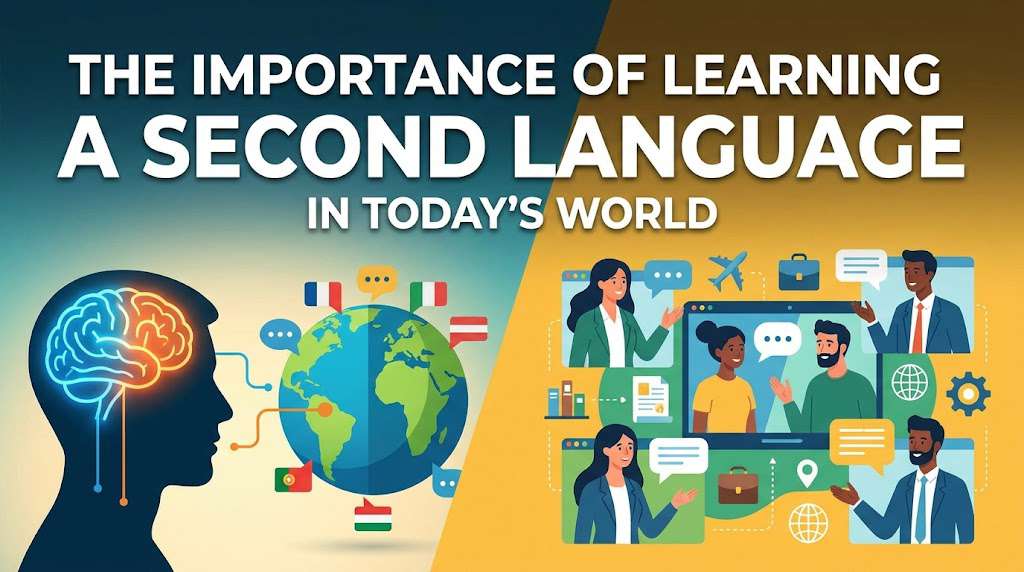
The Importance of Learning a Second Language in Today's World
Introduction
Consider for a moment the remarkable ability that every human being possesses from birth — the capacity to acquire language. As infants, we absorb the sounds, rhythms, and structures of our mother tongue effortlessly, without textbooks, grammar rules, or examinations. By the time we start school, most of us are already fluent speakers of at least one language.
Yet for many people, that first language remains their only language throughout their lives. In an increasingly interconnected world, this represents a missed opportunity of significant proportions.
Learning a second language is one of the most rewarding and practically valuable things a young person can do. It opens doors — to careers, to cultures, to friendships, and to ways of thinking that would otherwise remain closed. This article explores why bilingualism matters more than ever in today's world and how young people can embrace the challenge of language learning.
The World's Linguistic Landscape
There are approximately seven thousand languages spoken around the world today, though a relatively small number dominate global communication. English is widely regarded as the world's primary language of international business, science, diplomacy, and popular culture. Mandarin Chinese is the most spoken language by number of native speakers. Spanish, French, Arabic, Portuguese, and Swahili are among the other languages with significant global reach.
In many parts of the world — particularly in Africa and Asia — multilingualism is not an achievement but a basic feature of daily life. Many people switch effortlessly between two, three, or even more languages depending on whom they are speaking to and in what context. In Nigeria alone, for example, over five hundred languages are spoken alongside the national language of English.
For young people growing up in such environments, the value of language diversity is self-evident. For those in more monolingual societies, the case for learning a second language must sometimes be made more deliberately.
The Cognitive Benefits of Bilingualism
One of the most compelling arguments for learning a second language comes not from the world of culture or commerce, but from neuroscience. Research consistently demonstrates that learning and using more than one language has significant and lasting benefits for the brain.
Bilingualism improves cognitive flexibility. People who regularly switch between two languages develop a heightened ability to shift their attention, think flexibly, and manage competing pieces of information simultaneously. This mental agility — sometimes called the "bilingual advantage" — has been observed in children as young as seven months old.
Language learning strengthens memory. The process of memorising vocabulary, internalising grammar rules, and practising new sounds exercises the brain in ways that strengthen memory and concentration more broadly. Students who study a second language often find that their performance in other subjects improves as a result.
Bilingualism may protect against cognitive decline. Several studies have suggested that people who speak more than one language develop symptoms of dementia and Alzheimer's disease later in life than monolingual individuals. While research in this area is ongoing, the findings point to the profound long-term benefits of keeping the brain actively engaged with more than one linguistic system.
Learning one language makes learning others easier. Once the brain has developed the capacity to operate in a second language, acquiring a third or fourth becomes significantly less challenging. Many linguists describe the process as learning to learn languages — developing not just knowledge of a specific language but a set of transferable skills and strategies.
The Professional Benefits of Bilingualism
Beyond the cognitive advantages, the practical career benefits of speaking a second language are substantial and growing.
In an increasingly globalised economy, businesses operate across national and linguistic boundaries as a matter of course. Companies that trade internationally, serve diverse customer bases, or operate in multiple countries place a high premium on employees who can communicate effectively in more than one language.
Research consistently shows that bilingual employees earn higher salaries on average than their monolingual counterparts, and that language skills frequently tip the balance in competitive job applications. In fields such as diplomacy, international development, journalism, tourism, healthcare, and law, the ability to communicate across language barriers is not merely an advantage — it is often a requirement.
Furthermore, as African economies grow and integrate more deeply with regional and global markets, proficiency in languages such as French, Arabic, Mandarin, or Portuguese alongside English opens doors to an enormous range of professional opportunities across the continent and beyond.
The Cultural Benefits of Bilingualism
Language is far more than a tool for exchanging information. It is the vessel in which a culture's history, values, humour, and ways of seeing the world are carried. To learn a language is to gain access to an entire cultural universe that cannot be fully experienced through translation alone.
Many concepts, expressions, and ways of thinking exist in one language that have no precise equivalent in another. The German word Schadenfreude — pleasure derived from another person's misfortune — has no single-word equivalent in English. The Japanese concept of Ikigai — a sense of purpose and meaning in life — carries cultural depth that a simple translation cannot capture. Learning another language exposes us to these concepts and, in doing so, expands the way we think about the world and our place in it.
Bilingualism also builds empathy and cross-cultural understanding. When we make the effort to communicate with someone in their own language — however imperfectly — we signal respect for their culture and identity. This gesture of connection can bridge divides, dissolve misunderstandings, and build relationships of genuine trust and mutual appreciation.
Common Myths About Language Learning
Despite its many benefits, many young people are deterred from learning a second language by misconceptions that deserve to be challenged.
"I am too old to learn a new language." While it is true that young children acquire languages with extraordinary ease, research shows that older learners have significant advantages of their own — including greater vocabulary in their first language, stronger analytical skills, and more highly developed study habits. It is never too late to begin.
"I am not talented enough." Language learning is not a gift reserved for a special few. It is a skill that anyone can develop with consistent effort and the right approach. Talent matters far less than motivation, practice, and exposure.
"English is enough — everyone speaks it anyway." While English is widely spoken, the vast majority of the world's population does not speak it fluently. Moreover, even among those who do, communicating in a person's mother tongue conveys a warmth and respect that English alone cannot always achieve.
Practical Tips for Language Learners
For young people inspired to begin or deepen their language learning journey, the following strategies have been shown to be highly effective:
- Immerse yourself as much as possible. Watch films, listen to music, follow social media accounts, and read books in your target language. The more exposure you have, the faster you will progress.
- Practise speaking from the very beginning. Many learners delay speaking until they feel "ready." In reality, speaking early and often — even imperfectly — is one of the most effective ways to build fluency and confidence.
- Find a language partner or conversation group. Practising with a native or fluent speaker provides invaluable feedback and makes learning far more engaging and enjoyable.
- Use language learning apps consistently. Tools such as Duolingo, Babbel, and Anki can make daily vocabulary practice convenient and even fun.
- Set realistic goals and celebrate progress. Language learning is a long journey. Setting achievable milestones and acknowledging how far you have come helps maintain motivation over time.
- Do not fear making mistakes. Every error is a learning opportunity. The most successful language learners are those who are willing to communicate imperfectly rather than wait for perfection that never comes.
Conclusion
In a world that is more connected — and more complex — than at any previous point in human history, the ability to communicate across linguistic and cultural boundaries is an asset of extraordinary value. Learning a second language is not merely an academic exercise or a line on a curriculum vitae. It is an investment in the richness of one's own mind, in the breadth of one's opportunities, and in the depth of one's connections with the diverse and remarkable human beings who share this world.
For young people standing at the threshold of their futures, the question is not really whether to learn a second language. The question is: which one will you choose — and when will you begin?