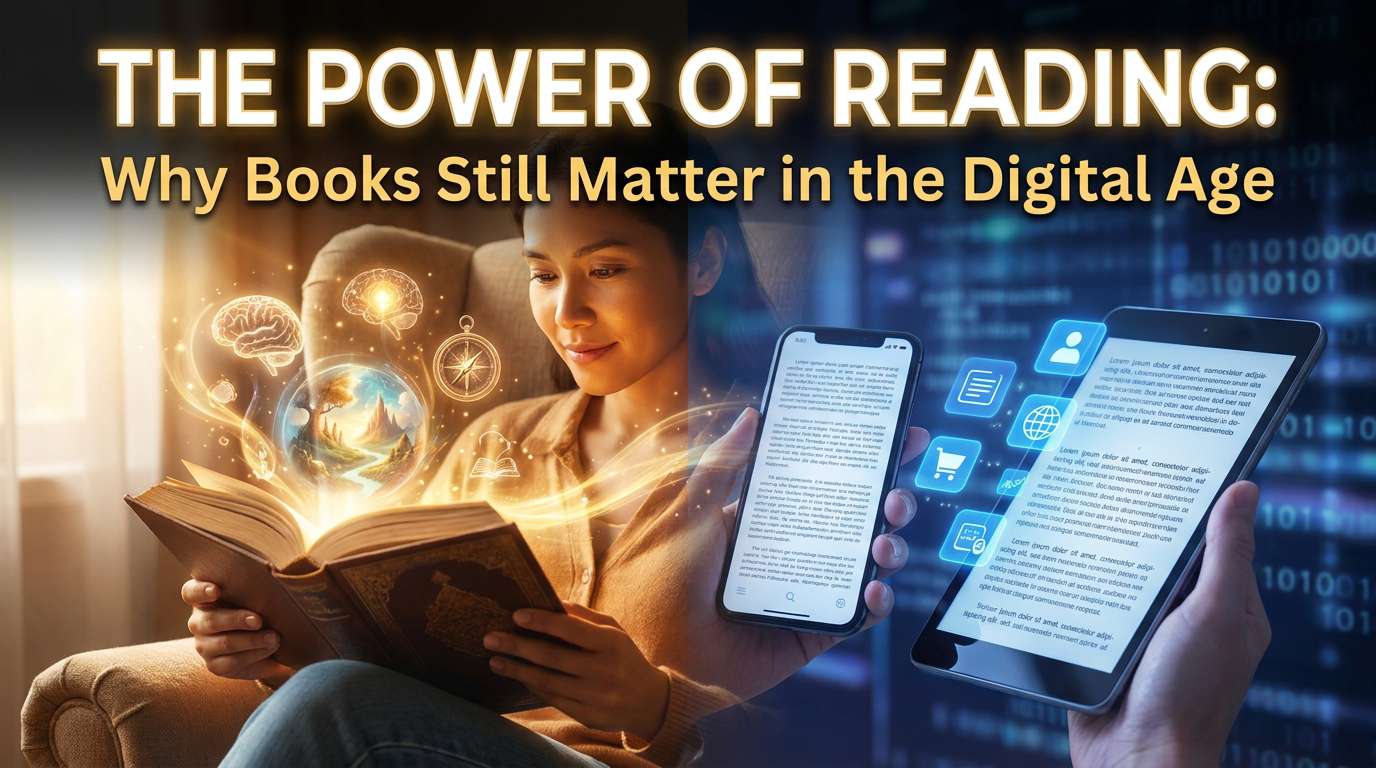
The Power of Reading: Why Books Still Matter in the Digital Age
Introduction
We live in an age of instant information. With a few taps on a smartphone, we can access news, entertainment, tutorials, and opinions from every corner of the world. Short videos, social media posts, and audio clips compete fiercely for our attention, offering content that is fast, colourful, and endlessly scrollable.
In this environment, many people — particularly young people — are reading fewer books than previous generations. Why sit with a novel for hours when a three-minute video can summarise the plot? Why read a lengthy article when a headline tells you enough?
Yet educators, psychologists, and successful people across every field continue to insist that reading books remains one of the most valuable habits a person can develop. This article explores why books still matter — perhaps now more than ever.
A Brief History of Reading
For most of human history, the ability to read was a privilege reserved for the wealthy and powerful. Books were rare and expensive, handwritten by scribes over months or years. The invention of the printing press in the fifteenth century changed everything, making books more widely available and gradually spreading literacy across the world.
For centuries, books were the primary means by which knowledge, stories, and ideas were preserved and shared. They shaped religions, sparked revolutions, advanced science, and gave voice to the experiences of people from every walk of life.
Today, books face competition from digital media unlike anything seen before. Yet their value has not diminished — if anything, the qualities that make books unique are more important than ever.
The Benefits of Reading
Research consistently shows that regular reading offers a wide range of benefits for the mind, the emotions, and even the body.
Reading improves vocabulary and language skills.
Every book introduces readers to new words, phrases, and ways of constructing sentences. Over time, this exposure builds a rich and varied vocabulary that improves both written and spoken communication. Students who read widely tend to perform better in English examinations and express themselves more clearly and confidently.
Reading strengthens concentration and focus.
In a world of constant notifications and short-form content, the ability to focus deeply on a single task for an extended period is becoming increasingly rare — and increasingly valuable. Reading a book requires sustained attention, training the brain to concentrate in a way that scrolling through social media simply does not.
Reading expands knowledge and understanding.
Whether fiction or non-fiction, every book offers insights into people, places, ideas, and experiences beyond our own immediate world. Non-fiction books deepen our understanding of history, science, politics, and culture. Fiction allows us to see the world through the eyes of characters whose lives are very different from our own.
Reading reduces stress.
Studies have found that reading for as little as six minutes can reduce stress levels by up to sixty-eight percent. Losing oneself in a good book allows the mind to relax and escape from the pressures of daily life in a healthy and productive way.
Reading develops empathy.
Fiction, in particular, has a remarkable ability to build empathy — the capacity to understand and share the feelings of others. When we read about characters facing challenges, making difficult choices, and experiencing joy or grief, we practise imagining the inner lives of people different from ourselves. This skill is invaluable in building healthy relationships and navigating a diverse world.
Fiction vs Non-Fiction: Which Should You Read?
Both fiction and non-fiction offer tremendous value, and the best readers enjoy a healthy mix of both.
- Fiction — novels, short stories, and poetry — develops imagination, empathy, and an appreciation for language and storytelling.
- Non-fiction — biographies, history books, science writing, and essays — builds knowledge, critical thinking, and an understanding of the real world.
The most important thing is not what you read, but that you read. Finding books on topics that genuinely interest you is the surest way to develop a lasting reading habit.
Reading in the Digital Age
It is worth acknowledging that not all reading is the same. Reading a well-researched book is a qualitatively different experience from scrolling through social media posts, even if both involve words on a screen.
Books require a level of depth, structure, and sustained engagement that most digital content does not. An author who has spent years researching and writing a book offers something fundamentally different from a social media post written in minutes.
This is not to say that digital content has no value — it absolutely does. But it cannot replace the depth of understanding and the richness of experience that a good book provides.
Encouragingly, e-books and audiobooks have made reading more accessible than ever before. For those who struggle to find time to sit with a physical book, listening to audiobooks during commutes, exercise, or household chores is an excellent alternative.
How to Build a Reading Habit
Many people would like to read more but find it difficult to get started or to maintain the habit. Here are some practical tips:
- Set aside a specific time each day for reading — even fifteen minutes before bed can make a significant difference.
- Choose books on topics you genuinely find interesting rather than books you feel you ought to read.
- Keep a book with you wherever you go, so you can read during spare moments.
- Set a realistic reading goal — for example, one book per month — and track your progress.
- Join a book club or discuss books with friends to make reading a social and enjoyable activity.
- Visit your local library, where thousands of books are available for free.
What Successful People Say About Reading
Many of the world's most accomplished people credit reading as a key factor in their success.
- Bill Gates, co-founder of Microsoft, reads approximately fifty books per year and has said that reading is his primary way of learning new things.
- Malala Yousafzai, Nobel Peace Prize laureate, has spoken passionately about the transformative power of education and books throughout her life and activism.
- Chimamanda Ngozi Adichie, one of Africa's most celebrated authors, has described how reading widely from a young age shaped her understanding of the world and gave her the tools to tell her own stories.
Conclusion
In a world that increasingly rewards speed, brevity, and distraction, the act of sitting quietly with a book is quietly radical. It is a commitment to depth over surface, to understanding over assumption, and to the slow and rewarding work of growing as a person.
Books have survived the invention of the radio, the television, the internet, and the smartphone. They endure because they offer something that no other medium can fully replicate — the experience of entering another world entirely, one page at a time.
Whether you prefer fantasy novels, historical biographies, science books, or classic literature, the most important step is simply to begin. Pick up a book today — and discover for yourself the extraordinary power of reading.