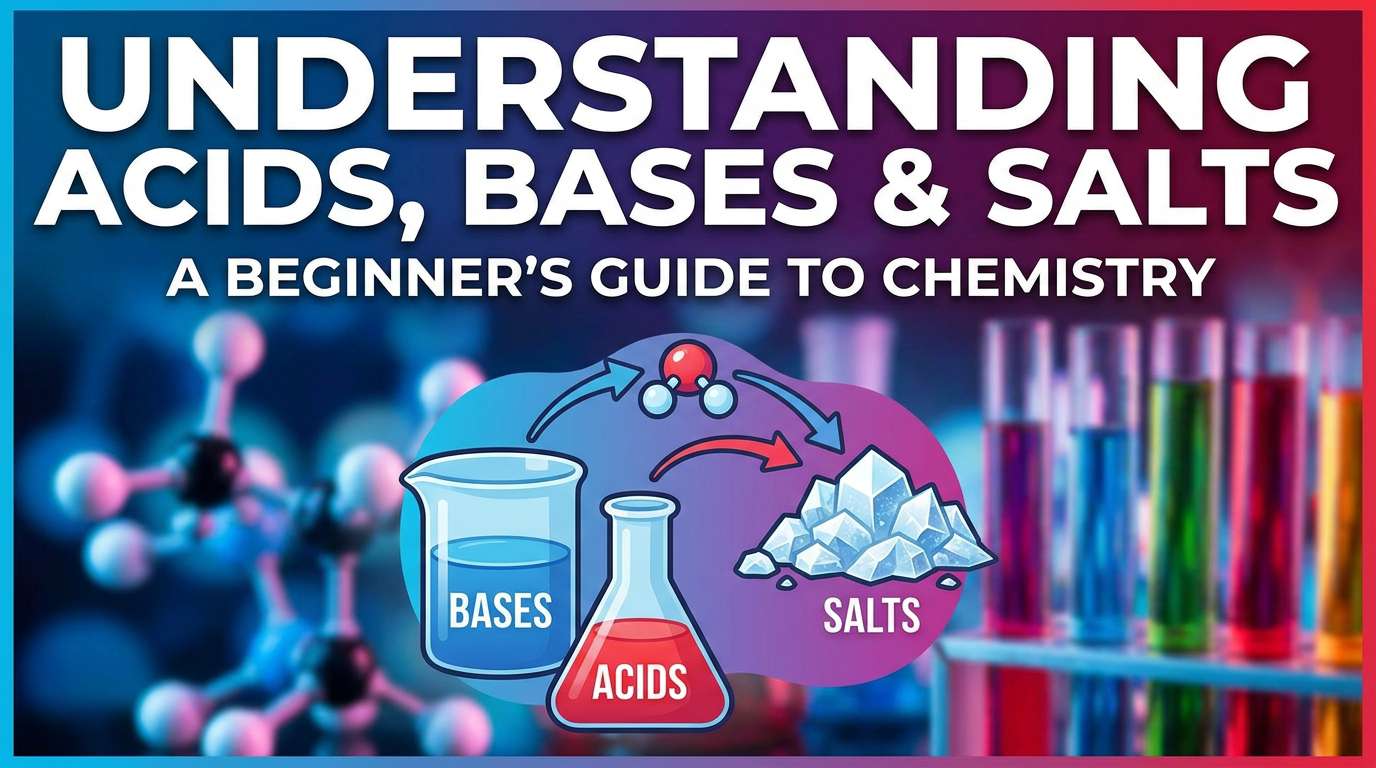
Understanding Acids, Bases and Salts
Introduction
Chemistry is the study of matter and the changes it undergoes. Among the most important substances studied in chemistry are acids, bases, and salts. These substances are found everywhere around us, from the foods we eat and the medicines we take to the cleaning products we use in our homes.
Acids, bases, and salts play vital roles in industrial production, agriculture, environmental management, medicine, and biological processes. Understanding their properties and reactions helps students appreciate how chemistry influences everyday life.
This article explores the meaning, properties, classification, preparation, uses, and importance of acids, bases, and salts in a simple and comprehensive manner.
What Are Acids?
Acids are substances that produce hydrogen ions (H⁺) when dissolved in water. They are known for their sour taste and their ability to react with metals and bases.
The word "acid" comes from the Latin word acidus, meaning sour.
Examples of Common Acids
- Hydrochloric Acid (HCl)
- Sulphuric Acid (H₂SO₄)
- Nitric Acid (HNO₃)
- Citric Acid (found in oranges and lemons)
- Acetic Acid (found in vinegar)
- Carbonic Acid (found in soft drinks)
Properties of Acids
Acids possess several unique characteristics:
- They have a sour taste.
- They turn blue litmus paper red.
- They react with metals to produce hydrogen gas.
- They conduct electricity in aqueous solutions.
- They react with bases to form salts and water.
- They have pH values less than 7.
Example Reaction with Metals
Hydrochloric acid reacts with zinc to produce zinc chloride and hydrogen gas.
Zinc + Hydrochloric Acid → Zinc Chloride + Hydrogen Gas
Strong and Weak Acids
Acids are classified according to the degree to which they ionize in water.
Strong Acids
Strong acids completely ionize in water.
Examples:
- Hydrochloric Acid
- Nitric Acid
- Sulphuric Acid
Weak Acids
Weak acids ionize only partially in water.
Examples:
- Acetic Acid
- Citric Acid
- Carbonic Acid
What Are Bases?
Bases are substances that produce hydroxide ions (OH⁻) when dissolved in water.
Bases are often bitter and slippery to touch.
Examples of Bases
- Sodium Hydroxide (NaOH)
- Potassium Hydroxide (KOH)
- Calcium Hydroxide [Ca(OH)₂]
- Magnesium Hydroxide [Mg(OH)₂]
- Ammonium Hydroxide (NH₄OH)
Properties of Bases
- Bitter taste.
- Slippery texture.
- Turn red litmus paper blue.
- Conduct electricity in solution.
- Neutralize acids.
- Have pH values greater than 7.
Strong and Weak Bases
Strong Bases
- Sodium Hydroxide
- Potassium Hydroxide
Weak Bases
- Ammonium Hydroxide
- Magnesium Hydroxide
What Are Salts?
Salts are ionic compounds formed when the hydrogen ion of an acid is replaced by a metal ion or ammonium ion.
Most salts are formed through neutralization reactions.
Examples of Salts
- Sodium Chloride (Table Salt)
- Potassium Nitrate
- Calcium Carbonate
- Magnesium Sulphate
- Ammonium Chloride
Neutralization Reaction
Neutralization occurs when an acid reacts with a base to produce salt and water.
Acid + Base → Salt + Water
Example:
Hydrochloric Acid + Sodium Hydroxide → Sodium Chloride + Water
The pH Scale
The pH scale measures how acidic or basic a substance is.
| pH Value | Nature |
|---|---|
| 0 – 6 | Acidic |
| 7 | Neutral |
| 8 – 14 | Basic/Alkaline |
Importance of Acids, Bases and Salts
In Agriculture
- Fertilizer production.
- Soil pH adjustment.
- Improvement of crop yield.
In Medicine
- Production of medicines.
- Preparation of antacids.
- Manufacture of disinfectants.
In Industry
- Soap production.
- Battery manufacturing.
- Food processing.
- Water treatment.
In Daily Life
- Vinegar contains acetic acid.
- Lemon juice contains citric acid.
- Baking soda is a mild base.
- Table salt is sodium chloride.
Laboratory Safety Precautions
- Wear protective equipment.
- Never taste chemicals.
- Handle concentrated acids carefully.
- Add acid to water, not water to acid.
- Wash spills immediately.
Common Examination Questions
- Define acids, bases, and salts.
- State three properties of acids.
- Explain neutralization.
- Differentiate between strong and weak acids.
- List four uses of salts.
Summary
- Acids produce hydrogen ions in water.
- Bases produce hydroxide ions in water.
- Salts are formed through neutralization.
- The pH scale measures acidity and alkalinity.
- Acids, bases, and salts are important in industry, medicine, agriculture, and daily life.
Conclusion
Acids, bases, and salts are fundamental substances in chemistry and everyday life. Understanding their properties, reactions, and applications helps students appreciate how chemistry contributes to health, agriculture, manufacturing, and environmental sustainability. A solid understanding of these concepts provides a strong foundation for further studies in chemistry and related sciences.