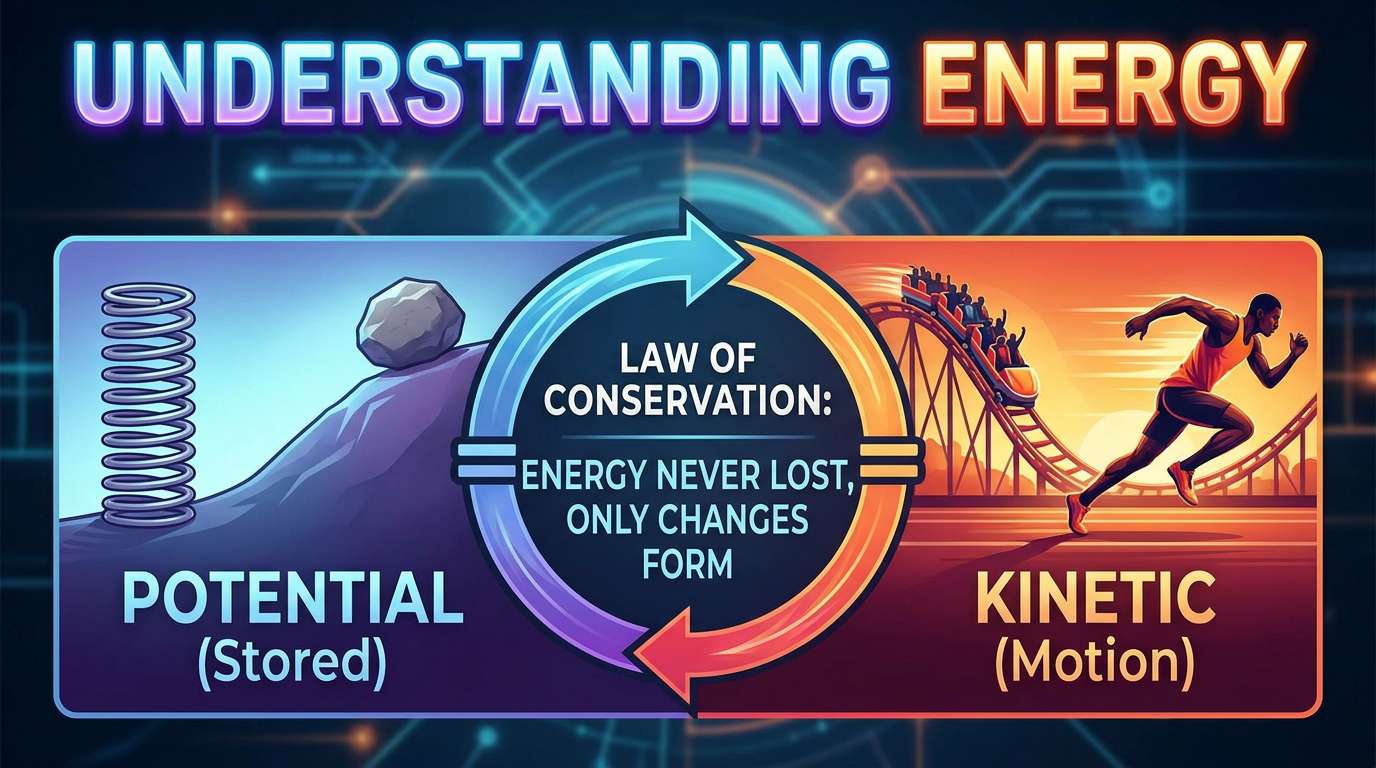
Understanding Energy: Kinetic, Potential, and the Law of Conservation
Introduction
We use the word "energy" constantly in everyday life. We talk about feeling energetic, about energy bills, about renewable energy and energy drinks. But what is energy, really? In physics, energy has a precise meaning: it is the capacity to do work — to move an object, heat a substance, produce light, or cause some other physical change.
Energy is one of the most important concepts in all of science. It connects fields as varied as mechanics, chemistry, biology, and astronomy, and it underpins everything from the way a roller coaster moves to how stars produce light. Despite appearing in many different forms, energy obeys one of the most powerful rules in all of physics: it can never be created or destroyed, only converted from one form into another.
What Is Energy?
Energy is measured in joules (J), named after the English physicist James Prescott Joule, who carried out important experiments on the relationship between heat and mechanical work in the nineteenth century. One joule is a relatively small amount of energy — lifting an apple about one metre off the ground requires roughly one joule of energy.
Energy exists in many forms, including:
- Kinetic energy — the energy of motion.
- Potential energy — stored energy due to position or condition.
- Thermal energy — the energy associated with the temperature of an object.
- Chemical energy — energy stored in the bonds between atoms and molecules.
- Electrical energy — energy carried by moving electric charges.
- Nuclear energy — energy stored within the nucleus of an atom.
- Light (radiant) energy — energy carried by electromagnetic waves.
Two of the most fundamental of these forms — kinetic and potential energy — are central to understanding how objects move and interact in the physical world.
Kinetic Energy: The Energy of Motion
Any object that is moving possesses kinetic energy. A rolling football, a flying aeroplane, a falling raindrop, and even the molecules vibrating inside a cup of hot tea all have kinetic energy, simply because they are in motion.
The amount of kinetic energy an object has depends on two factors: its mass and its speed. This relationship is expressed by the equation:
KE = ½mv²
where KE is kinetic energy (in joules), m is mass (in kilograms), and v is velocity (in metres per second).
Because velocity is squared in this equation, speed has a much greater effect on kinetic energy than mass does. Doubling an object's mass doubles its kinetic energy, but doubling its speed quadruples its kinetic energy. This is precisely why driving even slightly faster significantly increases the severity of a car crash — a vehicle travelling at sixty miles per hour carries far more than twice the kinetic energy of one travelling at thirty miles per hour.
Potential Energy: Stored Energy
Potential energy is energy that an object has because of its position, shape, or state, rather than its motion. It represents energy that is "stored" and has the potential to be converted into another form, such as kinetic energy.
The most commonly discussed type is gravitational potential energy, which depends on an object's height above the ground. The higher an object is lifted, the more gravitational potential energy it gains, because gravity has more distance over which to act on it if released. This is calculated using the equation:
GPE = mgh
where GPE is gravitational potential energy, m is mass, g is the acceleration due to gravity (approximately 9.8 metres per second squared on Earth), and h is height above a reference point.
Other forms of potential energy include:
- Elastic potential energy — stored in stretched or compressed objects such as springs, elastic bands, or a drawn bow.
- Chemical potential energy — stored in the bonds of molecules, released during reactions such as combustion or digestion.
- Electrical potential energy — stored due to the position of charged particles within an electric field.
The Constant Exchange Between Kinetic and Potential Energy
One of the most elegant aspects of physics is watching kinetic and potential energy transform into one another. A classic example is a pendulum swinging back and forth. At the highest point of its swing, the pendulum is momentarily motionless, and all of its energy is gravitational potential energy. As it swings downward, that potential energy converts into kinetic energy, reaching maximum speed — and therefore maximum kinetic energy — at the lowest point of the swing. As it rises on the other side, the kinetic energy converts back into potential energy, and the cycle repeats.
A roller coaster works on exactly the same principle. The chain lift at the beginning of the ride does the work of raising the carriages to the highest point, building up a large store of gravitational potential energy. As the carriages plunge down the first drop, that potential energy converts rapidly into kinetic energy, producing the thrilling acceleration riders feel. As the coaster climbs the next hill, kinetic energy converts back into potential energy, slowing the carriages down once again.
The Law of Conservation of Energy
All of these transformations are governed by one of the most important principles in physics: the law of conservation of energy. This law states that energy cannot be created or destroyed — it can only be transferred from one object to another or transformed from one form into another. The total amount of energy in a closed system always remains constant.
This does not mean that energy is never "lost" in a practical sense. In real-world systems, some energy is almost always converted into forms that are less useful for the task at hand — most commonly, heat generated by friction or air resistance. A swinging pendulum will eventually slow down and stop, not because its energy has vanished, but because friction at the pivot and resistance from the air gradually convert its kinetic and potential energy into thermal energy, which disperses into the surrounding environment.
This is why no machine can ever be perfectly efficient, and why the idea of a "perpetual motion machine" — a device that runs forever without any energy input — is impossible according to the laws of physics. Every real system loses some usable energy to its surroundings, even if the total quantity of energy in the universe remains unchanged.
Why Energy Conservation Matters Beyond Physics
Understanding the conservation of energy is not just important for solving physics problems — it has profound consequences for engineering, environmental science, and everyday decision-making. Power stations, for example, work by converting energy from one form into another: chemical energy in fossil fuels, nuclear energy in reactors, or kinetic energy from wind and water, is ultimately converted into electrical energy that can be transmitted and used in homes and businesses.
At every stage of these conversions, some energy is inevitably lost as waste heat, which is why engineers are constantly working to design more efficient engines, appliances, and power generation systems — not to "save" energy that would otherwise be destroyed, but to reduce the amount converted into unwanted, unusable forms.
Conclusion
Energy is one of the most powerful and unifying ideas in physics, present in every moving object, every chemical reaction, and every star in the night sky. By understanding the relationship between kinetic energy and potential energy, and the unbreakable law that governs their conversion, we gain insight into an enormous range of natural phenomena — from the swing of a pendulum to the thrill of a roller coaster, from the workings of a power station to the structure of the universe itself.
Far from being an abstract or purely theoretical idea, the law of conservation of energy is one of the most reliable and far-reaching principles ever discovered — a reminder that, in the physical world, nothing is ever truly lost, only changed.