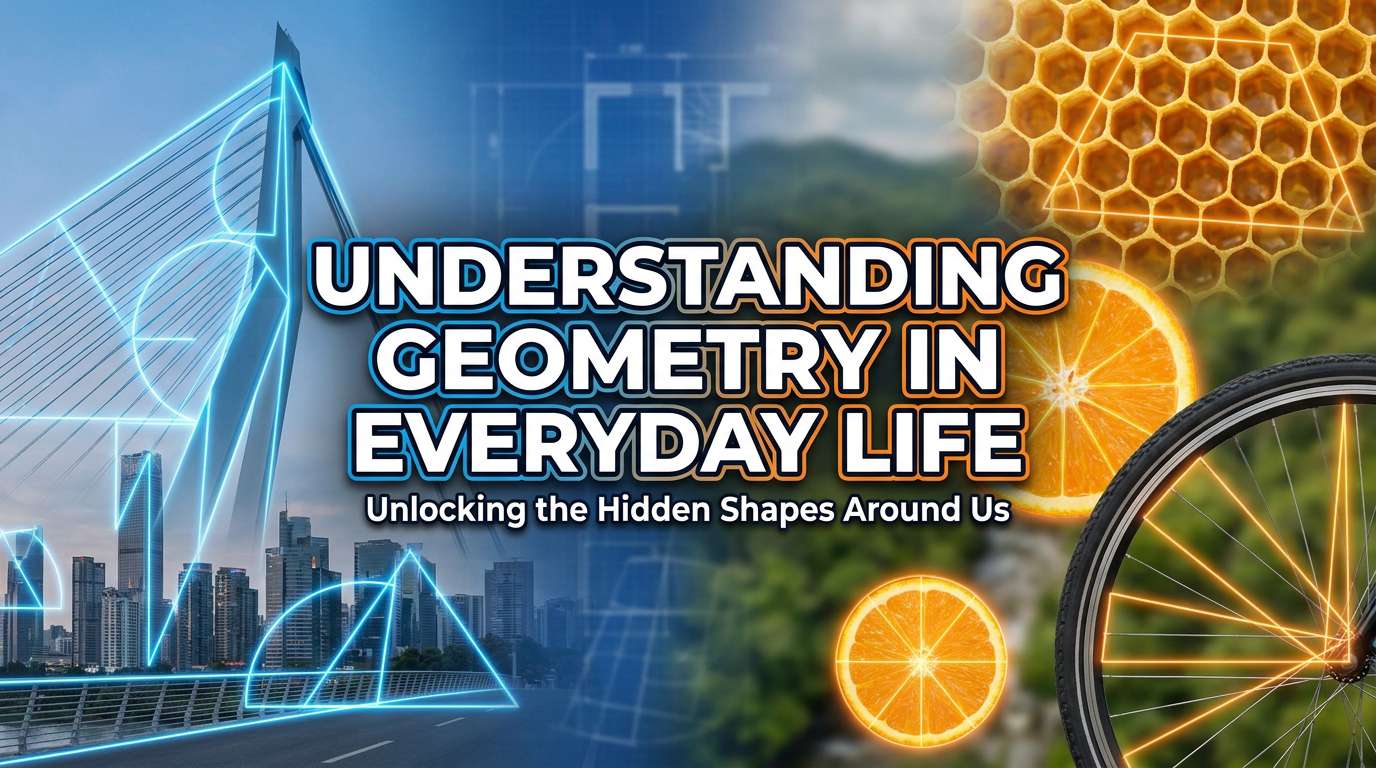
Understanding Geometry in Everyday Life
Introduction
Geometry is one of the oldest branches of mathematics. It deals with shapes, sizes, positions, angles, and dimensions of objects. From the buildings we live in to the roads we travel on, geometry plays a major role in our everyday lives.
Many students view geometry as a collection of formulas and diagrams, but it is much more than that. Geometry helps us understand the physical world around us and develop critical thinking and problem-solving skills.
What Is Geometry?
Geometry is the study of points, lines, angles, surfaces, and solid figures.
It helps us answer questions such as:
- How large is a room?
- How much paint is needed for a wall?
- What is the shortest distance between two places?
- How can structures be designed safely?
Basic Geometric Concepts
Points
A point represents an exact location. It has no length, width, or thickness.
Lines
A line is a straight path that extends endlessly in both directions.
Angles
Angles are formed when two lines meet at a point.
Common types include:
- Acute angle
- Right angle
- Obtuse angle
- Straight angle
Common Shapes
Examples of two-dimensional shapes include:
- Triangle
- Square
- Rectangle
- Circle
- Pentagon
- Hexagon
Understanding Perimeter
Perimeter is the total distance around a shape.
For a rectangle:
Perimeter = 2(length + width)
Perimeter is useful when fencing land or measuring boundaries.
Understanding Area
Area measures the surface covered by a shape.
Examples:
- Rectangle = length × width
- Square = side × side
- Triangle = ½ × base × height
Geometry in Daily Life
- Construction and architecture.
- Road and bridge design.
- Interior decoration.
- Sports field measurements.
- Engineering projects.
Benefits of Studying Geometry
- Improves logical reasoning.
- Develops spatial awareness.
- Enhances problem-solving skills.
- Supports careers in science and technology.
Common Mistakes Students Make
- Confusing area with perimeter.
- Using incorrect units.
- Memorizing formulas without understanding them.
- Drawing inaccurate diagrams.
Conclusion
Geometry is everywhere around us. Understanding shapes, measurements, and spatial relationships helps students solve practical problems and succeed in mathematics and many professional careers.