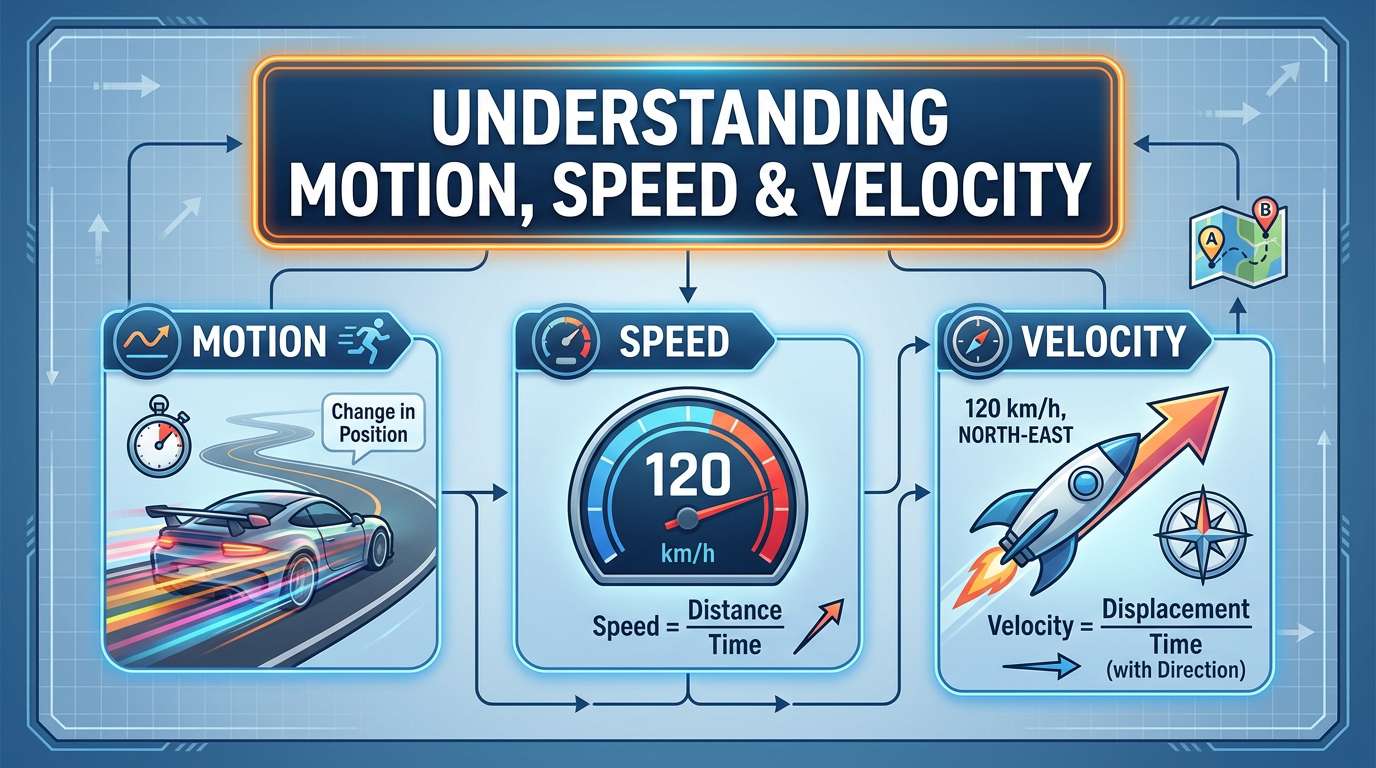
Understanding Motion, Speed and Velocity
Introduction
Motion is one of the most fundamental concepts in physics. Everything around us is either moving or capable of movement. From cars traveling on highways to planets orbiting the sun, motion is an essential part of our daily lives.
To understand motion properly, students must learn about two important quantities: speed and velocity. Although these terms are often used interchangeably in everyday conversations, they have different meanings in physics.
This article explains the concepts of motion, speed, and velocity in a simple and practical manner.
What Is Motion?
Motion is the change in position of an object with respect to time.
An object is said to be in motion if its position changes relative to a reference point.
Examples of motion include:
- A student walking to school.
- A football moving across a field.
- A bird flying in the sky.
- A moving train.
- The Earth revolving around the Sun.
Types of Motion
Motion can occur in different forms depending on how an object moves.
1. Linear Motion
Linear motion occurs when an object moves along a straight path.
Examples:
- A car traveling on a straight road.
- A runner moving on a straight track.
2. Circular Motion
Circular motion occurs when an object moves along a circular path.
Examples:
- A ceiling fan.
- The hands of a clock.
- A merry-go-round.
3. Rotational Motion
Rotational motion occurs when an object rotates about an axis.
Examples:
- A spinning top.
- The Earth rotating on its axis.
4. Oscillatory Motion
Oscillatory motion involves movement back and forth around a fixed position.
Examples:
- A swinging pendulum.
- A child on a swing.
Distance and Displacement
Before understanding speed and velocity, it is important to understand distance and displacement.
Distance
Distance is the total length of the path traveled by an object.
Distance is a scalar quantity because it has magnitude only.
Displacement
Displacement is the shortest straight-line distance between the starting point and ending point of an object's journey.
Displacement is a vector quantity because it has both magnitude and direction.
What Is Speed?
Speed is the rate at which an object covers distance.
It tells us how fast an object is moving.
Formula:
Speed = Distance ÷ Time
Units of speed include:
- Metres per second (m/s)
- Kilometres per hour (km/h)
Calculating Speed
Example:
A student walks 100 metres in 20 seconds.
Speed = Distance ÷ Time
Speed = 100 ÷ 20
Speed = 5 m/s
Therefore, the student's speed is 5 metres per second.
Types of Speed
Uniform Speed
An object moves with uniform speed if it covers equal distances in equal intervals of time.
Non-Uniform Speed
An object moves with non-uniform speed if it covers unequal distances in equal intervals of time.
Average Speed
Average speed is calculated using:
Average Speed = Total Distance ÷ Total Time
What Is Velocity?
Velocity is the rate of change of displacement with time.
Unlike speed, velocity includes direction.
Formula:
Velocity = Displacement ÷ Time
Since velocity includes direction, examples may be:
- 20 m/s north
- 60 km/h east
- 15 m/s south
Difference Between Speed and Velocity
| Speed | Velocity |
|---|---|
| Based on distance. | Based on displacement. |
| Scalar quantity. | Vector quantity. |
| Has magnitude only. | Has magnitude and direction. |
| No direction required. | Direction is essential. |
Understanding Acceleration
Acceleration is the rate of change of velocity with time.
An object accelerates when:
- Its speed increases.
- Its speed decreases.
- Its direction changes.
Formula:
Acceleration = Change in Velocity ÷ Time
Factors Affecting Motion
- Force
- Mass
- Friction
- Gravity
- Air resistance
These factors determine how easily an object moves and changes its motion.
Applications of Motion in Everyday Life
- Transportation systems.
- Sports and athletics.
- Engineering and construction.
- Space exploration.
- Machine design.
- Aviation.
Common Mistakes Students Make
- Confusing distance with displacement.
- Using the wrong units.
- Mixing up speed and velocity.
- Ignoring direction when calculating velocity.
- Forgetting to convert units when necessary.
Tips for Mastering Motion Concepts
- Understand the definitions clearly.
- Practice numerical problems regularly.
- Learn the correct formulas.
- Pay attention to units.
- Draw diagrams when solving problems.
Conclusion
Motion, speed, and velocity are essential concepts in physics that help us understand how objects move. While speed describes how fast an object travels, velocity provides additional information about direction.
By understanding distance, displacement, speed, velocity, and acceleration, students can build a strong foundation for studying more advanced physics topics and applying scientific principles to real-world situations.