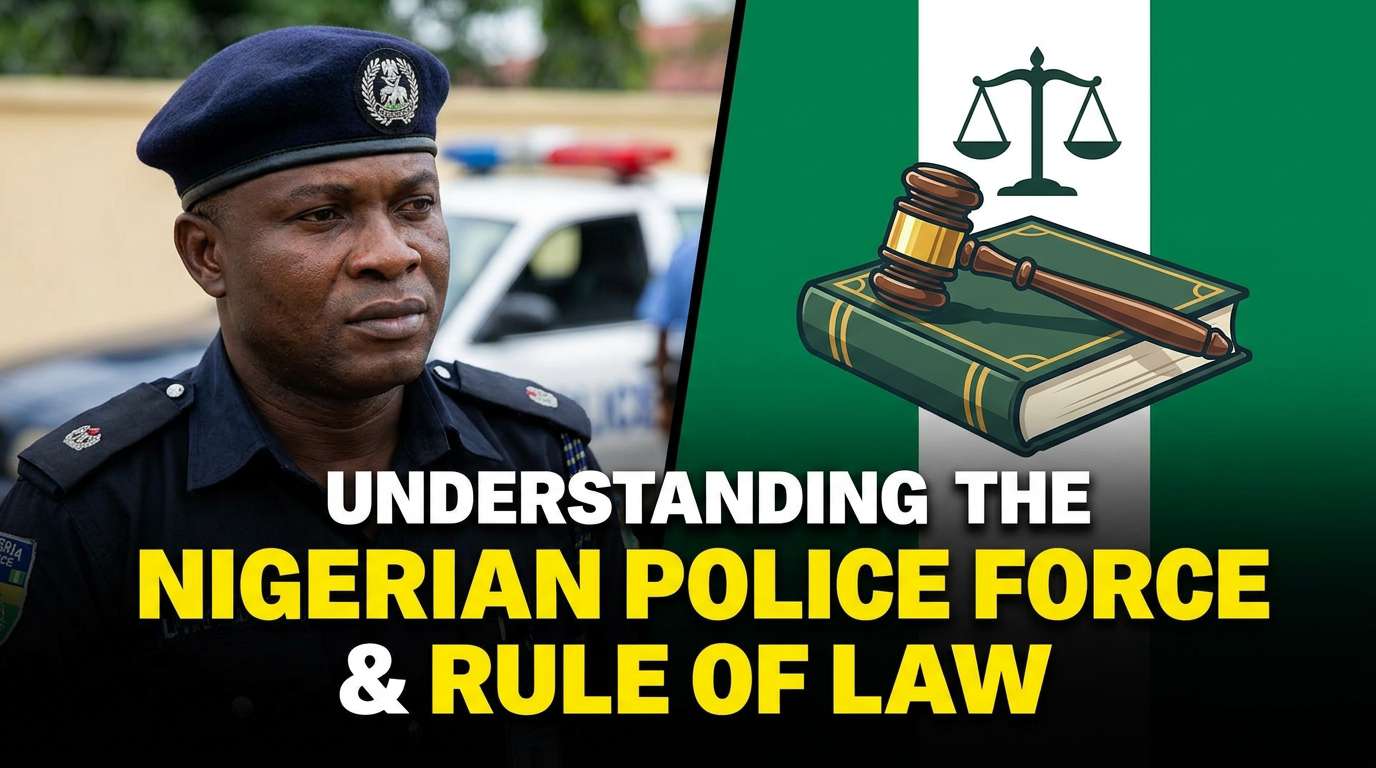
Understanding the Nigerian Police Force and Rule of Law
Introduction
Few institutions shape an ordinary citizen's day-to-day relationship with government authority as directly as the police. A traffic stop, a report filed after a theft, a checkpoint on a highway — these everyday encounters form the most frequent point of contact most Nigerians have with state power. How fairly and lawfully these encounters are conducted says a great deal about how genuinely the rule of law operates in practice, not just in constitutional text.
This article examines the Nigerian Police Force in depth — its constitutional basis, structure, and core functions — alongside the rights citizens hold when interacting with police, and the ongoing national conversation about strengthening police accountability, building directly on the broader principles of the rule of law and due process discussed elsewhere in this syllabus.
The Constitutional Basis of the Nigerian Police Force
The Nigerian Police Force (NPF) is established under the 1999 Constitution (as amended) as the principal law enforcement body responsible for maintaining law and order throughout Nigeria. Notably, policing in Nigeria currently falls under the Exclusive Legislative List, discussed in the article on Nigerian federalism, meaning that, as it currently stands, the federal government alone holds the constitutional authority to establish and control a police force with national policing powers, rather than individual states maintaining their own separate police forces (a subject of ongoing national debate, discussed further below).
The Structure of the Nigerian Police Force
The Nigerian Police Force operates under a centralized, hierarchical command structure, headed by the Inspector-General of Police (IGP), who holds overall responsibility for the Force's operations nationwide. Beneath the Inspector-General, the Force is organized into various commands and formations, including State Commands (each headed by a Commissioner of Police), Area Commands, Divisional Police Headquarters, and individual police stations and posts serving specific localities.
The Police Service Commission
A separate body, the Police Service Commission, holds constitutional responsibility for the appointment, promotion, discipline, and dismissal of police officers (excluding the Inspector-General), providing a degree of institutional oversight distinct from the Force's own internal command structure.
The Functions of the Nigerian Police Force
The Police Act sets out the Force's core functions, which include:
- The prevention and detection of crime.
- The apprehension of offenders.
- The preservation of law and order.
- The protection of life and property.
- The enforcement of laws and regulations they are directly charged with enforcing.
- Performing military duties within or outside Nigeria, as may be lawfully required.
Citizens' Rights When Interacting With Police
Building on the general due process protections discussed elsewhere in this syllabus, several specific rights apply directly to citizens' interactions with the police.
The Right to Know the Reason for Any Police Action
Whether being stopped, questioned, or arrested, a citizen has the right to be informed of the reason for the police action being taken against them, in a language they understand.
The Right to Refuse an Unlawful Search Without a Warrant
Except in certain specifically defined circumstances recognized by law (such as situations involving an immediate threat to safety or where a lawful arrest is being made), individuals and their property generally have a right to privacy that limits searches without either their consent or a valid, properly issued search warrant.
The Right Against Torture and Inhumane Treatment
Citizens have an absolute constitutional right to be treated with dignity, and are protected against torture, and cruel, inhumane, or degrading treatment, including during arrest, questioning, or detention.
The Right to Legal Representation and to Remain Silent
As discussed in the article on due process, individuals have the right to legal representation and the right to remain silent when questioned by police, protecting against coerced or involuntary self-incrimination.
The Right to Be Treated in Accordance With Due Process
Police actions, including arrest and detention, must be carried out in accordance with the due process protections discussed elsewhere in this syllabus, including being brought before a court within a reasonable time following arrest.
How Citizens Can Report Police Misconduct
Where a citizen believes their rights have been violated by police conduct, several avenues for reporting or seeking redress exist, including filing a formal complaint with the Police Service Commission, reporting to the Public Complaints Commission, seeking legal redress through the courts, including through human rights-focused civil society organizations that often assist with such cases, and, in the case of specific specialized units, reporting through dedicated oversight or complaint mechanisms established for that unit.
Efforts to Strengthen Police Accountability
In response to long-standing public concerns regarding certain aspects of police conduct, including instances of excessive force, extortion, and other misconduct, Nigeria has seen various reform efforts and public advocacy aimed at strengthening police accountability, including significant public protest movements calling for reform of specific police units accused of widespread abuse, subsequent institutional reforms and the establishment of specific oversight panels, and ongoing broader calls for improved police training, better funding and equipping of the Force, and stronger, more independent accountability mechanisms.
The Debate Over State Police
One of the most significant and ongoing debates concerning Nigerian policing involves whether individual states should be constitutionally permitted to establish and control their own state police forces, in addition to the existing federal Nigerian Police Force.
Arguments in Favour of State Police
- Could improve responsiveness to local security concerns, given police officers' potentially greater familiarity with local communities and languages.
- May help address concerns about the current federal police force being significantly understaffed relative to Nigeria's large population and territory.
- Could enhance the broader federal principle of decentralized governance discussed in the article on Nigerian federalism.
Arguments Against State Police
- Concerns that state governors or other powerful state-level political figures could potentially misuse a state police force for political purposes, including intimidation of political opponents.
- Concerns regarding the financial capacity of some states to adequately fund and maintain an effective, well-trained police force.
- Concerns about coordination and consistency in policing standards and practices across a decentralized system.
This debate remains an active and unresolved area of Nigerian constitutional and political discussion, illustrating how questions of policing connect directly to broader themes of federalism and the appropriate balance of power between federal and state government discussed elsewhere in this syllabus.
The Relationship Between Police Conduct and the Rule of Law
As discussed in the article on the rule of law, genuine rule of law requires that those who enforce the law also remain subject to it. Where police officers act unlawfully without meaningful accountability, public trust in the rule of law itself is significantly undermined, since the very institution responsible for enforcing legal order is seen to operate outside the legal constraints meant to govern its own conduct. Strengthening police accountability is therefore not simply an internal institutional matter — it is directly connected to the broader health of the rule of law within Nigerian society as a whole.
The Nigerian Police Force and WAEC/NECO Civic Education
Key examinable areas of this topic include:
- The constitutional basis and structure of the Nigerian Police Force.
- The core functions of the police as set out in law.
- Citizens' specific rights when interacting with police.
- Mechanisms for reporting police misconduct and seeking accountability.
- The ongoing debate over state police and its connection to Nigerian federalism.
- The relationship between police conduct and the broader principle of the rule of law.
Common Mistakes Students Make
- Assuming police can search any person or property at any time without restriction. Searches are generally subject to legal limits, including, in many circumstances, the requirement of a valid warrant or lawful justification.
- Confusing the Inspector-General of Police with the Police Service Commission. The Inspector-General leads the Force's operations; the Police Service Commission holds a distinct oversight role over appointments, promotion, and discipline.
- Assuming policing in Nigeria is currently organized at the state level. Policing currently falls under the Exclusive Legislative List, meaning it is presently a federal responsibility, though this is the subject of active reform debate.
- Overlooking citizens' available avenues for reporting police misconduct, assuming no formal accountability mechanisms exist.
- Treating the debate over state police as a simple, one-sided issue, without recognizing genuine, substantive arguments on multiple sides of this ongoing national conversation.
Conclusion
The Nigerian Police Force occupies a uniquely significant position within the country's system of governance, tasked with maintaining public order and enforcing the law, while itself remaining bound by that same law and by citizens' constitutionally protected rights. Understanding both the Force's official structure and functions, and citizens' own rights and available avenues for accountability, offers students genuine insight into how the rule of law is meant to operate — and the ongoing efforts required to ensure it operates well — in one of the most frequent and consequential points of contact between ordinary Nigerians and the power of the state.
As Nigeria continues to navigate significant, active debates — including questions of police reform and the potential introduction of state police — this remains a genuinely evolving area of Nigerian civic life, one that will continue to shape the practical relationship between citizens and law enforcement for years to come.