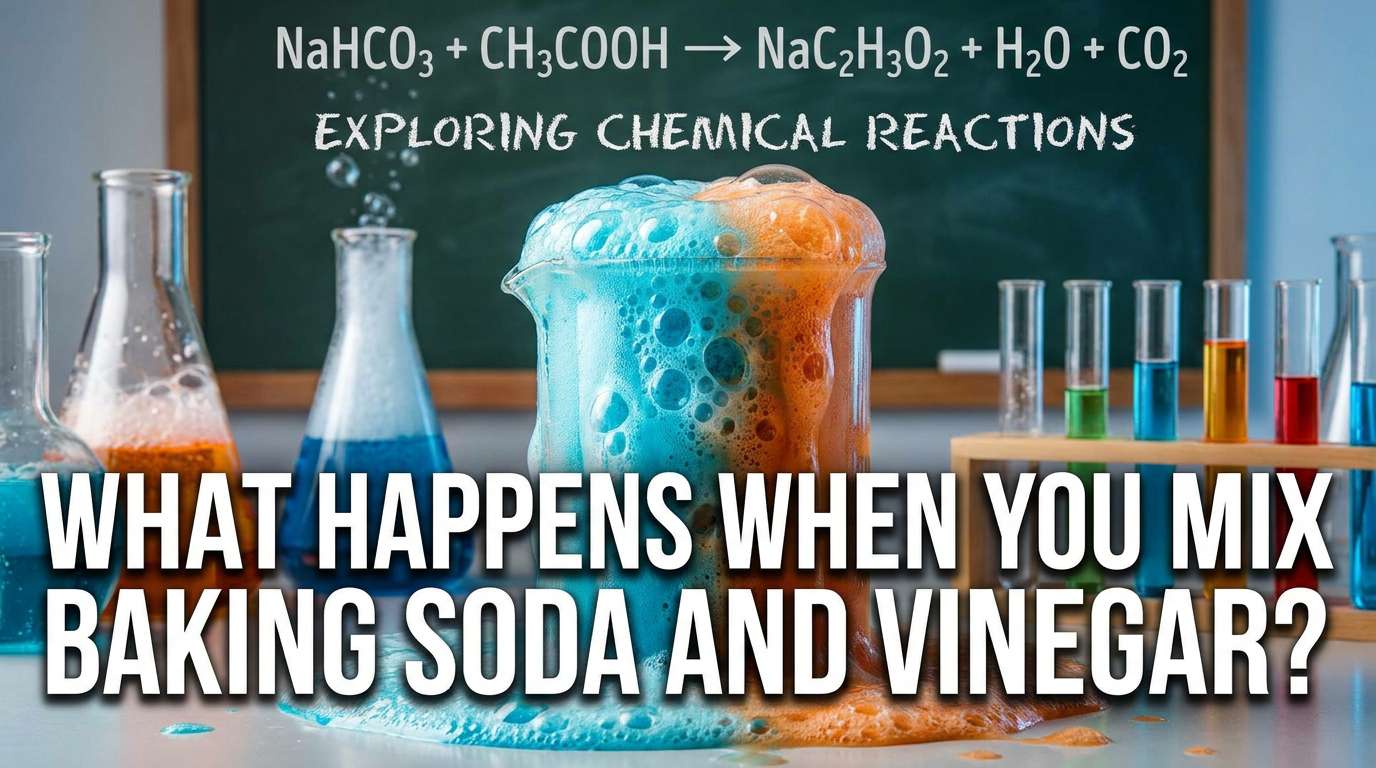
What Happens When You Mix Baking Soda and Vinegar? Exploring Chemical Reactions
Introduction
It might be the most famous chemistry experiment in the world, and most people first try it before they even know what a chemical reaction is. A spoonful of white powder goes into a bottle, a splash of vinegar is poured in, and suddenly foam erupts, bubbling and hissing over the sides like a miniature volcano.
It looks like magic. It is actually two genuine chemical reactions happening back to back, in the space of a few seconds — and together, they demonstrate several fundamental chemistry concepts at once: acid-base reactions, decomposition, gas production, and energy changes.
The Two Chemicals Involved
Baking soda is sodium bicarbonate, with the chemical formula NaHCO₃.1 Vinegar is a dilute water solution containing acetic acid, with the chemical formula CH₃COOH.1 On their own, each is a stable, unremarkable household substance. Brought together, they immediately begin to react.
Step One: The Acid-Base Reaction
The moment vinegar and baking soda meet, an acid-base reaction takes place. The hydrogen ions from the acetic acid in vinegar react with the sodium and bicarbonate ions from the baking soda.2 This first reaction produces two new substances: sodium acetate and carbonic acid.2
Step Two: Decomposition Into Gas
The carbonic acid formed in the first step is highly unstable. Almost instantly, it begins to decompose — breaking down into water and carbon dioxide gas (CO₂).2 This carbon dioxide gas rises up through the liquid mixture, exactly the way bubbles rise in a carbonated drink, producing the fizzing, foaming eruption everyone recognises from the classic vinegar-and-baking-soda volcano.2
The overall reaction is often written as a single combined equation:
NaHCO₃ + CH₃COOH → CH₃COONa + H₂O + CO₂3
In words: sodium bicarbonate plus acetic acid produces sodium acetate, water, and carbon dioxide gas.4
Why the Mixture Feels Cold: Endothermic vs. Exothermic Reactions
One of the most interesting things about this reaction is what happens to its temperature. If you measure the temperature of vinegar before adding baking soda, and then measure again once the two have combined, you will find the mixture has actually gotten colder — dropping by several degrees within about a minute.5
This tells us the reaction is endothermic — a reaction that absorbs heat energy from its surroundings rather than releasing it.6 This happens because chemical reactions involve breaking existing bonds and forming new ones. Breaking a bond always requires an input of energy, while forming a new bond always releases energy.7 In this particular reaction, more energy is needed to break apart the bonds in the original baking soda and vinegar than is released when the new bonds form in the carbon dioxide, water, and sodium acetate.8 Because more energy goes in than comes out, the reaction pulls that extra energy from its surroundings — cooling the mixture and everything touching it.7
This is the exact opposite of an exothermic reaction, where more energy is released when new bonds form than was needed to break the old ones, causing the surroundings to heat up instead.7
How to Recognise a Chemical Reaction Has Occurred
The baking soda and vinegar reaction is a useful, safe way to observe several classic signs that a genuine chemical reaction — not just a physical mixing — has taken place:
- Gas production: The visible bubbling and foaming as carbon dioxide gas is released.9
- Temperature change: The noticeable drop in temperature as the reaction absorbs heat from its surroundings.9
- New substances formed: Sodium acetate, water, and carbon dioxide are all genuinely new compounds — chemically distinct from the baking soda and vinegar that reacted to form them.
Why the Reaction Cannot Be Stopped Halfway
Once the carbonic acid begins decomposing into water and gas, the reaction is effectively unstoppable in that direction. Every time carbon dioxide gas escapes the solution (as bubbles rising to the surface), it removes product from the reaction mixture, which continually pulls the entire reaction forward toward completion. This is an example of a chemical principle called Le Chatelier's Principle: removing a product from a reaction as it forms drives the reaction to keep proceeding until the reactants run out.
The Science Fair Volcano and Beyond
This same chemistry is what powers the classic papier-mâché "volcano" science project, as well as inflatable-bag classroom demonstrations, where the carbon dioxide gas produced is used to inflate a sealed plastic bag as visible proof of gas production.9 It is also the same underlying chemistry used in Alka-Seltzer tablets, which similarly combine an acid with sodium bicarbonate to release carbon dioxide gas the moment they touch water.9
Baking Soda and Vinegar in WAEC/JAMB Chemistry
- Acid-base reactions: Identifying and writing the equation for the reaction between an acid (acetic acid) and a base/carbonate (sodium bicarbonate).
- Balanced chemical equations: Correctly balancing the equation NaHCO₃ + CH₃COOH → CH₃COONa + H₂O + CO₂.
- Endothermic and exothermic reactions: Distinguishing between reactions that absorb heat and those that release heat, using measurable temperature change as evidence.
- Tests for carbon dioxide gas: Recognising that the gas produced can be confirmed using the limewater test, which turns cloudy in the presence of CO₂.
- Signs of a chemical reaction: Identifying gas production and temperature change as key evidence that a chemical, rather than physical, change has occurred.
Common Mistakes Students Make
- Assuming all fizzing reactions are exothermic. The baking soda and vinegar reaction actually cools down, making it a clear example of an endothermic reaction, despite the dramatic bubbling.6
- Forgetting the reaction happens in two steps. The initial acid-base reaction produces carbonic acid, which then decomposes separately into water and carbon dioxide — students often skip the intermediate carbonic acid step.2
- Writing an unbalanced equation. The full equation must balance exactly, with matching atoms of sodium, hydrogen, carbon, and oxygen on both sides.
- Confusing "cold" with "no reaction occurred." A drop in temperature is not evidence that nothing happened — it is direct evidence of an endothermic chemical reaction actively taking place.7
Conclusion
A splash of vinegar poured over a spoonful of baking soda might be the very first chemical reaction most people ever witness — often before they even know what "chemical reaction" means. But behind that familiar fizz lies a genuinely rich piece of chemistry: an acid-base reaction, a decomposition step, a measurable energy change, and a visible gas product, all completed in a matter of seconds.
It's proof that some of the very best chemistry lessons don't require an expensive laboratory at all — just a kitchen cupboard, a bottle of vinegar, and a healthy sense of curiosity about why the ordinary sometimes fizzes.