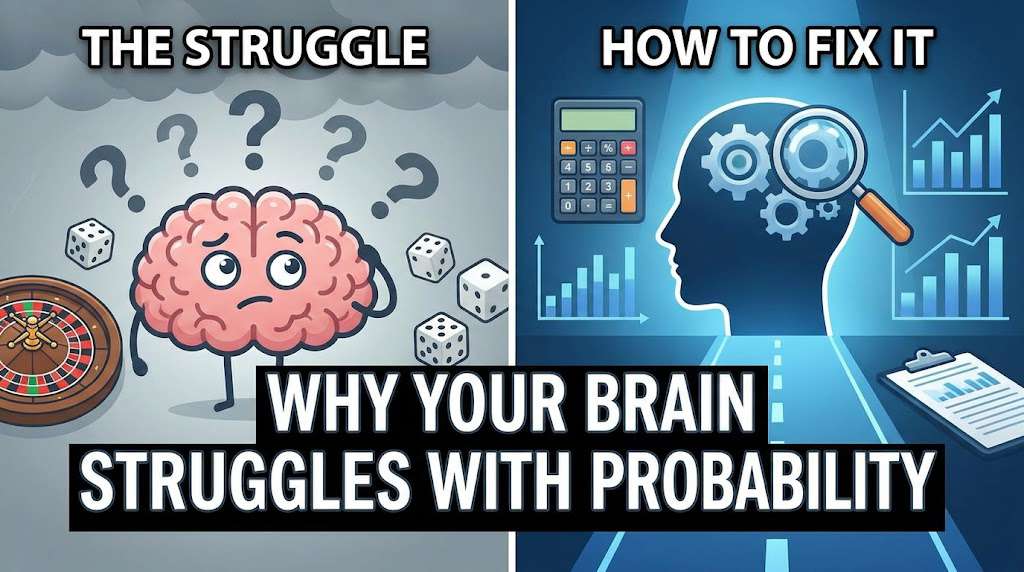
Why Your Brain Struggles With Probability — And How to Fix It
Introduction
You flip a fair coin five times and get heads every single time. What is the probability that the next flip will be tails?
Most people feel — deeply and instinctively — that tails is now "due." Five heads in a row feels like an imbalance that the universe needs to correct. Surely the next flip must be more likely to be tails?
It is not. The probability of tails on the sixth flip is exactly what it has always been: 50%. The coin has no memory. Each flip is completely independent of every flip before it. Yet the feeling that tails is overdue is so powerful that it has a name — the Gambler's Fallacy — and it has cost people enormous amounts of money, influenced medical decisions, shaped legal judgements, and led military commanders into catastrophic errors.
This is not a story about people being foolish. It is a story about the human brain being brilliantly designed for one kind of world while living in another. Our intuitions about probability are not random errors — they are systematic, predictable, and shared by almost everyone. Understanding why our brains fail at probability, and learning how to correct those failures, is one of the most practically useful things a mathematics education can give you.
What Is Probability?
Probability is the mathematics of uncertainty. It gives us a precise, numerical way to describe how likely an event is to occur, on a scale from 0 (impossible) to 1 (certain).
A probability of:
- 0 means the event will never happen.
- 1 means the event will definitely happen.
- 0.5 means the event is equally likely to happen or not happen.
- 0.1 means the event has a 1 in 10 chance of happening.
- 0.01 means the event has a 1 in 100 chance of happening.
Probability can be calculated theoretically — by counting equally likely outcomes — or estimated experimentally — by observing what actually happens over many repeated trials. For a fair coin, theory tells us P(heads) = 0.5. After flipping a coin 10,000 times, experiment will give us a proportion very close to 0.5 as well.
Why Our Brains Were Not Built for Probability
To understand why probability is so counterintuitive, we need to understand something about how the human brain evolved.
For hundreds of thousands of years, our ancestors lived in environments where survival depended on pattern recognition. Noticing that a particular rustling in the grass preceded a predator attack — and remembering that pattern — kept you alive. Brains that were good at finding patterns, even in limited data, survived and reproduced. Brains that waited for statistically significant sample sizes before drawing conclusions often did not.
The result is a brain magnificently equipped to find patterns, remember vivid examples, make fast intuitive judgements, and trust personal experience over abstract reasoning. These are excellent tools for navigating a physical, social world full of genuine patterns.
But probability often requires the opposite skills: ignoring vivid individual examples, thinking carefully about large samples of data, accepting counterintuitive conclusions, and recognising that randomness can produce patterns that mean nothing at all. Our brains find this deeply uncomfortable — and they resist it powerfully.
The Major Probability Biases That Mislead Us
1. The Gambler's Fallacy
As described in the introduction, the Gambler's Fallacy is the belief that after a sequence of random outcomes in one direction, the opposite outcome becomes more likely. It applies wherever events are truly independent — where each outcome has no influence on the next.
Real-world examples of the Gambler's Fallacy causing harm:
- Casinos: Roulette wheels have displayed boards showing recent results specifically because operators know players will bet against long streaks — and lose. The wheel has no memory.
- Lottery players: Many players avoid numbers that have recently been drawn, believing they are less likely to come up again. In a fair lottery, all numbers are equally likely every single draw.
- Judges and asylum decisions: A 2016 study of asylum court decisions found that judges were significantly less likely to approve an application after approving several in a row — as if they felt a rejection was "due." The decisions of an independent court should not depend on the sequence of previous rulings.
- Sports commentary: Commentators regularly speak of players being "due" a goal or "overdue" a miss, as if past performance changes the probability of the next shot.
2. The Hot Hand Fallacy
The Hot Hand Fallacy is in some ways the opposite of the Gambler's Fallacy. It is the belief that a person who has been successful recently is more likely to be successful on the next attempt — that success breeds success in a way that goes beyond their actual underlying ability.
The term comes from basketball: fans and players fervently believe that a player who has made several shots in a row has a "hot hand" and is more likely to make the next one. For decades, statistical analysis suggested this was largely an illusion — that basketball shooting was closer to independent events than people believed, and what felt like streaks were just the natural clustering that occurs in any random sequence.
More recent research suggests there may be a small genuine hot hand effect in some sports, but it is far smaller than our intuitions suggest. The powerful feeling that a hot streak predicts future success almost always exaggerates any real effect.
3. The Availability Heuristic
The availability heuristic is the tendency to judge the probability of an event by how easily examples of it come to mind. If you can think of many vivid examples quickly, your brain concludes the event must be common.
This causes systematic probability errors because the ease with which examples come to mind depends on factors completely unrelated to actual probability:
- Media coverage: Plane crashes receive enormous news coverage; car crashes receive almost none. As a result, most people dramatically overestimate the danger of flying relative to driving, even though statistically, driving is far more dangerous per kilometre travelled.
- Vividness: A dramatic, emotionally powerful event feels more probable than a dull but equally or more likely one. People overestimate the probability of dying in a terrorist attack and underestimate the probability of dying from heart disease.
- Personal experience: If someone you know won the lottery, you will feel that winning the lottery is more likely than the statistics suggest. If you have never known anyone who won, you may feel it is less likely than it actually is.
4. The Representativeness Heuristic
The representativeness heuristic leads us to judge the probability of something by how closely it resembles our mental prototype — our idea of what a typical example looks like.
The psychologists Daniel Kahneman and Amos Tversky, who identified most of these biases in the 1970s and 1980s, demonstrated this with a famous example. They described a woman named Linda:
Linda is 31 years old, single, outspoken, and very bright. She majored in philosophy. As a student, she was deeply concerned with issues of discrimination and social justice, and also participated in anti-nuclear demonstrations.
Which is more probable?
- A: Linda is a bank teller.
- B: Linda is a bank teller and is active in the feminist movement.
The vast majority of people — including statistically trained scientists — choose B. But this is mathematically impossible. Option B is a subset of Option A. The probability of two things both being true can never be greater than the probability of either one alone. Linda being both a bank teller AND a feminist cannot be more likely than her simply being a bank teller.
People choose B because the description of Linda resembles a feminist more than a plain bank teller. The representativeness heuristic overrides basic logic.
5. Base Rate Neglect
Base rate neglect occurs when we ignore background statistical information in favour of specific, vivid details. We focus on the particular case in front of us and forget to consider how common or rare the phenomenon is in the population as a whole.
A medical example makes this clear. Suppose a disease affects 1 in 1,000 people. A test for the disease is 99% accurate — if you have the disease, it correctly returns a positive result 99% of the time, and if you do not have it, it correctly returns a negative result 99% of the time.
You test positive. What is the probability you actually have the disease?
Most people say 99%. The correct answer is approximately 9%. Here is why:
- In a population of 100,000 people, approximately 100 have the disease.
- The test correctly identifies 99 of them as positive.
- Of the 99,900 who do not have the disease, the test incorrectly identifies 1% — approximately 999 people — as positive.
- So out of roughly 1,098 positive tests, only 99 are true positives.
- 99 ÷ 1,098 ≈ 9%.
A positive result from a highly accurate test, for a rare disease, still means you probably do not have the disease. This is why doctors order confirmatory tests before giving a diagnosis — and why understanding base rates is a genuine medical necessity, not just an abstract mathematical exercise.
6. The Conjunction Fallacy
Already illustrated by the Linda problem above, the conjunction fallacy is the error of judging a specific combination of events as more probable than a single one of those events alone.
In formal probability notation, the rule is:
P(A and B) ≤ P(A)
The probability of two events both occurring can never exceed the probability of either event occurring on its own. Adding more conditions to a scenario can only maintain or reduce its probability — never increase it. Yet the more detailed and plausible-sounding a story is, the more probable we feel it to be.
7. Confirmation Bias in Probability
Confirmation bias leads us to notice and remember evidence that supports our existing beliefs, while ignoring evidence that contradicts them. In the context of probability, this means we tend to notice when our predictions come true and forget when they do not.
This is why superstitions persist. If you wear a lucky shirt and your team wins, you remember. If you wear it and they lose, you explain it away or forget. Over time, your brain builds up a skewed record that seems to confirm your shirt's power — even though your selective memory has distorted the evidence.
8. The Clustering Illusion
Truly random sequences produce clusters — runs of the same outcome — far more often than people expect. When we see these clusters, our pattern-hungry brains immediately conclude that something non-random must be causing them.
During World War II, Londoners became convinced that German V-1 rocket attacks were targeted at specific areas of the city based on the cluster patterns they observed. A statistical analysis after the war showed the distribution was consistent with completely random targeting. The clusters were real — but they were the natural product of randomness, not evidence of targeting.
The clustering illusion is why we see faces in clouds, animals in constellations, and meaningful patterns in random data. Our brains cannot easily accept that randomness produces irregular, clumpy distributions rather than smooth, evenly spread ones.
Famous Probability Problems That Fool Almost Everyone
The Monty Hall Problem
You are on a game show. There are three doors. Behind one is a car; behind the other two are goats. You choose Door 1. The host — who knows what is behind each door — opens Door 3 to reveal a goat. He then offers you a choice: stick with Door 1, or switch to Door 2.
Should you switch?
Almost everyone says it does not matter — there are two doors left, so it must be 50/50. The correct answer is: always switch. Switching gives you a 2/3 probability of winning; staying gives you only 1/3.
Here is the reasoning:
- When you first chose Door 1, you had a 1/3 chance of being right.
- The other two doors together had a 2/3 chance of hiding the car.
- When the host opens a goat door, he does not randomly redistribute probability — the 2/3 chance that was spread across Doors 2 and 3 now concentrates entirely on Door 2.
- Switching gives you that 2/3 probability.
When this problem was published in a magazine in 1990, thousands of readers — including mathematics professors — wrote in insisting the answer was wrong. Running the experiment with simulations consistently confirms: switching wins approximately twice as often as staying.
The Birthday Problem
How many people need to be in a room before there is a greater than 50% probability that two of them share a birthday?
Most people guess somewhere between 100 and 183 (half of 365). The correct answer is just 23 people.
The reason is that we instinctively think about the probability that someone shares a birthday with us. But the question is whether any two people in the room share a birthday with each other. With 23 people, there are 253 possible pairs — and that is enough pairs for a match to become more likely than not.
By 70 people, the probability of a shared birthday exceeds 99.9%.
How to Think About Probability More Clearly
Knowing about these biases is the first step. Here are practical strategies to overcome them:
Think in Frequencies, Not Percentages
Research by psychologist Gerd Gigerenzen shows that people reason much more accurately about probability when problems are framed as frequencies rather than percentages. Instead of "a 1% chance," think "1 in every 100 people." This makes the base rate concrete and vivid, reducing neglect of background information.
Always Ask: Compared to What?
Whenever you hear a probability or a risk statistic, ask what it is being compared to. "This activity doubles your risk" sounds alarming — but if your original risk was 1 in a million, doubling it to 2 in a million is negligible. Absolute risk is almost always more informative than relative risk.
Consider the Sample Size
A friend who knows three people who got sick after taking a vaccine, and one who did not, is not giving you useful probability information. Three cases is not a meaningful sample. The human brain naturally treats small, vivid samples as more representative than they are. Always ask how large and how representative the sample is.
Deliberately Seek Disconfirming Evidence
To counter confirmation bias, actively look for cases where your expectation was wrong. If you believe a strategy works, deliberately search for times it failed. If you think a pattern is real, ask how often you would see the same pattern by pure chance.
Use Bayes' Theorem
Bayes' Theorem is a mathematical formula for updating your probability estimate when you receive new evidence. It is the mathematical cure for base rate neglect. In its simplest form, it tells you to multiply the prior probability of something being true by the likelihood of seeing the evidence you observed if it were true — and then normalise.
The formal formula is:
P(A|B) = P(B|A) × P(A) / P(B)
You do not need to calculate this exactly in everyday situations. The key habit is simply to ask: before I saw this evidence, how likely was this? How much should this evidence actually update my belief?
Simulate and Experiment
When a probability problem confuses you, simulate it. Flip a coin 100 times and record the results. Shuffle a deck of cards and count outcomes. Run computer simulations. Seeing probability play out in real data is far more convincing to the intuitive brain than any abstract argument.
Probability in WAEC and JAMB Mathematics
Probability is a core topic in both WAEC and JAMB mathematics examinations. Understanding not just the formulas but the reasoning behind them will give you a significant advantage:
- Basic probability: P(event) = number of favourable outcomes ÷ total number of outcomes.
- Complementary probability: P(not A) = 1 − P(A). Always a useful shortcut.
- Addition rule: P(A or B) = P(A) + P(B) − P(A and B) for non-mutually exclusive events.
- Multiplication rule: P(A and B) = P(A) × P(B) for independent events.
- Conditional probability: P(A|B) = P(A and B) ÷ P(B) — the probability of A given that B has already occurred.
- Tree diagrams and sample spaces: Visual tools that make complex probability problems manageable by listing all possible outcomes systematically.
The biases described in this article explain why many students find probability questions harder than other mathematics topics — not because the mathematics is more complex, but because the correct answers frequently contradict intuition. Knowing this, you can train yourself to slow down on probability questions, distrust your first instinct, and work methodically through the mathematics instead.
Common Mistakes Students Make in Probability
- Assuming events are independent when they are not. Drawing cards from a deck without replacement changes the probabilities with each draw — the events are not independent.
- Forgetting to use the complement. Sometimes P(not A) is far easier to calculate than P(A) directly, and then P(A) = 1 − P(not A).
- Confusing "or" with "and." "A or B" uses the addition rule. "A and B" uses the multiplication rule. These are very different operations.
- Not listing the sample space carefully. Many errors come from missing possible outcomes. Draw a table or tree diagram before attempting to calculate.
- Applying the Gambler's Fallacy to exam questions. In problems involving independent events — coins, dice, spins of a wheel — previous outcomes have no effect on subsequent ones.
Conclusion
The human brain is an extraordinary instrument — but it was not built for probability. Evolution optimised us for pattern recognition, vivid memory, and fast intuitive judgement. These tools serve us well in many situations but lead us systematically astray when we need to reason carefully about chance and uncertainty.
The good news is that these biases, once understood, can be countered. Thinking in frequencies, considering base rates, seeking disconfirming evidence, and trusting careful mathematical reasoning over instinct are skills that can be practised and developed.
Probability is not just an examination topic. It is the mathematics of decision-making under uncertainty — which is to say, it is the mathematics of almost every important decision you will ever make. Understanding it clearly, and knowing where your own brain is likely to mislead you, is one of the most practically powerful things a mathematical education can give you.
The coin still has no memory. But now, neither does your bias.